Flood Resistant Building Materials: 2026 Selection Guide
Select flood resistant building materials with this 2026 guide. Compare Class 4 and 5 specs, framing, insulation, and cost premiums for resilient construction.

The Physics of Flood Damage: Class 4 and Class 5 Materials
Floodwater is not merely a moisture problem; it is a hydrostatic and biological hazard. Standard building assemblies fail during inundation due to three primary mechanisms: capillary wicking (which draws water upward into wall cavities), hydrostatic pressure (which causes structural blowouts), and prolonged saturation (which triggers microbial growth and material delamination). To mitigate these risks, the National Flood Insurance Program (NFIP) categorizes materials based on their survivability after 72 hours of direct contact with floodwater. According to FEMA Technical Bulletin 2, only Class 4 (Flood Damage Resistant) and Class 5 (Highly Flood Damage Resistant) materials are approved for use below the Base Flood Elevation (BFE).
Class 4 materials can survive wetting and drying with only cosmetic remediation, such as cleaning or repainting. Class 5 materials are impervious and require no remediation whatsoever. Selecting the correct classification for specific structural zones is the foundational step in resilient construction.
Material Selection Matrix by Elevation Zone
The following matrix dictates material requirements based on proximity to the BFE. Applying above-grade materials in below-grade zones is the most common failure point in flood-prone construction.
| Elevation Zone | Material Category | Required Specification | Primary Failure Mode to Avoid |
|---|---|---|---|
| Below Grade / Foundation | Concrete & Masonry | Class 5: Min 3,500 psi, w/c ratio ≤ 0.45 | Spalling, rebar corrosion, hydrostatic cracking |
| Below BFE (Enclosures) | Framing & Sheathing | Class 4: Marine plywood or galvanized steel | OSB delamination, wood rot, fastener withdrawal |
| Below BFE (Enclosures) | Insulation | Class 5: Closed-cell spray foam (1.7+ pcf) | Fiberglass batt wicking, trapped cavity moisture |
| Above BFE (Living Space) | Interior Finishes | Class 4: Paperless gypsum, porcelain tile | Paper-faced drywall mold, laminate flooring warp |
| Exterior Envelope | Cladding | Class 5: Fiber cement, brick veneer, stucco | Vinyl siding trapping water, wood rot behind veneer |
Foundation & Below-Grade Strategies
Foundations in Special Flood Hazard Areas (SFHAs) must resist both buoyancy and lateral hydrostatic loads. Poured concrete is the standard, but the mix design must be optimized for impermeability.
Concrete Mix and Admixtures
Specify a minimum compressive strength of 3,500 psi with a water-cement (w/c) ratio of 0.45 or lower. A lower w/c ratio reduces capillary pores, limiting water ingress. For critical below-grade walls, integrate a crystalline waterproofing admixture (such as Kryton KIM or Xypex Admix C-500). These chemicals react with moisture and unhydrated cement particles to form insoluble needle-like crystals that self-seal micro-cracks up to 0.02 inches wide.
Masonry and CMU
If using Concrete Masonry Units (CMU), specify solid-grouted cores rather than hollow cells. Hollow cells will fill with floodwater and retain it for months, creating massive lateral pressure and interior mold risks. Apply a fluid-applied elastomeric membrane to the exterior positive side of the masonry before backfilling.
Framing, Sheathing, and the "Wicking" Problem
Standard Oriented Strand Board (OSB) is highly susceptible to edge swelling and delamination when exposed to standing water. Even moisture-resistant OSB variants will fail if submerged for 48+ hours. For wall sheathing below the BFE, you must upgrade to marine-grade alternatives.
- Marine-Grade Plywood: Must carry the APA (The Engineered Wood Association) Marine stamp. According to the APA Engineered Wood Association, marine plywood uses 100% waterproof phenol-formaldehyde structural adhesives and is manufactured with a limited number of core voids, preventing water from pooling inside the panel layers.
- Light-Gauge Steel Framing: For non-combustible, rot-proof framing, specify cold-formed steel studs. Use a minimum 20-gauge thickness with a 33 ksi yield strength. Crucially, the galvanization coating must be G60 or G90 to prevent rapid oxidation in high-humidity, post-flood drying environments.
- Pressure-Treated Lumber: If using wood framing below the BFE, it must be treated with water-borne preservatives like Alkaline Copper Quaternary (ACQ) or Copper Azole (CA-C) to a minimum retention level of 0.60 pcf for ground/freshwater contact. Note that ACQ requires hot-dip galvanized or stainless steel fasteners to prevent galvanic corrosion.
Insulation & Interior Finishes: Breaking the Mold Cycle
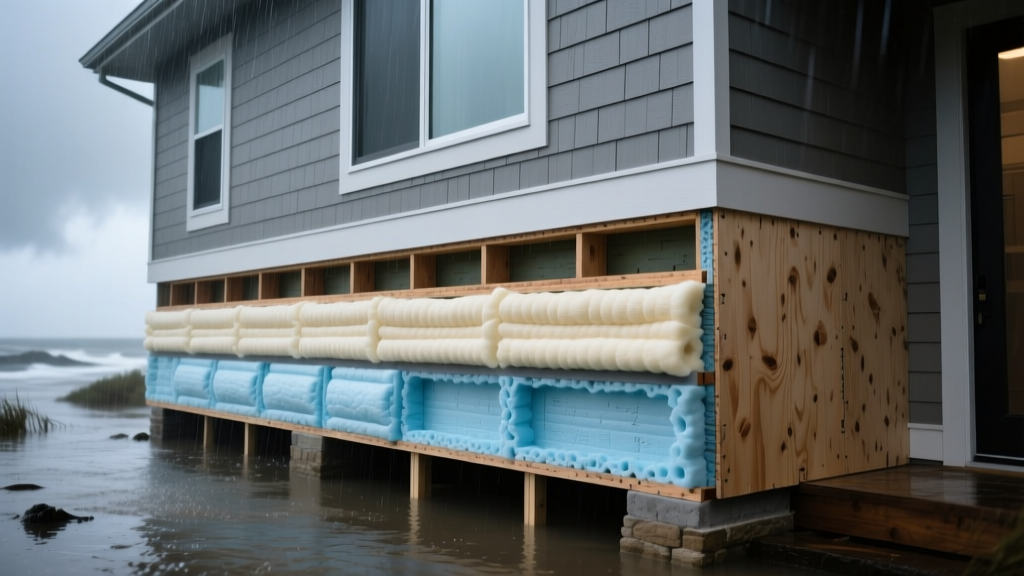
The interior cavity is where traditional construction suffers the most catastrophic financial losses post-flood. Fiberglass and mineral wool batts act as sponges; once wet, they cannot be dried in place and must be entirely demolished.
Closed-Cell Spray Polyurethane Foam (ccSPF)
ccSPF is the only insulation viable for below-BFE cavities. It is classified as a Class 5 material because its closed-cell structure (typically 1.7 to 2.0 lbs/ft³ density) absorbs less than 5% moisture by volume. Furthermore, ccSPF acts as an air and vapor barrier, preventing humid flood air from migrating into the assembly. Apply a minimum of 3 inches to the interior side of the sheathing to achieve an R-value of roughly R-21 while structurally bracing the wall against hydrostatic pressure.
Paperless Drywall and Flooring
Standard paper-faced gypsum board will wick water inches above the flood line and harbor mold within 24 hours. Replace it with fiber-reinforced, paperless gypsum panels (e.g., Georgia-Pacific DensArmor Plus). Install these panels with a 1-inch gap above the finished floor level, sealing the gap with a flexible, paintable polyurethane sealant.
For flooring, avoid engineered wood, laminate, and carpet entirely. Specify porcelain tile, which must meet ASTM C373 standards for water absorption of less than 0.5%. Set the tile using a modified, polymer-fortified thinset mortar over a sloped, sealed concrete slab.
If floodwater breaches the exterior cladding but does not enter the interior cavity, the resulting hydrostatic pressure differential can literally push the interior drywall off the studs. To prevent structural blowout, install engineered flood vents (such as Smart Vents) in the lower courses of exterior walls. These dual-function louvers allow water to flow freely in and out of enclosed crawl spaces and breakaway wall cavities, equalizing pressure within one hour of flooding.
2026 Cost Premium Analysis: Standard vs. Flood-Resistant
Building with flood resistant building materials requires an upfront capital premium. However, when factoring in reduced NFIP insurance premiums and avoided demolition costs after a localized inundation event, the ROI is typically realized within a single flood cycle. The table below outlines current 2026 market averages for material and installation costs.
| Assembly Component | Standard Material (Cost / Sq Ft) | Flood-Resistant Material (Cost / Sq Ft) | Premium % |
|---|---|---|---|
| Wall Insulation | Fiberglass Batt ($1.10 - $1.40) | ccSPF ($2.80 - $3.60) | +175% |
| Wall Sheathing | Standard OSB ($0.60 - $0.85) | Marine Plywood ($2.20 - $2.90) | +250% |
| Interior Wallboard | Paper-Faced Gypsum ($0.50 - $0.70) | Paperless Gypsum ($0.90 - $1.25) | +70% |
| Exterior Cladding | Vinyl Siding ($4.50 - $6.50) | Fiber Cement ($8.50 - $12.50) | +85% |
| Subflooring | Standard T&G Plywood ($1.20 - $1.60) | Advantech / Treated ($1.90 - $2.40) | +55% |
Sourcing & Verification: What to Ask Your Supplier
Procuring the correct materials requires strict specification enforcement. Do not rely on supplier substitutions during supply chain shortages. Implement the following verification checklist when drafting your purchase orders:
- Demand the APA Stamp: Visually inspect every sheet of marine plywood upon delivery for the physical APA Marine stamp. Generic "exterior grade" plywood is not flood-rated.
- Verify Galvanization: Require mill certificates for light-gauge steel framing to prove G60 or G90 zinc coating weights.
- Check Drywall Core Density: Ensure paperless gypsum boards are specifically rated for high-moisture environments; some "mold-resistant" boards still utilize paper backing on one side.
- Validate Foam Density: Require the ccSPF contractor to provide post-installation core samples proving the cured foam meets the 1.7 pcf minimum density required for water resistance.
- Review Adhesive Chemistries: Confirm that all subfloor adhesives and exterior sealants are polyurethane-based, not water-based acrylics, which will re-emulsify upon subsequent flooding.
Adhering to the IBHS FORTIFIED Home Standard for wind and water resistance further ensures that your material selections integrate properly with structural tie-downs and water-management details. By prioritizing Class 4 and Class 5 assemblies, builders transform vulnerable structures into resilient assets capable of weathering severe hydrological events with minimal financial or structural degradation.
Written by
Priya KapoorPriya Kapoor is a real estate market analyst and construction economics researcher with expertise in housing affordability, development feasibility, and infrastructure investment. She holds a Master of Regional Planning from Cornell University and previously worked as a senior analyst at CBRE's Investment Properties group, where she modeled returns for $4B in mixed-use development pipelines. Priya now runs an independent research practice advising developers, municipalities, and REITs on construction cost forecasting and market timing. She publishes the quarterly "BuildMat Market Pulse" report tracking material price indices across 12 commodity categories. Based in Austin, TX, Priya serves on the board of Habitat for Humanity Austin and is a marathon runner.
More from Priya Kapoor
View all
Construction Cost
Cost to Build a 1600 Sq Ft Home in 2026: Full Breakdown
Accurate 2026 cost to build a 1600 sq ft home—material, labor, and regional pricing breakdowns included. Plan your budget with real-time estimates.
Aug 11, 2026

Wood & Lumber
Name the Types of Wood for Pressure Treatment and Preservation
Learn how to name the types of wood best suited for pressure treatment. Compare species treatability, chemical retention levels, and 2026 preservation costs.
Aug 4, 2026

Stone & Masonry
Stone Veneer Suppliers Lindenhurst: 2026 Cost Analysis
Analyze 2026 stone veneer costs in Lindenhurst, NY. Compare local supplier pricing, delivery fees, and Suffolk County installation labor rates.
Aug 4, 2026