Building Material for Washington Monument: NYT Clues & 2026 Trends
Explore the building material for Washington Monument, from NYT crossword clues to 2026 heritage stone trends, marble sourcing, and gneiss restoration.

The 'NYT' Connection: Crosswords, Culture, and Heritage Stone
When architects, historians, and puzzle enthusiasts search for the building material for washington monument nyt, they are typically chasing a daily New York Times crossword clue or researching a recent media retrospective on American monuments. However, this specific search query highlights a massive, often overlooked sector of the 2026 building materials industry: heritage stone preservation and historical masonry sourcing. The Washington Monument is not merely a singular slab of rock; it is a complex, multi-source geological puzzle that continues to dictate modern standards for stone matching, structural consolidation, and architectural salvage.
Understanding the exact petrology of the monument provides critical insights for modern contractors working on historic restorations. The intersection of media-driven public interest (the 'NYT effect') and advanced 2026 quarrying technologies has sparked a renaissance in sourcing authentic, monument-grade metamorphic rocks for both federal preservation projects and high-end commercial replicas.
Deconstructing the Obelisk: A Material Breakdown
The 555-foot-tall obelisk relies on three distinct primary materials, each chosen for specific load-bearing and aesthetic properties. Modern structural engineers studying the monument's longevity often reference the National Park Service historical archives to understand how 19th-century material choices perform under 21st-century environmental stressors.
| Material Type | Geological Source | Application / Depth | Compressive Strength (Approx) |
|---|---|---|---|
| Bluestone Gneiss | Patapsco River Valley, MD | Foundation and subterranean base | 18,000 - 22,000 psi |
| Cockeysville Marble | Beaver Dam Quarry, Texas, MD | Exterior facade (Ground to 152 ft) | 9,000 - 11,000 psi |
| Sheffield Marble | Sheffield, MA | Exterior facade (152 ft to Capstone) | 8,500 - 10,500 psi |
| Cast Aluminum | Frishmuth Foundry, PA | Pyramidal Capstone (Apex) | N/A (Non-load bearing) |
The Foundation: Bluestone Gneiss
The foundation utilizes bluestone gneiss, a highly foliated metamorphic rock. Gneiss is selected for subterranean and high-load applications due to its low porosity (typically under 1.5%) and high resistance to freeze-thaw cycling. In 2026, modern structural retrofits often specify high-density gneiss from the Appalachians when underpinning historic masonry, as its sheer strength outperforms standard granite in localized shear tests.
The Facade: A Tale of Two Marbles
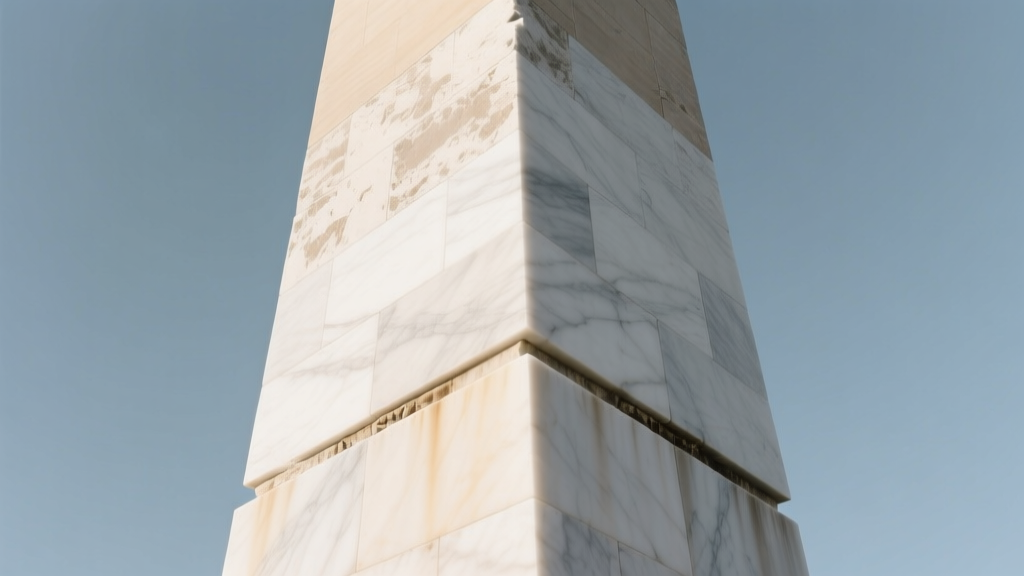
The most famous quirk of the monument is the visible color shift at the 152-foot mark. The original Cockeysville marble (a Cambrian-era dolomitic marble with a coarse, sugar-like crystal structure) ran out, forcing builders to source Sheffield marble from Massachusetts. The Sheffield stone is slightly finer-grained and weathers to a different albedo. According to the Natural Stone Institute, variations in trace minerals like iron and graphite cause these distinct weathering patinas, a critical factor for modern restoration architects attempting to blend new Dutchman patches into historic facades.
Expert Insight: The 152-Foot Color Line
The distinct horizontal line where the Maryland marble meets the Massachusetts marble is not a structural flaw, but a supply-chain artifact of the 1880s. For modern heritage contractors, this line serves as a masterclass in petrographic compatibility. When specifying replacement stone today, you cannot rely on visual matching alone; you must order thin-section petrographic analysis to ensure the new stone's coefficient of thermal expansion matches the adjacent historic blocks, preventing spalling during seasonal temperature swings.
2026 Industry Trends in Heritage Stone Sourcing
The heritage materials sector has evolved dramatically. Sourcing authentic marble and gneiss for monument-grade restoration now relies on advanced diagnostics and chemical engineering rather than just traditional quarrying.
1. Hyperspectral Imaging for Petrographic Matching
In 2026, visual color matching is considered obsolete for high-profile restorations. Preservation teams now use drone-mounted hyperspectral cameras to map the exact mineralogical composition of existing facade stones. This data is cross-referenced with geological databases to find active quarries yielding stone with identical trace-element profiles. This ensures that when the new stone oxidizes over the next 50 years, it will age at the exact same rate as the 19th-century original.
2. Alkoxysilane Consolidants Over Dutchman Repairs
Cockeysville marble is prone to 'sugaring'—a granular disintegration caused by thermal expansion differences between calcite and dolomite crystals. Rather than cutting out decayed stone and inserting 'Dutchman' patches (which introduces new mortar joints that trap moisture), the 2026 industry standard is the micro-injection of ethyl silicate consolidants (such as Conservare OH100).
- Application Threshold: Stone moisture content must be below 5% before application.
- Penetration Depth: Achieves 1.5 to 2.5 inches of consolidation in coarse-grained marble.
- Curing Mechanism: Reacts with atmospheric moisture to form a silica gel network within the stone matrix, restoring up to 60% of lost tensile strength without altering vapor permeability.
3. Architectural Salvage and 3D-Printed Stone Composites
With many historic East Coast marble quarries permanently closed, the salvage industry has industrialized. Large-scale CNC wire saws are now used to slice 2-inch veneers from decommissioned 19th-century bank facades, repurposing them for heritage repairs. For non-load-bearing ornamental replacements, 3D-printed geopolymers mixed with pulverized historic marble dust are being utilized, offering a 1:1 visual match while reducing structural dead load by 40%.
Substitute Materials vs. Authentic Quarrying: A Decision Matrix
When restoring historic monuments or designing neo-classical commercial builds in 2026, project managers must weigh the use of authentic natural stone against modern substitutes. The NPS Preservation Brief 16 provides strict guidelines on when substitutes are permissible, primarily limiting them to scenarios where authentic stone is structurally compromised or entirely unavailable.
| Criteria | Authentic Quarry Stone (Marble/Gneiss) | Cast Stone / Geopolymer Substitutes |
|---|---|---|
| Aesthetic Aging | Develops natural patina; weathers authentically over centuries. | May yellow or chalk; lacks natural crystalline light refraction. |
| Lead Time | 12 to 24 months (quarrying, block selection, milling). | 4 to 8 weeks (mold fabrication and casting). |
| Vapor Permeability | High; allows internal moisture to escape, preventing freeze-thaw damage. | Variable; often requires engineered weep holes to prevent trapped moisture. |
| Cost per Sq. Ft. (Installed) | $180 - $350+ (highly dependent on block yield and transport). | $90 - $160 (economies of scale in repetitive molding). |
Sourcing Monument-Grade Materials Today
For contractors tasked with sourcing materials that mirror the Washington Monument's specifications, the supply chain requires specialized navigation. True Cockeysville marble is virtually unobtainable in large block form today. The industry workaround is sourcing high-purity, coarse-grained dolomitic marble from the Georgia Marble Company's Tate quarry or specific veins in the Carrara region of Italy, provided petrographic testing confirms a matching coefficient of thermal expansion.
For the bluestone gneiss foundation requirements, modern structural engineers frequently specify high-grade Appalachian gneiss from Pennsylvania or New York, ensuring the stone meets ASTM C615 standards for dimension stone with a minimum flexural strength of 1,500 psi and water absorption of less than 0.20%.
FAQ: Monument-Grade Stone Specifications
Why was aluminum used for the Washington Monument capstone?
In 1884, aluminum was considered a precious metal, more valuable than gold, due to the extreme energy required to smelt it. The 100-ounce cast aluminum apex served as a display of American industrial prowess and provided a highly conductive, non-corrosive lightning rod to protect the masonry below.
How do you clean historic marble without causing sugaring?
Never use acidic cleaners or high-pressure water (anything over 300 PSI). The 2026 standard is the application of a cellulose-based poultice mixed with a neutral pH ammonium carbonate solution, left on the stone for 24 hours to draw out sulfation crusts via capillary action without abrading the fragile crystal matrix.
Written by
Marcus ChenMarcus Chen is a licensed structural engineer (PE) and building materials analyst with over 12 years of experience across residential, commercial, and industrial construction. He holds a Master of Science in Civil Engineering from UC Berkeley and spent six years at Thornton Tomasetti before transitioning to independent consulting and technical writing. Marcus specializes in material selection for seismic-prone regions, concrete reinforcement strategies, and lifecycle cost analysis. His work has been cited by the American Concrete Institute (ACI) and the Structural Engineers Association of California (SEAOC). When he is not on a job site or at his desk, you will find him hiking the Sierra Nevada or restoring a 1920s craftsman bungalow in Oakland, CA.
More from Marcus Chen
View all
Construction Cost
How Much Did the Eiffel Tower Cost to Build?
How much did the Eiffel Tower cost to build in 1889? We adjust for inflation and compare its budget to modern skyscraper construction.
Aug 4, 2026

Fire Resistance
What Is a Fire Resistant Material? Testing & Certification Guide
Discover what is a fire resistant material through ASTM and UL testing. Learn how fire ratings, certifications, and assemblies work in construction.
Aug 4, 2026

Construction Cost
How Much Did the Burj Khalifa Cost to Build?
How much did the Burj Khalifa cost to build? We break down the $1.5B project and extract 5 money-saving strategies for your next build.
Jul 30, 2026