Foothill Building Materials Pomona CA vs Big Box: 2026 Review
Compare Foothill Building Materials in Pomona, CA against big-box stores. Discover 2026 pricing, lumber grades, delivery times, and contractor perks.

The Inland Empire Supply Chain: Local Yards vs. Big Box
Sourcing construction materials in the San Gabriel Valley requires navigating a fragmented supply chain. For contractors and serious DIYers operating in the Inland Empire, the decision between utilizing specialized local suppliers—like the Foothill Building Materials network in Pomona, CA—and relying on big-box home improvement stores directly impacts project margins, timeline reliability, and structural quality. As we move through 2026, regional logistics and lumber grading discrepancies have made this choice more critical than ever.
Quick Verdict: The 2026 Supplier Breakdown
Choose Foothill / Local Pomona Yards for: Framing lumber (Douglas Fir), heavy masonry, boom-truck deliveries, and Net-30 contractor credit lines.
Choose Big-Box Stores for: Finish carpentry, quick hardware restocks, evening/weekend pickups, and small-scale DIY drywall patches.
Deep Dive: Foothill Building Materials Profile
The Foothill corridor in Southern California hosts several specialized building supply yards that cater specifically to the demands of local topography and building codes. When evaluating Foothill Building Materials in the Pomona area against corporate competitors, the differences in inventory curation and material handling become immediately apparent.
Lumber Grading and Framing Stock
Big-box stores predominantly stock SPF (Spruce-Pine-Fir) #2 or lower for dimensional lumber. While adequate for interior non-load-bearing walls, SPF lacks the shear strength and moisture resistance required for Southern California's high-wind and seismic zones. Local Foothill yards in Pomona prioritize Douglas Fir-Larch (DF-L) #2 & Btr for structural framing. DF-L offers a higher bending strength (Fb = 1,200 psi compared to SPF's 875 psi) and holds fasteners more securely under seismic stress.
Furthermore, local yards store their premium framing lumber under covered, ventilated shelters. Big-box lumber is often kept in open-air garden centers, leading to warping, cupping, and moisture absorption before it even reaches the job site. According to framing standards monitored by the California Contractors State License Board (CSLB), using warped or improperly graded lumber is a primary cause of structural callbacks and inspection failures in residential framing.
Hardscape, Masonry, and Heavy Aggregates
Pomona's clay-heavy soil requires specific base materials for hardscaping and retaining walls. Foothill suppliers stock specialized Class II road base, decomposed granite (DG) in precise sieve sizes (3/8" minus), and high-strength Type S masonry mortar. Big-box stores typically only carry 80lb bags of generic concrete mix and basic play sand, forcing contractors to make multiple trips or source from distant landscape supply yards.
Head-to-Head Comparison Matrix
| Feature | Foothill / Local Pomona Yards | Big-Box Pro Desks (HD/Lowe's) |
|---|---|---|
| Primary Framing Lumber | Douglas Fir #2 & Btr (Kiln-Dried) | SPF #2 (Often green/wet) |
| Will-Call Wait Time | 10 - 15 minutes (Dedicated yard staff) | 30 - 55 minutes (Shared retail staff) |
| Delivery Equipment | Boom trucks with 80ft reach, flatbeds | Standard flatbeds, Moffett forklifts |
| Contractor Credit | Net-30 to Net-60 (Flexible terms) | Net-30 (Strict corporate underwriting) |
| Return Policy | Restocking fee (10-15%), no cut lumber | Lenient, but requires original receipt |
2026 Pricing Analysis: Inland Empire Market Rates
Price volatility in the Southern California construction market has stabilized compared to previous years, but localized premiums remain. Based on Q1 2026 market averages for the Pomona and greater San Gabriel Valley region, here is how core materials price out across supplier types.
- 2x4x8 Framing Stud: Foothill DF-L ($4.15 - $4.40) vs. Big Box SPF ($3.98 - $4.25). Analysis: The 15-cent premium for DF-L at a local yard yields a 30% increase in structural stiffness, making it a mandatory upgrade for seismic retrofits.
- 5/8" Type X Fire-Rated Drywall (4x8): Local Yard ($14.80) vs. Big Box ($15.50). Analysis: Local yards buy in bulk unit shipments directly from regional USG or CertainTeed distributors, bypassing big-box retail markup.
- 80lb Quikrete Concrete Mix: Local Yard ($6.25/pallet rate) vs. Big Box ($6.98/retail). Analysis: Local yards require full pallet purchases (56 bags) for the discounted rate, whereas big boxes allow single-bag purchases at the higher tier.
For comprehensive data on regional material cost fluctuations and sustainable sourcing, the California Department of Resources Recycling and Recovery (CalRecycle) provides ongoing guidelines for construction waste reduction and material lifecycle tracking, which local yards are increasingly adopting to meet state mandates.
Contractor Perks: Credit Terms and Will-Call Efficiency
Time on the job site is the most expensive commodity in construction. The will-call experience at Foothill Building Materials in Pomona is engineered for commercial efficiency. When a foreman calls in a will-call order at 6:00 AM, the yard crew pulls, stages, and straps the materials to a designated loading dock. Upon arrival, the driver backs in, and a forklift loads the truck in under 10 minutes.
Conversely, big-box Pro Desks require the contractor to wait for an associate to print a pick-ticket, walk the aisles with a pallet jack, navigate around retail shoppers, and wait in a shared checkout line. This process routinely consumes 45 to 60 minutes per trip. Over a 200-day work year, that equates to nearly 200 lost labor hours per crew.
"The true cost of building materials isn't just the line-item price on the invoice; it's the labor cost of your crew standing around waiting for a flatbed to arrive, or your foreman spending an hour hunting for joist hangers in a retail aisle."
Delivery Logistics in the San Gabriel Valley
Pomona's unique topography—ranging from flat valley floors to steep, winding foothill streets—dictates delivery logistics. Big-box delivery fleets primarily utilize standard flatbeds with Moffett piggyback forklifts. While effective for flat suburban driveways, these rigs struggle with narrow, steep inclines common in the northern Pomona foothills and adjacent Claremont hillsides.
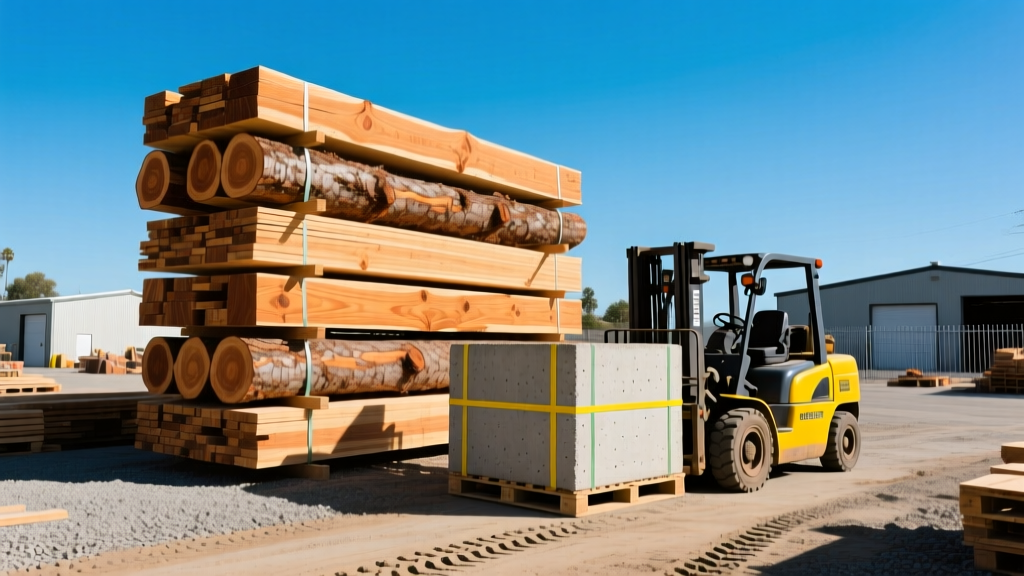
Local Foothill suppliers deploy articulating boom trucks. These trucks can drop pallets of roofing shingles, I-joists, or heavy masonry blocks directly onto second-story decks or over backyard block walls with an 80-foot reach. This eliminates the need for manual secondary carrying or renting a separate telehandler on-site, saving contractors roughly $450 per day in equipment rental fees.
Weather and Tarping Protocols
The Inland Empire experiences severe Santa Ana winds and sudden dry heat spikes. Local yards mandate heavy-duty, UV-resistant tarping and nylon strapping for all drywall and finish lumber deliveries. Big-box deliveries frequently arrive with inadequate plastic wrap that tears in transit, resulting in sun-baked, warped composite trim or moisture-compromised drywall edges before the materials are even unloaded.
Final Recommendation: When to Use Which Supplier
Optimizing your supply chain in 2026 requires a hybrid approach. Do not rely exclusively on one supplier type.
Use Foothill / Local Yards For:
- Primary structural framing (DF-L lumber, engineered I-joists)
- Heavy masonry, pavers, and retaining wall blocks
- Roofing bundles requiring boom-truck deck drops
- High-volume drywall and insulation orders
Use Big-Box Stores For:
- Finish hardware (hinges, specialty screws, fasteners)
- Small-quantity trim and molding restocks
- Emergency tool or blade replacements mid-shift
- Weekend DIY projects and minor repairs
By leveraging the structural integrity, specialized delivery, and contractor-friendly credit lines of Foothill Building Materials in Pomona for your heavy lifting, and utilizing big-box stores for convenience-based finish restocks, you protect both your project's structural integrity and your bottom line. For further insights into regional housing development and material demand forecasting, review the latest construction economic reports from the USC Lusk Center for Real Estate, which tracks Inland Empire development trends and supply chain constraints.
Written by
David NakamuraDavid Nakamura is a licensed architect (AIA) and construction technology writer focused on sustainable building methods, mass timber engineering, and high-performance building envelopes. He holds a Master of Architecture from the University of Washington and is a certified Passive House Consultant (CPHC). David spent eight years at the Seattle firm Mithun, where he led the design of three LEED Platinum projects, before founding his own practice specializing in net-zero residential design. He serves on the editorial advisory board of GreenBuilder Magazine and has authored peer-reviewed papers on cross-laminated timber (CLT) connections for the Journal of Structural Engineering. In his spare time, David teaches woodworking at Pratt Fine Arts Center and kayaks the Puget Sound.
More from David Nakamura
View all
Construction Cost
Labor Cost to Build a Deck Per Sq Ft: 2026 Installation Guide
Discover the exact labor cost to build a deck per sq ft in 2026. This installation guide breaks down contractor rates, complexity factors, and hidden fees.
Aug 4, 2026

Construction Cost
How Much Does It Cost to Build a 3 Bedroom House? Financing Guide
Learn exactly how much it costs to build a 3 bedroom house and explore 2026 financing options, construction loan types, and budget frameworks for your build.
Aug 4, 2026

Construction Cost
Cost to Build a Tennis Court: 2026 Guide
How much does it cost to build a tennis court in 2026? Breakdowns for asphalt, concrete, and synthetic surfaces plus fencing and lighting.
Jul 30, 2026