Orion's Used Building Materials: Reclaimed Lumber & Brick Guide
Explore Orion's used building materials for reclaimed lumber and vintage brick. Learn pricing, inspection metrics, and yield loss for salvage projects.

The Economics and Ecology of Architectural Salvage
Sourcing from specialized suppliers like Orion's used building materials represents a critical intersection of historic preservation, sustainable construction, and high-end interior design. Unlike standard lumber yards that deal in homogeneous, kiln-dried dimensional timber, architectural salvage yards process materials with deep historical provenance. When you purchase reclaimed heart pine, vintage Chicago common brick, or salvaged slate roofing, you are acquiring materials with physical characteristics that are virtually impossible to replicate with modern manufacturing. Old-growth timber features tighter growth rings (often 15 to 30 rings per inch), resulting in higher density and superior dimensional stability compared to second-growth plantation wood. However, integrating Orion's used building materials into a modern construction schedule requires a rigorous understanding of yield loss, moisture equilibrium, and structural grading that standard building supply procurement simply does not demand.
Core Inventory Breakdown: What Orion's Actually Stocks
Specialized salvage yards categorize their inventory not just by material type, but by extraction method and historical era. Understanding these categories is essential for accurate specification and budgeting.
Heavy Timber and Dimensional Lumber
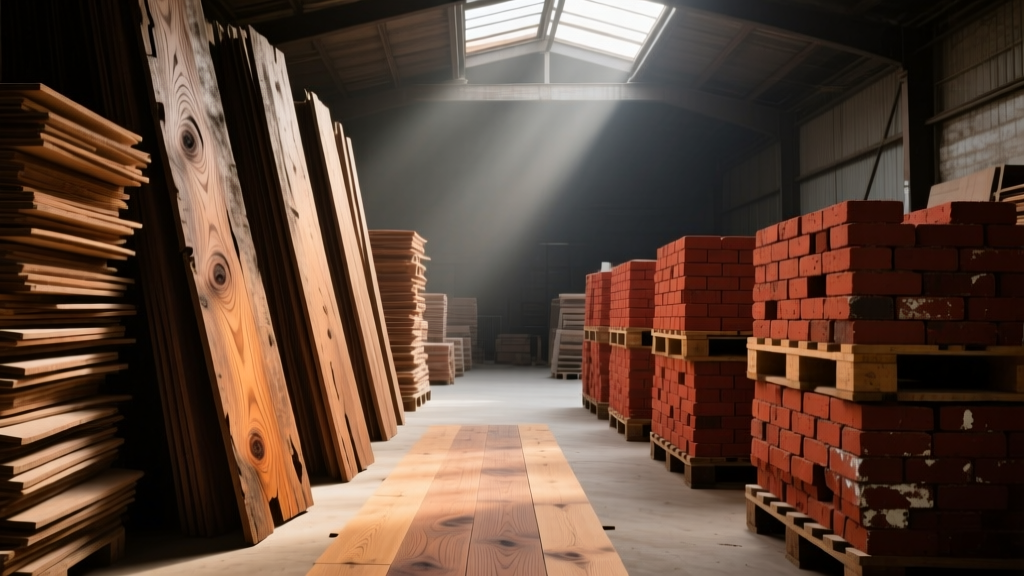
The highest-value inventory at Orion's used building materials typically consists of structural beams and dimensional lumber extracted from deconstructed 19th and early 20th-century agricultural and industrial buildings.
- Old Growth Longleaf Heart Pine: Prized for its rich amber hue and extreme hardness (1,225 lbf on the Janka scale). Often salvaged from textile mills in the American South.
- Douglas Fir and Hemlock Beams: Commonly sourced from Pacific Northwest warehouses. These are frequently specified for exposed structural ceiling beams in modern commercial builds.
- White Oak and Chestnut: American Chestnut is entirely salvaged (due to the mid-20th-century blight) and commands a massive premium for custom millwork and wide-plank flooring.
Vintage Masonry and Terra Cotta
Salvaged brick offers a color variation and surface texture that modern wire-cut bricks cannot match. Orion's used building materials typically stock pallets of Chicago Common Brick—a historically significant, soft-fired clay brick known for its mottled pink, orange, and buff coloration. Because these bricks were fired in beehive kilns without modern temperature controls, their compressive strength varies wildly from 2,000 PSI to over 8,000 PSI within the same pallet, necessitating careful sorting before structural or veneer application.
Integrating salvaged materials directly contributes to the U.S. Green Building Council's LEED v4.1 MRc3 (Sourcing of Raw Materials) credit. Projects that incorporate at least 15% salvaged, refurbished, or reused materials (by cost) can secure crucial points toward certification, making Orion's inventory a strategic asset for commercial developers.
Pricing Matrix: Salvage vs. New Production
Pricing at architectural salvage yards fluctuates based on the labor intensity of the deconstruction process and the remaining supply of specific historical structures. Below is a comparative cost analysis for common materials.
| Material Category | Orion's Avg. Salvage Cost | New Equivalent Cost | Primary Specification Use |
|---|---|---|---|
| Reclaimed Heart Pine (S4S Flooring) | $9.50 - $14.00 / sq ft | $6.00 - $9.00 / sq ft | High-end residential flooring, feature walls |
| Vintage Chicago Common Brick | $0.95 - $1.60 / brick | $0.55 - $0.80 / brick | Interior accent walls, exterior veneer |
| 10x10 Douglas Fir Beams (Rough Sawn) | $12.00 - $18.00 / board foot | $4.50 - $7.00 / board foot | Exposed structural beams, mantels |
| Salvaged Slate Roofing Tiles | $3.50 - $6.00 / sq ft | $12.00 - $20.00 / sq ft | Roofing replacement, patio paving |
Critical Inspection Metrics for Salvaged Goods
Buying from Orion's used building materials requires a different quality assurance protocol than buying from a big-box retailer. You are responsible for verifying the structural integrity and biological safety of the materials.
Embedded Fasteners and Iron Rot
Reclaimed lumber is notorious for hidden metal. Even if a supplier claims the wood has been passed through a metal detector, ferrous metals left inside the wood for decades cause "iron rot"—a localized chemical degradation where the wood turns black and spongy around the nail or bolt shaft. When specifying timber for CNC milling or fine woodworking, always budget for an additional 5% to 8% material loss due to hidden iron rot and the necessity of cutting around compromised zones.
Biological Contamination and Kiln Protocols
According to guidelines established by the USDA Forest Products Laboratory, reclaimed wood must be thermally treated to eliminate biological threats. Wood salvaged from barns or warehouses often harbors powderpost beetles or fungal spores. Ensure that any interior-grade millwork sourced from Orion's has been kiln-dried to a core temperature of at least 133°F for a minimum of three hours. This specific thermal threshold is required to sterilize the wood and halt any active insect infestation.
Never install reclaimed exterior siding or interior flooring directly from the salvage yard. The material must acclimate to the specific environment. Use a pin-type moisture meter to verify the wood has reached an Equilibrium Moisture Content (EMC) of 6% to 8% for interior HVAC-controlled environments, or 12% to 15% for exterior applications. Installing wood at 18% EMC in a modern, climate-controlled home will guarantee severe cupping and gapping within six months.
Masonry Compatibility: The Mortar Mismatch Problem
One of the most frequent and costly mistakes contractors make when using vintage brick from Orion's used building materials is pairing it with modern Portland cement-based mortar. Vintage bricks, particularly soft-fired commons, have a high porosity and a lower compressive strength than modern extruded bricks.
If you use a hard, impermeable Type S or Type N Portland mortar, the brick will act as the sacrificial element in the wall assembly. When moisture enters the wall and freezes, the rigid mortar will not yield, causing the face of the vintage brick to spall and shatter.
The Solution: You must specify a soft, vapor-permeable mortar. Use a Type O mortar (1 part Portland cement, 2 parts hydrated lime, 9 parts sand) or, ideally, a Natural Hydraulic Lime (NHL 3.5) mortar. This ensures the mortar is softer than the brick, allowing the wall to breathe and accommodating slight thermal expansions without destroying the historic masonry unit. For comprehensive testing standards on masonry durability, refer to the Building Materials Reuse Association (BMRA) guidelines on historic material integration.
Logistics, Processing, and Yield Loss Realities
Procuring salvaged materials is not a simple "order and deliver" transaction. The logistics of processing raw salvage into buildable specifications introduce significant variables into your project timeline.
Understanding the Milling Yield Loss
When you purchase 1,000 board feet of rough-sawn, nail-embedded reclaimed oak from a salvage yard, you will not end up with 1,000 board feet of finished flooring. The process of de-nailing, planing, ripping off wane (bark edges), and cross-cutting checks (end splits) results in a standard yield loss of 20% to 35%. Therefore, to achieve 1,000 board feet of usable, S4S (surfaced on four sides) flooring, you must purchase a minimum of 1,300 to 1,400 board feet of rough salvage stock. Failing to calculate this yield loss is the primary reason renovation projects stall due to material shortages.
Lead Times and Deconstruction Schedules
Unlike new manufacturing, which operates on predictable extrusion and milling schedules, salvage yards are dependent on deconstruction timelines. If Orion's is currently dismantling a specific 1920s warehouse, the heavy timbers will not be available for purchase until the roof is carefully removed, the joinery is cataloged, and the beams are lowered via crane. This deconstruction phase can take 4 to 8 weeks before the materials even reach the yard for initial sorting and metal detection. Always build a minimum 60-day buffer into your project schedule when relying on specific salvaged architectural elements.
- Verify kiln-drying certificates for all interior wood to ensure 133°F thermal sterilization.
- Calculate a 25% yield loss factor when ordering rough-sawn timber for custom milling.
- Specify NHL 3.5 or Type O mortar for all vintage masonry installations to prevent spalling.
- Test moisture content (EMC) on-site upon delivery before authorizing installation.
- Request a structural grading stamp for any salvaged beams intended for load-bearing applications.
Written by
David NakamuraDavid Nakamura is a licensed architect (AIA) and construction technology writer focused on sustainable building methods, mass timber engineering, and high-performance building envelopes. He holds a Master of Architecture from the University of Washington and is a certified Passive House Consultant (CPHC). David spent eight years at the Seattle firm Mithun, where he led the design of three LEED Platinum projects, before founding his own practice specializing in net-zero residential design. He serves on the editorial advisory board of GreenBuilder Magazine and has authored peer-reviewed papers on cross-laminated timber (CLT) connections for the Journal of Structural Engineering. In his spare time, David teaches woodworking at Pratt Fine Arts Center and kayaks the Puget Sound.
More from David Nakamura
View all
Construction Cost
Labor Cost to Build a Deck Per Sq Ft: 2026 Installation Guide
Discover the exact labor cost to build a deck per sq ft in 2026. This installation guide breaks down contractor rates, complexity factors, and hidden fees.
Aug 4, 2026

Construction Cost
How Much Does It Cost to Build a 3 Bedroom House? Financing Guide
Learn exactly how much it costs to build a 3 bedroom house and explore 2026 financing options, construction loan types, and budget frameworks for your build.
Aug 4, 2026

Construction Cost
Cost to Build a Tennis Court: 2026 Guide
How much does it cost to build a tennis court in 2026? Breakdowns for asphalt, concrete, and synthetic surfaces plus fencing and lighting.
Jul 30, 2026