Jackson Building Materials Inc Cost Analysis for Commercial Projects
Explore our 2026 cost analysis of Jackson Building Materials Inc. Compare regional supplier pricing, delivery fees, and bulk discounts against national chains.

The Economics of Regional Distribution in 2026
For commercial general contractors and mid-sized residential developers, material procurement is no longer just about securing the lowest unit price on a quote sheet. The 2026 construction landscape demands a rigorous Total Cost of Ownership (TCO) analysis. When evaluating regional distributors like Jackson Building Materials Inc against national big-box competitors or direct-mill purchasing, the financial nuances of freight, credit terms, and inventory staging often dictate project profitability. According to the Bureau of Labor Statistics Producer Price Index, volatility in softwood lumber and gypsum products continues to require agile procurement strategies, making the localized supply chain management offered by regional dealers highly relevant.
This cost analysis breaks down the financial architecture of sourcing from a regional dealer model like Jackson Building Materials Inc, examining landed costs, hidden surcharges, and cash flow implications for commercial projects ranging from 10,000 to 150,000 square feet.
Landed Cost Matrix: Regional Dealer vs. National Big-Box
Sticker prices on dimensional lumber and drywall rarely tell the full story. National retailers often advertise lower baseline unit costs, but regional suppliers like Jackson Building Materials Inc optimize the "last mile" of construction logistics. Below is a comparative matrix of landed cost variables for a standard 50,000 sq. ft. commercial build.
| Cost Variable | Jackson Building Materials Inc (Regional) | National Big-Box Retailer | Direct Mill / Manufacturer |
|---|---|---|---|
| Base Unit Pricing | Market + 2-4% premium | Baseline Market Rate | Market - 5-8% discount |
| Delivery Minimums | $750 - $1,200 (Flexible staging) | $2,500+ (Rigid scheduling) | $15,000+ (Full truckload only) |
| Crane / Boom Unloading | Included on orders >$3,500 | $150 - $250 per drop fee | Not provided (Receiver must unload) |
| Restocking Fees | 10% (or waived for account holders) | 15% - 20% strict policy | Non-returnable |
| Commercial Credit Terms | Net-30 to Net-60 available | Net-30 (strict limits) | Prepay or Letter of Credit |
Category-Specific Cost Breakdown & Pricing Realities
To understand the true cost of doing business with a regional supplier, we must analyze specific material categories. The pricing below reflects Q1 2026 market averages for the Southeast and Midwest distribution corridors, adjusted for regional dealer margins.
Structural Framing & Engineered Lumber
While standard SPF #2 2x4 studs may cost $4.15 to $4.45 per piece at a national chain, Jackson Building Materials Inc typically quotes between $4.30 and $4.60. However, the cost advantage shifts dramatically in engineered wood products. For Weyerhaeuser Trus Joist Versa-Lam LVL beams, regional dealers often have direct territory allocations that bypass secondary distributor markups. A 1-3/4" x 11-7/8" Versa-Lam 2.0E beam might cost $145 per linear foot at a national retailer, but a regional dealer with an active commercial account can deliver it to the joist hanger for $128 per linear foot, saving thousands on multi-story structural framing.
Drywall, Insulation, & Acoustical Ceilings
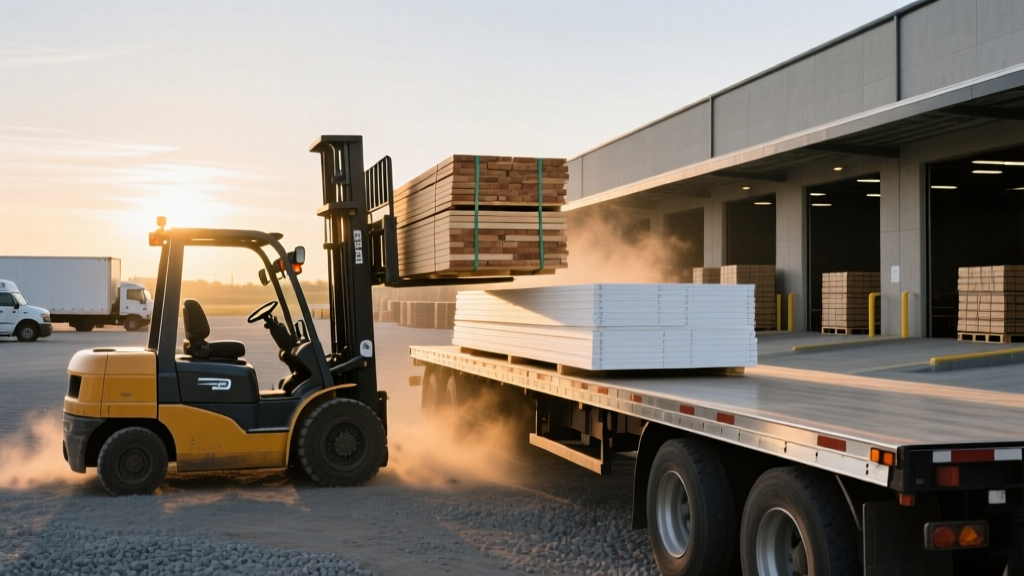
Gypsum board is heavy, making freight the primary cost driver. USG Sheetrock UltraLight Panels Firecode X (5/8") currently sits at $16.80 to $18.50 per 4x12 sheet. National chains charge per-sheet delivery fees that can add $1.20 to $2.00 per board in freight. Regional suppliers utilize dedicated boom trucks that drop bundled, weather-wrapped pallets directly onto the decking or into specific floor zones of a commercial build. This reduces secondary labor costs for moving materials by up to 14%, a critical labor savings noted in recent U.S. Census Bureau construction spending reports highlighting the rising premium on skilled drywall finishers.
When reviewing quotes from Jackson Building Materials Inc or similar regional dealers, always isolate the Fuel Adjustment Factor. In 2026, FAF surcharges on heavy masonry and drywall deliveries are fluctuating between 4.5% and 6.2% depending on the delivery zip code. Ensure your estimate includes this variable, as it is often added at the invoicing stage rather than the initial quote stage.
Masonry & Hardscape Logistics
For commercial masonry, CMU (Concrete Masonry Units) and architectural veneer are where regional dealers shine. A standard 8x8x16 lightweight CMU block costs roughly $2.10 to $2.35. The hidden cost here is the pallet deposit. National suppliers often charge $25 to $35 per pallet, which is rarely fully refunded due to damage deductions. Regional dealers like Jackson Building Materials Inc typically operate a closed-loop pallet return system, charging a $15 deposit that is 100% refunded upon return, saving masonry contractors up to $1,200 per 10,000 square feet of blockwork.
Cash Flow Implications: The Value of Net-60 Terms
Material costs are only half the equation; the cost of capital required to finance those materials dictates project viability. Commercial GCs operating on tight draw schedules rely heavily on supplier credit terms.
- The Net-30 Baseline: National suppliers typically offer Net-30 terms up to a strict credit limit (often capped at $50,000 for mid-sized GCs). Once the limit is hit, subsequent orders require cash-on-delivery (COD), stalling project momentum.
- The Net-60 Advantage: Regional partners like Jackson Building Materials Inc frequently extend Net-45 or Net-60 terms to established commercial accounts, with credit lines exceeding $250,000.
- The Math: If a GC is financing a $100,000 material package at a commercial borrowing rate of 8.5% APR, extending payment terms from 30 days to 60 days saves roughly $425 in direct interest costs per billing cycle. Over a 14-month commercial build, the working capital preservation easily eclipses the 2% premium paid on baseline unit prices.
Procurement Decision Framework: When to Use Regional vs. National
Use the following decision matrix to determine when to route your purchase orders to Jackson Building Materials Inc versus a national competitor or direct manufacturer.
Route to Jackson Building Materials Inc (Regional) When:
- Phased Deliveries are Required: Your site lacks laydown space, requiring multiple "just-in-time" drops of under $3,000 per delivery.
- Crane Access is Limited: You need materials hoisted to a second-floor deck or roof, and you want to avoid third-party boom truck rental fees ($350+ per hour).
- Cash Flow is Constrained: You need Net-60 terms to align material payments with owner draw disbursements.
- High Return Probability: You are ordering custom millwork or excess architectural finishes where a flexible 10% restocking fee is preferable to a strict no-return policy.
Route to National Big-Box or Direct Mill When:
- Commodity Volume is Massive: You are buying full truckloads (45,000+ lbs) of standard SPF framing lumber where direct-mill pricing saves 8% and you have your own forklifts to unload.
- Emergency / Spot Purchases: You need 20 sheets of plywood and 5 bags of Portland cement immediately, and your crew can pick it up in a company truck (avoiding delivery fees entirely).
- Standardized Corporate Accounts: Your firm has a national master service agreement (MSA) with a big-box retailer that mandates centralized purchasing for rebate tier compliance.
Summary: Optimizing the Supply Chain
Sourcing from Jackson Building Materials Inc represents a strategic shift from commodity purchasing to logistics management. While the line-item unit cost on a quote may appear 2% to 5% higher than a national retailer, the elimination of drop fees, boom truck rentals, excessive pallet deposits, and short-term financing costs routinely results in a 4% to 7% net savings on the total installed cost of materials. For commercial estimators and project managers in 2026, building a strong credit relationship with a capable regional distributor is one of the most effective methods for protecting project margins against supply chain friction.
Written by
James ThorntonJames Thornton is a construction industry veteran with 25 years of hands-on experience in wood framing, lumber grading, and residential building codes. He started as a framing carpenter in rural Oregon, earned his ICC Residential Building Inspector certification, and eventually became a senior plan reviewer for the City of Portland Bureau of Development Services. James holds a B.S. in Wood Science & Technology from Oregon State University and is a certified lumber grader through the West Coast Lumber Inspection Bureau (WCLIB). He has inspected over 3,000 residential construction sites and authored the city's internal guide on advanced framing techniques (2x6 at 24" O.C.). James lives in Bend, OR, where he builds custom timber-frame cabins and competes in lumberjack sports.
More from James Thornton
View all
Insulation
Best Home Insulation Materials: Complete 2026 Guide
Compare top home insulation materials for 2026. Find R-values, installed costs per square foot, and best uses for fiberglass, spray foam, and mineral wool.
Aug 4, 2026

Sustainable Building
Certify Your Green Building Material for LEED and WELL
Step-by-step guide to certifying a green building material for LEED v5 and WELL v2. Master EPDs, HPDs, and VOC limits for 2026 project specifications.
Aug 4, 2026

Stone & Masonry
Veneer Stacked Stone Panels: Interior Design & Style Showcase
Discover how veneer stacked stone panels transform interiors. Explore modern design profiles, material pairings, and technical installation specs.
Aug 4, 2026