Westside Building Materials Anaheim vs Big Box: 2026 Cladding Guide
Compare Westside Building Materials Anaheim with big-box stores for exterior cladding. We review stone veneer, stucco, pricing, and logistics.

The Sourcing Dilemma for Orange County Contractors
For general contractors and custom home builders operating in Orange County and the greater Inland Empire, sourcing exterior cladding involves a critical calculation that goes far beyond the sticker price per square foot. When specifying manufactured stone veneer (MSV), traditional stucco, or architectural millwork, the choice between a specialized regional supplier like Westside Building Materials in Anaheim and a national big-box retailer's Pro Desk fundamentally alters project margins, labor efficiency, and long-term warranty validity.
This comparison review dissects the operational, financial, and technical differences between sourcing from Westside Building Materials Anaheim versus big-box alternatives in 2026, providing a concrete framework for material procurement.
Product Matrix: Specialty Yard vs. Big Box Pro Desk
The most immediate divergence between a dedicated masonry and stucco supplier and a generalist big-box store is the depth of the SKU catalog and the availability of complementary system components.
| Material Category | Westside Building Materials (Anaheim) | Big-Box Pro Desk (Home Depot/Lowe's) |
|---|---|---|
| Manufactured Stone Veneer | Full lines of Cultured Stone, Eldorado, Coronado; extensive color blending and matching corner pieces. | Limited to 2-3 basic Owens Corning or generic imported lines; severe shortage of matching corner units. |
| Stucco & EIFS Systems | Complete LaHabra, Omega, and Dryvit systems including specialized base coats, weep screeds, and control joints. | Quikrete base coats, basic fiberglass mesh, and standard metal lath. Lacks specialized EIFS components. |
| Architectural Millwork | High-density polyurethane and cellular PVC (Versatex, Fypon) with custom order capabilities. | Basic PVC trim boards and a limited selection of generic corbels and keystones. |
| Technical Support | On-staff masonry specialists; direct manufacturer rep access for warranty claims and color matching. | Generalist department staff; reliance on 1-800 manufacturer hotlines for technical disputes. |
Manufactured Stone Veneer (MSV): Beyond the Square Foot Price
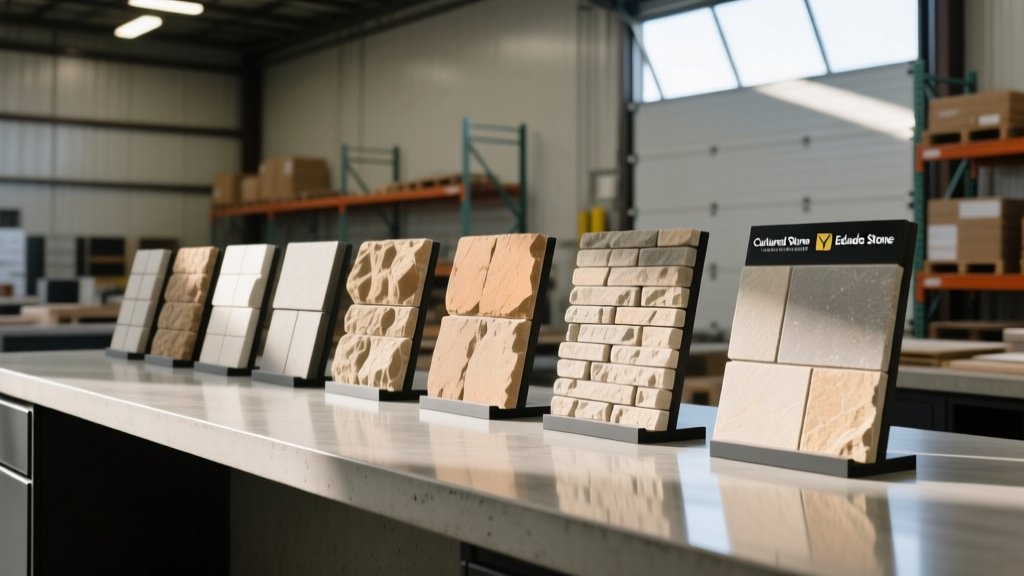
When evaluating MSV, inexperienced estimators often default to the flat square-foot cost of the fieldstone. However, the true cost of MSV installation is dictated by corner pieces, color blending, and compliance with industry installation standards set by the Brick Industry Association (BIA) and the National Veneer Manufacturers Association (NVMA).
The Corner Piece Labor Penalty
Big-box retailers frequently stock MSV fieldstone without the corresponding 90-degree corner pieces, or they carry them in severely limited colorways. When a mason is forced to install a veneer system without manufactured corners, they must 'return' or miter the fieldstone at the corners to simulate a wrap.
Westside Building Materials Anaheim maintains deep inventory of corner units for premium lines like Cultured Stone's Dressed Fieldstone and Eldorado Stone's Alpine Reinvention. Furthermore, their ability to pull from multiple pallets to ensure natural color variation prevents the 'monochromatic patch' effect that occurs when big-box stores fulfill orders from a single, unblended production run.
Stucco, EIFS, and Moisture Management
Exterior stucco in Southern California must navigate strict Title 24 energy codes and rigorous moisture management requirements. While big-box stores sell the basic ingredients for a traditional three-coat stucco system (Portland cement, sand, lath), they do not sell the integrated system.
Westside supplies complete, warrantied Exterior Insulation and Finish Systems (EIFS) from manufacturers like Dryvit, as well as traditional LaHabra stucco systems. Sourcing a complete system from a single specialty yard is critical for liability. If a stucco failure occurs due to moisture intrusion, manufacturers will routinely deny warranty claims if the base coat, acrylic finish, and mesh were not sourced as a tested, unified assembly. According to EPA guidelines on moisture control, improper material layering in wall assemblies is a primary driver of mold and structural rot.
Additionally, Westside stocks specialized weep screeds (ASTM C1063 compliant) and expanded metal lath with the correct furring dimples to ensure the scratch coat fully encapsulates the metal. Big-box lath is often flat, leading to improper keying and subsequent delamination in seismic zones.
Logistics, Delivery, and the True Cost of Breakage
Material logistics represent a hidden margin-killer in exterior cladding. The physical properties of manufactured stone and architectural millwork make them highly susceptible to transit damage.
The Breakage Variable
Big-box retailers typically fulfill large material orders via Less-Than-Truckload (LTL) freight or standard box trucks. Pallets of MSV are often stacked alongside heavy items like roofing shingles or Portland cement, resulting in crushing and edge chipping. Field data from regional contractors indicates an 8% to 12% breakage rate on MSV delivered via standard LTL freight.
Conversely, Westside Building Materials utilizes specialized flatbed delivery with A-frame racks and dedicated pallet strapping for fragile veneers. This targeted logistics approach reduces transit breakage to under 2%. When calculating material overage, contractors ordering from big-box stores must factor in a 10% waste allowance, whereas specialty yard deliveries safely allow for a standard 5% waste factor.
Final Sourcing Framework: When to Use Which
To optimize both budget and build quality in 2026, contractors should apply the following decision matrix when choosing between Westside Building Materials Anaheim and big-box alternatives:
- Use Westside Building Materials Anaheim When:
- The project specifies premium MSV (Cultured Stone, Eldorado) requiring exact color blends and pre-cast corners.
- You are installing a warranted EIFS or specialized three-coat stucco system where unified component sourcing is legally required for the warranty.
- The site has restricted access requiring specialized delivery equipment (e.g., Moffett forklifts or A-frame flatbeds).
- The design includes high-end polyurethane millwork that requires precise factory-matched priming and sizing.
- Use Big-Box Pro Desks When:
- You need emergency, same-day replenishment of basic consumables (standard metal lath, masonry ties, basic mortar mix).
- The project is a low-budget flip utilizing basic, non-warrantied cosmetic interior stone accents where corners can be easily mitered or hidden with trim.
- You are purchasing standard dimensional lumber or OSB sheathing to prep the walls prior to the cladding phase.
Ultimately, while the initial invoice from a specialized supplier may reflect a 5% to 15% premium on raw materials, the elimination of mason labor penalties, the reduction in transit breakage, and the preservation of manufacturer warranties consistently yield a lower total installed cost for high-performance exterior envelopes.
Written by
David NakamuraDavid Nakamura is a licensed architect (AIA) and construction technology writer focused on sustainable building methods, mass timber engineering, and high-performance building envelopes. He holds a Master of Architecture from the University of Washington and is a certified Passive House Consultant (CPHC). David spent eight years at the Seattle firm Mithun, where he led the design of three LEED Platinum projects, before founding his own practice specializing in net-zero residential design. He serves on the editorial advisory board of GreenBuilder Magazine and has authored peer-reviewed papers on cross-laminated timber (CLT) connections for the Journal of Structural Engineering. In his spare time, David teaches woodworking at Pratt Fine Arts Center and kayaks the Puget Sound.
More from David Nakamura
View all
Construction Cost
Labor Cost to Build a Deck Per Sq Ft: 2026 Installation Guide
Discover the exact labor cost to build a deck per sq ft in 2026. This installation guide breaks down contractor rates, complexity factors, and hidden fees.
Aug 4, 2026

Construction Cost
How Much Does It Cost to Build a 3 Bedroom House? Financing Guide
Learn exactly how much it costs to build a 3 bedroom house and explore 2026 financing options, construction loan types, and budget frameworks for your build.
Aug 4, 2026

Construction Cost
Cost to Build a Tennis Court: 2026 Guide
How much does it cost to build a tennis court in 2026? Breakdowns for asphalt, concrete, and synthetic surfaces plus fencing and lighting.
Jul 30, 2026