Commercial Building Materials Cost Breakdown: 2026 Procurement Guide
Analyze 2026 commercial building materials costs, from structural steel to IMPs. Discover hidden procurement expenses and value engineering frameworks.

Baseline Material Pricing Matrix (Q1 2026)
Procuring commercial building materials requires looking past the supplier invoice. While raw material costs typically represent 45% to 55% of total hard costs in mid-rise commercial and industrial projects, the baseline price is merely the starting point for financial modeling. According to data tracked by the Bureau of Labor Statistics Producer Price Index, construction material inputs have stabilized compared to the extreme volatility of the early 2020s, but regional supply chain bottlenecks and localized labor deficits continue to create significant price disparities.
The following matrix outlines baseline unit costs for core commercial materials in early 2026. These figures reflect national averages for mid-volume commercial orders (e.g., 50,000 to 150,000 square foot facilities) and exclude regional freight surcharges, tariffs, and specialized fabrication premiums.
| Material Category | Specification / Grade | Unit | Base Cost Range (2026) | Volatility Index |
|---|---|---|---|---|
| Structural Steel | ASTM A992 W-Shapes (Fabricated) | Ton | $1,250 - $1,420 | Moderate |
| Ready-Mix Concrete | 5,000 psi, 3/4-inch aggregate | Cubic Yard | $155 - $185 | Low |
| Insulated Metal Panels | 2.5-inch PIR core, 26-ga steel | Sq. Ft. | $14.50 - $19.00 | Moderate |
| Mass Timber (CLT) | 5-ply Cross-Laminated Timber | Sq. Ft. (Floor Area) | $48.00 - $65.00 | High |
| Cold-Formed Steel Studs | 20-gauge, 3-5/8-inch width | Linear Ft. | $1.85 - $2.40 | Low |
The Hidden Procurement Costs Destroying Margins
General contractors and developers frequently lose 4% to 8% of their material budget to secondary procurement costs that are rarely itemized on initial estimates. Understanding these hidden expenses is mandatory for accurate commercial building materials cost analysis.
1. Demurrage and Detention Fees
When delivery trucks arrive at a congested commercial site and are forced to wait, carriers charge demurrage. For ready-mix concrete, trucks typically allow 90 minutes of free time. After that, penalties escalate at $125 to $200 per hour. For structural steel flatbeds, detention fees begin after two hours of waiting, averaging $85 to $150 per hour. On a high-rise project with daily concrete pours, poor crane scheduling can result in $40,000+ in annualized demurrage penalties.
2. Off-Site Staging and Double-Handling
Urban commercial sites rarely have the footprint to store materials. Procuring structural steel or curtain wall glazing early to lock in prices often necessitates off-site storage. Renting a secure laydown yard, combined with the labor and crane time required to load, transport, unload, and re-load the materials, adds $45 to $75 per ton to structural steel costs. Double-handling fragile materials like architectural glass increases the risk of breakage, which insurance deductibles rarely cover below $10,000 per incident.
3. Environmental Compliance and Washout Fees
Concrete washout is no longer a simple site housekeeping issue; it is a heavily regulated environmental compliance requirement. Commercial sites must utilize sealed washout containers to prevent alkaline runoff from entering storm drains. Hauling and disposing of these containers costs $250 to $400 per pull. A 100,000 square foot commercial build requiring extensive foundations and flatwork can easily generate 80 to 120 washout pulls, adding $20,000 to $48,000 in unseen material handling costs.
Value Engineering: Substitution Frameworks
Value engineering in 2026 is not about selecting the cheapest material; it is about optimizing the intersection of material cost, labor availability, and schedule compression. The U.S. Census Bureau Construction Spending reports indicate that prolonged project schedules are currently the primary driver of commercial loan interest overruns. Therefore, materials that accelerate enclosure often justify higher upfront costs.
Scenario: 50,000 Sq. Ft. Distribution Center Enclosure
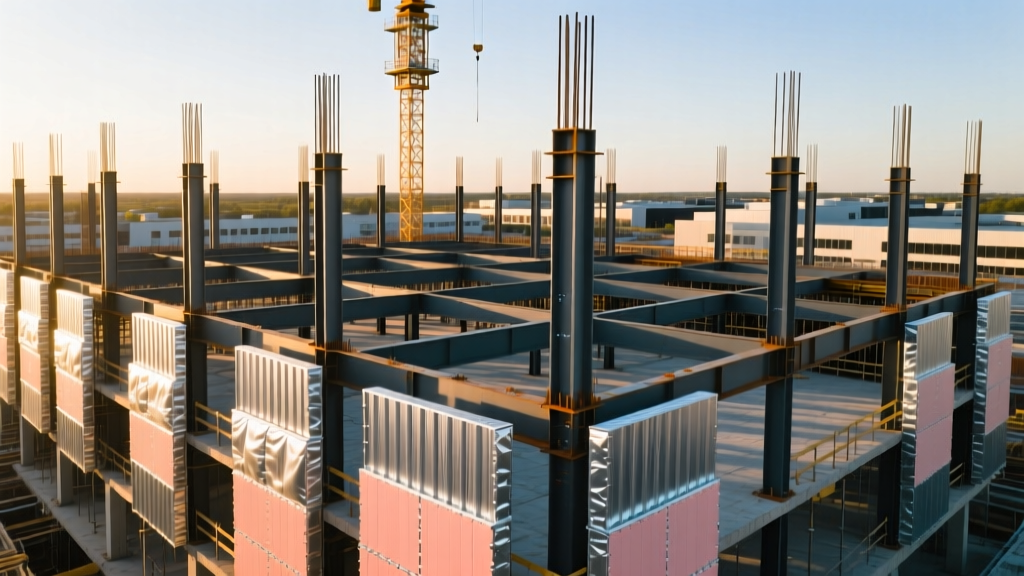
When evaluating exterior wall systems for mid-sized commercial facilities, the decision frequently narrows down to traditional tilt-up concrete versus Insulated Metal Panels (IMPs). Below is a direct cost and schedule comparison for a 50,000 square foot footprint with a 32-foot clear height.
- Option A: Tilt-Up Concrete Panels
- Material & Casting Cost: $9.50 per sq. ft.
- Erection & Bracing Labor: $7.50 per sq. ft.
- Insulation & Interior Furring (Added step): $4.00 per sq. ft.
- Total Installed Cost: $21.00 per sq. ft.
- Schedule Impact: 10 weeks (includes curing time and sequential interior insulation).
- Option B: Insulated Metal Panels (IMPs)
- Material Cost (2.5-inch PIR core): $16.50 per sq. ft.
- Erection Labor (Single-step installation): $5.00 per sq. ft.
- Total Installed Cost: $21.50 per sq. ft.
- Schedule Impact: 5 weeks (panels provide structure, insulation, and finish simultaneously).
Contract Strategies for Price Volatility
Locking in commercial building materials costs requires strategic contract structuring. Relying on fixed-price subcontracts in a fluctuating market forces subcontractors to inflate their bids by 8% to 12% to cover risk contingencies. To optimize procurement, developers and GCs must utilize data-backed escalation clauses.
Implementing PPI-Tied Escalation Clauses
Instead of accepting inflated fixed bids, negotiate a Guaranteed Maximum Price (GMP) with a material escalation clause tied directly to the Engineering News-Record (ENR) cost indices or the Bureau of Labor Statistics Producer Price Index (PPI).
For structural steel, tie the contract to the specific PPI commodity code for 'Steel mill products' (WPU1017). Establish a deadband threshold—typically +/- 5%. If the index moves less than 5% from the date of the bid to the date of the mill order, no price adjustment occurs. If the index spikes by 12%, the owner absorbs the 7% overage. This transparency removes the subcontractor's need to pad the bid with phantom risk premiums, often resulting in a lower baseline contract price and a more predictable cash flow.
Early Procurement and Mill Directives
For long-lead commercial materials like switchgear, custom curtain wall extrusions, and heavy timber, early procurement is mandatory. However, simply buying early is insufficient if the fabricator lacks storage. Issue 'Mill Directives' that allow you to purchase the raw material (e.g., aluminum billets or steel coils) and lock in the commodity price, while paying the fabricator a monthly storage fee to hold the raw stock until the shop drawings are fully approved. This prevents paying for fabricated materials that cannot yet be installed, keeping project cash flow aligned with actual site progress.
Written by
David NakamuraDavid Nakamura is a licensed architect (AIA) and construction technology writer focused on sustainable building methods, mass timber engineering, and high-performance building envelopes. He holds a Master of Architecture from the University of Washington and is a certified Passive House Consultant (CPHC). David spent eight years at the Seattle firm Mithun, where he led the design of three LEED Platinum projects, before founding his own practice specializing in net-zero residential design. He serves on the editorial advisory board of GreenBuilder Magazine and has authored peer-reviewed papers on cross-laminated timber (CLT) connections for the Journal of Structural Engineering. In his spare time, David teaches woodworking at Pratt Fine Arts Center and kayaks the Puget Sound.
More from David Nakamura
View all
Construction Cost
Labor Cost to Build a Deck Per Sq Ft: 2026 Installation Guide
Discover the exact labor cost to build a deck per sq ft in 2026. This installation guide breaks down contractor rates, complexity factors, and hidden fees.
Aug 4, 2026

Construction Cost
How Much Does It Cost to Build a 3 Bedroom House? Financing Guide
Learn exactly how much it costs to build a 3 bedroom house and explore 2026 financing options, construction loan types, and budget frameworks for your build.
Aug 4, 2026

Construction Cost
Cost to Build a Tennis Court: 2026 Guide
How much does it cost to build a tennis court in 2026? Breakdowns for asphalt, concrete, and synthetic surfaces plus fencing and lighting.
Jul 30, 2026