Japan Building Materials News: 2026 Technical Specs for Seismic Walls
Explore the latest Japan building materials news with a deep dive into 2026 technical specs for seismic dampers, aerogel insulation, and JAS-certified CLT.

The Shift in Japanese Construction: From Code-Minimum to Performance-Driven
Tracking the latest Japan building materials news reveals a definitive pivot from mere code compliance to hyper-optimized, performance-driven material specifications. Driven by the Ministry of Land, Infrastructure, Transport and Tourism (MLIT) and the continuous refinement of the Building Standards Act (BSA), Japanese manufacturers are engineering materials that exceed baseline seismic and thermal requirements by significant margins. For global architects, structural engineers, and procurement managers, understanding the exact technical specifications of these innovations is critical. This analysis breaks down the precise metrics, testing standards, and material properties defining Japan's most advanced building products in 2026.
Technical Breakdown: Advanced Seismic Damping Systems
Japan's seismic engineering ecosystem is globally unmatched, largely due to the widespread integration of passive energy dissipation devices. Rather than relying solely on structural stiffness, modern Japanese mid-rise and high-rise designs incorporate specialized damping walls. The latest generation of these systems focuses on minimizing residual drift and protecting non-structural elements during long-period ground motions.
The three primary damping technologies dominating current specifications are viscoelastic dampers, oil (hydraulic) dampers, and buckling-restrained braces (BRBs). Each operates on distinct mechanical principles and requires specific structural integration tolerances.
| System Type | Core Mechanism | Yield Force / Capacity | Max Displacement | Temperature Sensitivity |
|---|---|---|---|---|
| Viscoelastic Damper | Shear deformation of polymer layers | 50 kN - 800 kN | ±60 mm to ±150 mm | High (Requires temp-compensating design) |
| Oil Damper | Fluid forced through orifices | 100 kN - 2000 kN | ±100 mm to ±300 mm | Low (Highly stable across -10°C to 40°C) |
| Buckling-Restrained Brace | Axial yielding of steel core in mortar tube | 500 kN - 5000 kN | ±40 mm to ±120 mm | Negligible (Steel yielding mechanics) |
When specifying BRBs for international projects based on Japanese models, engineers must note the steel grade requirements. Japanese specifications typically mandate SN400B or SN490B steel (yield strengths of 235 MPa and 295 MPa, respectively) for the core plate, encased in an unbonded mortar or rubber filler within a steel tube. The unbonded layer must maintain a precise thickness of 1.0 mm to 2.0 mm to allow for Poisson expansion of the core during compression without inducing friction against the restrainer.
Next-Generation Thermal Envelopes: Silica Aerogel and VIPs
With Japan's ZEH (Net Zero Energy House) standards becoming increasingly stringent, the building materials sector has aggressively commercialized ultra-high-performance insulation. Traditional extruded polystyrene (XPS) and polyurethane foams are being supplemented—or replaced in high-value applications—by Silica Aerogel blankets and Vacuum Insulation Panels (VIPs).
Silica Aerogel Blankets
Aerogel blankets, often integrated into exterior wall cavities or roof assemblies where depth is restricted, offer a thermal conductivity (lambda value) as low as 0.014 W/m·K at 10°C. This is roughly 2.5 times more efficient than standard fiberglass batts. The technical advantage lies in the material's nanoporous structure (pore sizes < 70 nm), which restricts the Knudsen effect, effectively halting gaseous thermal conduction. When specifying aerogel, contractors must account for its hydrophobic nature; while it repels liquid water, it remains highly vapor-permeable (typically > 0.5 perms), making it ideal for exterior continuous insulation layers where drying to the exterior is required.
Vacuum Insulation Panels (VIPs)
VIPs represent the absolute ceiling of thermal resistance, achieving lambda values between 0.004 and 0.008 W/m·K. Constructed with a fumed silica or fiberglass core sealed in a multi-layer metalized polymer barrier film, VIPs are evacuated to an internal pressure of less than 1 Pa. The critical specification challenge with VIPs is their vulnerability to puncture. Japanese manufacturers now produce VIPs with integrated protective felt layers and embed RFID tags within the panel edges to verify vacuum integrity post-installation. VIPs must never be cut on-site; dimensions must be pre-calculated to the millimeter during the BIM phase.
When calculating the overall U-value of a wall assembly using VIPs, you must apply a linear thermal bridging correction factor for the panel edges. The metalized barrier film creates a micro-thermal bridge at the seams. According to Japanese testing protocols, the effective lambda value of the overall VIP array increases by approximately 15-20% compared to the center-of-panel value. Always specify panels with welded, folded edges rather than flat-sealed edges to minimize this effect.
Acoustic Metamaterials for Low-Frequency HVAC Noise
A rapidly emerging sector in Japan building materials news is the application of acoustic metamaterials, specifically engineered to combat low-frequency noise (100 Hz to 500 Hz) generated by heavy HVAC systems and urban rail transit. Traditional mass-loaded vinyls and porous absorbers require impractical thicknesses to absorb wavelengths in this range.
Japanese acoustic engineers have developed phononic crystal panels featuring periodic arrays of sub-wavelength Helmholtz resonators embedded within thin gypsum or polycarbonate matrices. These panels, typically 30 mm to 50 mm thick, exhibit localized bandgaps that trap and dissipate specific acoustic frequencies. Technical specifications for these metamaterial panels show a transmission loss (TL) improvement of +12 dB to +18 dB at targeted resonant frequencies (e.g., 250 Hz) compared to a standard 12.5 mm gypsum board. When specifying these for mechanical room enclosures, the acoustic consultant must provide the exact 1/3-octave band spectrum of the offending equipment so the manufacturer can tune the resonator cavity volumes (typically ranging from 5 cm³ to 25 cm³) to the precise target frequency.
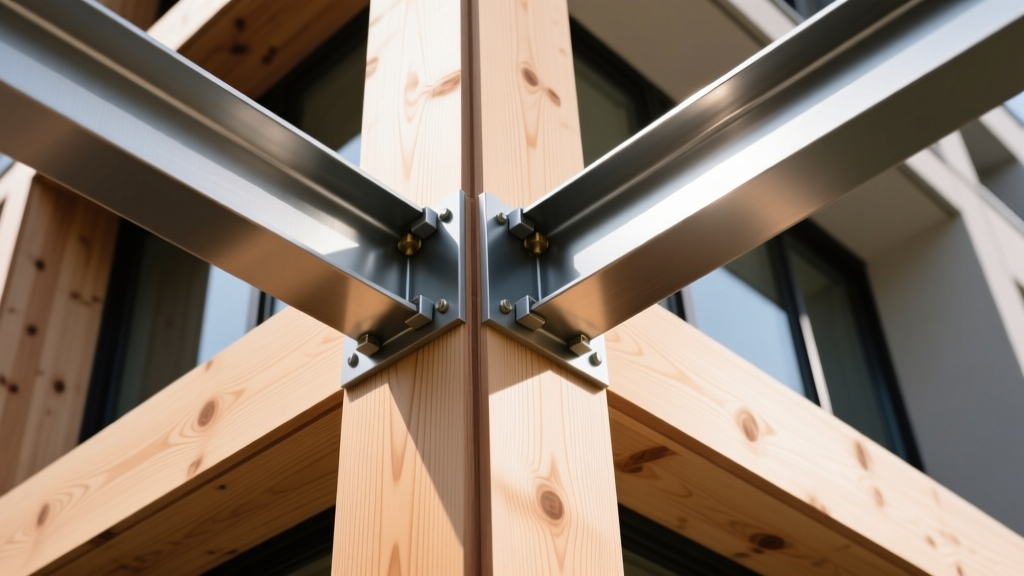
Mass Timber Innovations: JAS-Certified CLT and Fire-Rated Glulam
Japan's push toward carbon-neutral construction has accelerated the adoption of Cross-Laminated Timber (CLT) and Glued Laminated Timber (Glulam). However, the technical standards governing these materials in Japan differ significantly from North American or European norms. The Ministry of Land, Infrastructure, Transport and Tourism (MLIT) strictly enforces the Japanese Agricultural Standards (JAS) for wood products, which dictate precise adhesive, moisture, and lamination parameters.
- Adhesive Specifications: JAS standards for structural CLT mandate the use of Phenol-Resorcinol-Formaldehyde (PRF) or specific one-component polyurethane (1C-PUR) adhesives. The delamination test requirements involve rigorous cyclic boiling and drying processes that exceed standard EN 16351 protocols.
- Moisture Content Tolerances: Laminations must be kiln-dried to a moisture content of 12% ± 3% prior to pressing. The differential moisture content between adjacent laminations cannot exceed 5%, a strict tolerance designed to prevent internal checking and rolling shear failures in Japan's highly humid summer climate.
- Fire Resistance Metrics: For exposed mass timber in commercial applications, Japanese fire codes require calculating the residual cross-section after a specified charring period. The standardized charring rate for CLT and Glulam under JIS A 1304 testing is set at 0.7 mm/min for the first 30 minutes, dropping to 0.5 mm/min thereafter. To achieve a 2-hour Fire Resistance Rating (FRR), a sacrificial char layer of exactly 78 mm must be added to the structural dimension of the timber element.
For international procurement, it is vital to recognize that JAS-certified CLT utilizes primarily Japanese Cedar (Sugi) and Cypress (Hinoki). These species have lower density (approx. 380 kg/m³ to 420 kg/m³) and lower rolling shear strength compared to the Spruce-Pine-Fir (SPF) commonly used in European or North American CLT. Structural engineers must apply species-specific modification factors when integrating Japanese CLT into international load calculations.
Navigating the JIS to ASTM/ISO Specification Gap
One of the most significant hurdles for global firms utilizing Japanese building materials is translating Japanese Industrial Standards (JIS) into ASTM or ISO equivalents. Direct 1:1 conversions rarely exist, particularly for structural steel, concrete compressive strength testing, and fire retardant coatings.
Do not rely on generic conversion charts. For structural steel, JIS G 3106 SM490Y is often mistakenly equated to ASTM A572 Grade 50. While yield strengths are similar (335 MPa vs 345 MPa), the Charpy V-notch impact testing requirements and maximum carbon equivalent (Ceq) limits differ, which can severely affect weldability procedures in sub-zero environments. Always commission a material-specific equivalency report from a certified metallurgical testing lab before substituting JIS steel in critical seismic moment frames.
Integrating Japanese Specs into Global Procurement
Sourcing advanced Japanese building materials for projects outside of East Asia requires a strategic approach to logistics and compliance. Lead times for custom-tuned seismic dampers and JAS-certified mass timber can exceed 16 to 20 weeks. Furthermore, chemical treatments applied to Japanese timber for termite resistance (often utilizing borate-based compounds like disodium octaborate tetrahydrate at retention levels of 4.0 kg/m³) must be verified against local environmental and building codes, such as the EPA regulations in the United States or REACH in the European Union.
By focusing on the exact technical specifications—understanding the lambda values of aerogels, the displacement capacities of BRBs, and the precise charring rates of JAS timber—construction professionals can successfully leverage the cutting-edge innovations highlighted in Japan building materials news. The Architectural Institute of Japan (AIJ) continues to publish vital English-language research on these material behaviors, serving as an essential resource for engineers looking to push the boundaries of structural resilience and thermal efficiency in global construction.
Written by
Priya KapoorPriya Kapoor is a real estate market analyst and construction economics researcher with expertise in housing affordability, development feasibility, and infrastructure investment. She holds a Master of Regional Planning from Cornell University and previously worked as a senior analyst at CBRE's Investment Properties group, where she modeled returns for $4B in mixed-use development pipelines. Priya now runs an independent research practice advising developers, municipalities, and REITs on construction cost forecasting and market timing. She publishes the quarterly "BuildMat Market Pulse" report tracking material price indices across 12 commodity categories. Based in Austin, TX, Priya serves on the board of Habitat for Humanity Austin and is a marathon runner.
More from Priya Kapoor
View all
Construction Cost
Cost to Build a 1600 Sq Ft Home in 2026: Full Breakdown
Accurate 2026 cost to build a 1600 sq ft home—material, labor, and regional pricing breakdowns included. Plan your budget with real-time estimates.
Aug 11, 2026

Wood & Lumber
Name the Types of Wood for Pressure Treatment and Preservation
Learn how to name the types of wood best suited for pressure treatment. Compare species treatability, chemical retention levels, and 2026 preservation costs.
Aug 4, 2026

Stone & Masonry
Stone Veneer Suppliers Lindenhurst: 2026 Cost Analysis
Analyze 2026 stone veneer costs in Lindenhurst, NY. Compare local supplier pricing, delivery fees, and Suffolk County installation labor rates.
Aug 4, 2026