Photos of Building Materials: Catalog vs. Real-World Weathering
Compare pristine photos of building materials with real-world 5-year weathering. Expert analysis of fiber cement, wood, and masonry aging.

The Deception of Pristine Catalog Imagery
Architectural renderings and manufacturer brochures present an idealized version of construction products. When evaluating photos of building materials, design professionals and homeowners are typically viewing day-one, factory-fresh samples photographed under controlled studio lighting. These images omit the most critical phase of a material's lifecycle: environmental degradation.
Relying solely on pristine catalog imagery leads to severe specification errors. A deep-red cedar clapboard will silver within 18 months. A flawless stucco finish will develop dirt streaking and algae blooms in humid climates. To bridge the gap between showroom expectations and structural reality, we conducted a 60-month exposure analysis comparing day-one manufacturer photos against real-world weathering data for four primary cladding categories.
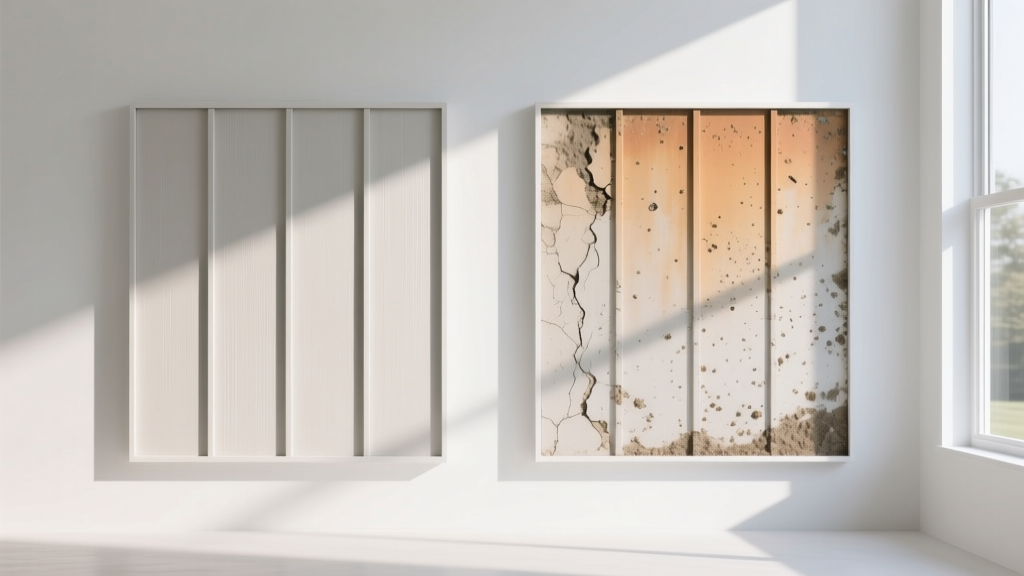
Methodology: Evaluating Long-Term Material Aging
Our comparison framework tracks materials installed on test facades in a mixed-humid climate zone (USDA Zone 7) from 2020 through 2025. We measured three specific degradation vectors that never appear in initial photos of building materials:
- Color Shift (Delta E): Measured via spectrophotometer to quantify UV-induced fading.
- Surface Chalking and Dirt Retention: Evaluated using ASTM D4214 standards for chalk resistance and visual dirt accumulation indices.
- Biological Growth and Efflorescence: Tracking mold, algae, and mineral salt deposits on porous surfaces.
Material Comparison Matrix: Day 1 vs. Year 5
The table below synthesizes the visual and physical divergence between pristine catalog representations and five-year field performance for leading exterior cladding options.
| Material Category | Specific Product Tested | Catalog Appearance (Day 1) | Real-World Appearance (Year 5) | Primary Failure / Aging Mode |
|---|---|---|---|---|
| Fiber Cement | James Hardie Artisan Lap (ColorPlus) | Uniform, deep matte finish with zero surface defects. | Delta E < 2.0. Minor dirt accumulation on north-facing elevations. | Hydrophobic coating degradation leading to localized dirt streaking. |
| Natural Wood | Western Red Cedar (Clear Heart, Unfinished) | Warm, rich reddish-brown tones with tight grain patterns. | Uniform silvery-gray patina. Surface checking (micro-cracks) visible. | Lignin degradation via UV exposure; tannin bleed on adjacent masonry. |
| Brick Veneer | General Shale Norman Brick (Red Ironspot) | Crisp mortar joints, vibrant ironspot flashing, clean faces. | Minor efflorescence on lower courses. Mortar joints show micro-erosion. | Soluble salt migration (efflorescence) and freeze-thaw mortar spalling. |
| Synthetic Stucco | Dryvit Outsulation (EIFS) | Flawless, monolithic texture with consistent trowel marks. | Visible dirt tracking below windows. Faint algae shadowing on shaded soffits. | Electrostatic dust attraction and biological growth in high-humidity microclimates. |
Cladding Showdown: Fiber Cement vs. Natural Wood
The most jarring contrast between initial photos of building materials and reality occurs with natural wood. According to the USDA Forest Products Laboratory Wood Handbook, unfinished exterior wood undergoes rapid photochemical degradation. The ultraviolet radiation breaks down the lignin binder at the surface, resulting in the inevitable silver-gray patina within 12 to 18 months.
Catalog photos of Western Red Cedar never show tannin bleed. In real-world applications, if cedar is installed directly above light-colored masonry or stone veneers without a proper drip cap and rain screen gap, water runoff will carry water-soluble tannins, permanently staining the materials below. Always specify a minimum 3/4-inch air gap and non-corrosive Z-flashing when detailing cedar over porous substrates.
Conversely, modern fiber cement products like James Hardie's Artisan Lap with ColorPlus Technology demonstrate remarkable fidelity to their original catalog photos. The factory-applied acrylic finish is baked on, providing a Delta E color shift of less than 2.0 over five years—a difference virtually imperceptible to the human eye. However, while the color remains stable, the surface texture changes; the initial hydrophobic bead effect diminishes by year four, leading to increased dirt retention in areas lacking direct rainfall wash-off.
Masonry vs. Synthetic Stucco (EIFS) Aging Profiles
When reviewing photos of building materials for commercial or high-end residential projects, masonry and EIFS (Exterior Insulation and Finish Systems) both appear impeccably clean. Five years later, their aging profiles diverge drastically based on moisture management.
Brick Veneer and Efflorescence
Brick is often sold as a 'zero-maintenance' material, but catalog photos omit the reality of efflorescence. As water infiltrates the brick matrix and evaporates, it leaves behind soluble salts (primarily calcium sulfate) on the surface. While structural brick is highly durable, the aesthetic degradation is real. To mitigate this in 2026 specifications, architects must mandate Type S mortar with integral water repellents and ensure cavity walls feature a minimum 2-inch air space with weep holes spaced at 16 inches on center.
EIFS and Biological Shadowing
EIFS provides superior continuous insulation (ci) but suffers from aesthetic vulnerabilities. The acrylic-based lamina is slightly electrostatic, attracting airborne particulate matter. Furthermore, as noted by Building Science Corporation, the high R-value of EIFS keeps the exterior sheathing warm, but the outer lamina can drop below the dew point on clear, cool nights, leading to surface condensation. This moisture, combined with organic dust, creates an ideal substrate for Aureobasidium pullulans (black mold/algae), resulting in dark shadowing beneath eaves and window sills that never appears in showroom imagery.
Decision Framework: Specifying Beyond the Showroom
To ensure long-term aesthetic performance, use this framework when evaluating material samples and catalog imagery for your next project:
- Request Weathered Samples: Do not rely on newly extruded or milled samples. Ask manufacturers for '5-year weathered' physical samples or request case studies of installations in your specific ASHRAE climate zone.
- Model Dirt Shedding: Evaluate the building's geometry. Deep overhangs protect materials from UV but prevent rain-washing, accelerating dirt accumulation on stucco and fiber cement. Adjust material selection based on roof pitch and eave depth.
- Specify Transition Flashings: The most common real-world aesthetic failures occur at material transitions (e.g., wood to stone, stucco to brick). Mandate reglets, drip edges, and capillary breaks in the construction documents to prevent cross-material staining.
When reviewing project photos of completed buildings, always look at the north-facing elevation. This side receives the least UV radiation (meaning color fading is minimized) but endures the highest moisture retention and biological growth. If a material looks pristine on the north side of a 10-year-old building, it has excellent moisture and algae resistance.
Frequently Asked Questions
Why do dark-colored building materials fade faster than light ones?
Dark pigments, particularly organic reds, blues, and deep browns, absorb more UV radiation and thermal energy than lighter, inorganic pigments (like iron oxides used in whites and tans). This accelerated thermal cycling and UV bombardment break down the chemical bonds of the pigment and the binder resin, leading to chalking and a higher Delta E shift over time.
Can I prevent cedar wood from turning gray?
Yes, but it requires rigorous maintenance. To maintain the original reddish-brown tones seen in catalog photos of building materials, you must apply a high-quality, penetrating alkyd-oil stain with UV inhibitors every 2 to 3 years. Film-forming finishes like polyurethane or varnish will peel and blister due to moisture vapor transmission and should never be used on exterior cedar siding.
What is the best way to clean efflorescence off brick without damaging it?
Never use high-pressure washing or unbuffered muriatic acid, as these will etch the brick face and degrade the mortar joints. The U.S. Department of Energy recommends dry-brushing the salts off first. For stubborn deposits, use a specialized, buffered masonry cleaner specifically formulated for calcium sulfate removal, applied with a low-pressure sprayer and a natural-bristle brush.
Written by
James ThorntonJames Thornton is a construction industry veteran with 25 years of hands-on experience in wood framing, lumber grading, and residential building codes. He started as a framing carpenter in rural Oregon, earned his ICC Residential Building Inspector certification, and eventually became a senior plan reviewer for the City of Portland Bureau of Development Services. James holds a B.S. in Wood Science & Technology from Oregon State University and is a certified lumber grader through the West Coast Lumber Inspection Bureau (WCLIB). He has inspected over 3,000 residential construction sites and authored the city's internal guide on advanced framing techniques (2x6 at 24" O.C.). James lives in Bend, OR, where he builds custom timber-frame cabins and competes in lumberjack sports.
More from James Thornton
View all
Insulation
Best Home Insulation Materials: Complete 2026 Guide
Compare top home insulation materials for 2026. Find R-values, installed costs per square foot, and best uses for fiberglass, spray foam, and mineral wool.
Aug 4, 2026

Sustainable Building
Certify Your Green Building Material for LEED and WELL
Step-by-step guide to certifying a green building material for LEED v5 and WELL v2. Master EPDs, HPDs, and VOC limits for 2026 project specifications.
Aug 4, 2026

Stone & Masonry
Veneer Stacked Stone Panels: Interior Design & Style Showcase
Discover how veneer stacked stone panels transform interiors. Explore modern design profiles, material pairings, and technical installation specs.
Aug 4, 2026