Grounded 2 Building Materials: Second-Gen Earth Systems
Explore grounded 2 building materials, the second-generation earth-coupled and electrically grounded foundation systems transforming 2026 construction.

Decoding the 'Grounded 2' Shorthand in Modern Specifications
In architectural forums and commercial procurement specs, you will increasingly encounter the phrase grounded 2 building materials. While it sounds like a typo to the uninitiated, industry professionals use this shorthand to refer to Second-Generation Grounded Systems. These are advanced, dual-function foundation materials engineered to provide both structural earth-coupling and ultra-low impedance electrical grounding.
First-generation grounding relied on passive concrete encasing standard steel rebar, supplemented by driven copper rods (Ufer grounds). As the 2026 construction landscape shifts toward high-voltage DC (HVDC) microgrids, commercial EV fleet depots, and static-sensitive micro-manufacturing facilities, standard concrete's high electrical resistivity is no longer sufficient. Second-generation systems solve this by turning the entire structural slab into an active, highly conductive grounding electrode.
Material Composition: What Makes Second-Gen Different?
The leap from standard earth-sheltered foundations to active Grounded 2 systems relies on two primary material innovations that alter the fundamental physics of the slab.
Carbon-Fiber Reinforced Conductive Concrete (CFRCC)
Standard 4,000 PSI concrete exhibits an electrical resistivity between 10,000 and 100,000 ohm-centimeters (Ω·cm), making it a poor standalone conductor. Grounded 2 systems utilize CFRCC, integrating 0.5% to 1.5% carbon microfibers by volume into the mix design. This creates a continuous conductive matrix within the cement paste, dropping the bulk resistivity to between 300 and 500 Ω·cm. According to testing frameworks referenced by the National Institute of Standards and Technology (NIST), this transformation allows the concrete mass to safely dissipate massive fault currents without thermal spalling.
Graphene-Infused Dielectric Membranes
To prevent the conductive slab from shorting into the surrounding soil prematurely, Grounded 2 systems employ a dual-layer sub-slab membrane. The bottom layer is a conductive geotextile that equalizes soil potential, while the top layer is a graphene-infused high-density polyethylene (HDPE) membrane. This top layer acts as a dielectric moisture barrier, ensuring the slab's electrical energy is directed strictly toward the main grounding busbar rather than bleeding into the earth.
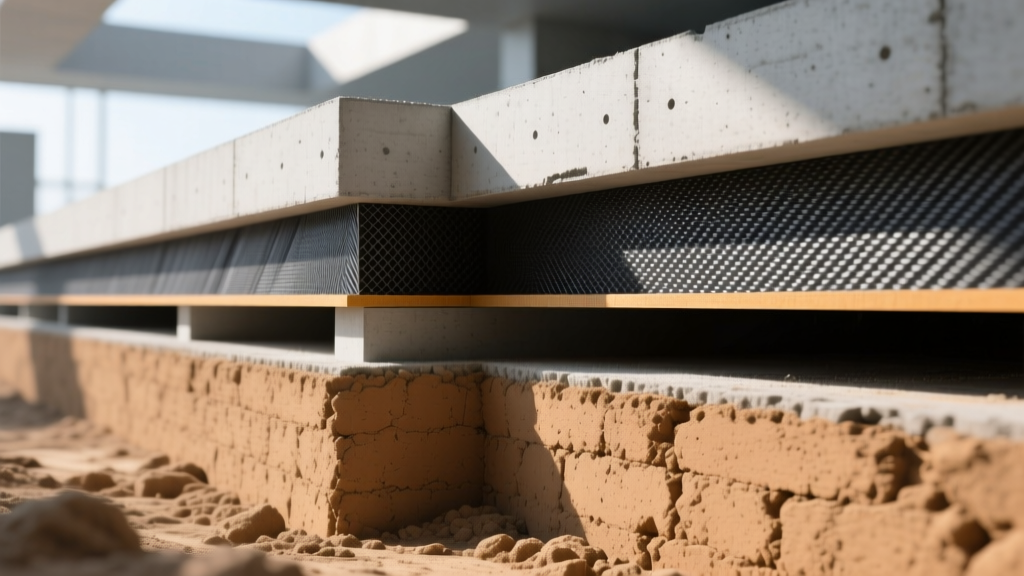
Specification Matrix: First-Gen vs. Grounded 2 Systems
| Specification | Standard Foundation (Gen 1) | Grounded 2 Systems (Gen 2) |
|---|---|---|
| Electrical Resistivity | 15,000+ Ω·cm | 300 - 500 Ω·cm |
| Primary Reinforcement | Epoxy-Coated Steel Rebar | GFRP / Carbon-Fiber Rebar |
| Moisture Management | Passive Polyethylene (6-mil) | Active Capillary-Break Geotextile |
| Grounding Electrode | Driven Copper Rods / Ufer | Integrated Slab Mass |
| Fault Current Capacity | Moderate (Prone to Thermal Spalling) | High (Distributed Dissipation) |
2026 Industry Trends Driving the Grounded 2 Shift
The adoption of grounded 2 building materials is not merely a theoretical exercise; it is being forced by specific commercial demands emerging in 2026.
- EV Fleet Depot Expansion: Commercial charging islands pulling 350kW+ per stall generate massive harmonic distortion and fault risks. The National Fire Protection Association (NFPA) continually updates NEC guidelines to address these loads, making low-impedance slab grounding a code necessity in many jurisdictions.
- Smart Grid Edge Nodes: Buildings acting as bi-directional power nodes require ultra-stable grounding to protect sensitive inverters from ground-potential rise (GPR) during lightning strikes or grid switching events.
- Earth-Coupled Thermal Mass: Aligning with U.S. Department of Energy guidelines for earth-sheltered and passive designs, Grounded 2 slabs utilize the surrounding earth for thermal regulation while simultaneously serving as the facility's electrical ground, eliminating the need for trenching separate grounding loops.
Never tie standard copper grounding wires directly to the carbon-fiber rebar in a Grounded 2 system without a bimetallic lug or dielectric union. The galvanic potential difference between copper and carbon in the presence of alkaline concrete pore water will cause rapid anodic corrosion of the copper wire. Field failures show this can sever your primary fault path within 18 to 24 months. Always use exothermic welding with a specialized dielectric separator or transition to aluminum-copper clad transition lugs.
Cost Analysis and Procurement Realities
Transitioning to grounded 2 building materials requires a shift in how general contractors procure and batch concrete. You cannot order CFRCC from standard big-box suppliers; it requires precise batch-plant protocols.
Material and Labor Premiums
Adding carbon microfibers and sourcing Glass Fiber Reinforced Polymer (GFRP) rebar adds approximately $3.50 to $5.20 per cubic foot over a standard 4,000 PSI mix with #5 epoxy rebar. For a 10,000 square foot commercial slab (6 inches thick), this translates to an upfront material premium of $11,000 to $16,500.
The ROI Offset
Despite the higher material cost, Grounded 2 systems frequently yield a net savings on large-scale projects. By utilizing the slab as the primary grounding electrode, contractors eliminate the need for extensive copper grounding grids, deep-driven ground rods, and the associated trenching labor. On a recent 50,000 sq. ft. logistics hub project, the elimination of the traditional copper grid saved $34,000 in material and 120 labor hours, resulting in a net project savings of $18,000 while achieving a 40% lower overall ground impedance.
Batching Protocol Specifics
To prevent the carbon fibers from clumping (which creates weak structural voids), the fibers must be introduced during the final 3 minutes of mixing at the batch plant, maintaining a drum speed of exactly 150 RPM. Slump tests should be monitored closely, as the microfibers can reduce workability; a polycarboxylate ether (PCE) superplasticizer is typically required to maintain a 4-inch to 5-inch slump without adding excess water.
Code Compliance and Testing Standards
Specifying grounded 2 building materials requires strict adherence to overlapping structural and electrical codes. Engineers must specify testing for both compressive strength and electrical stability.
While ASTM C1202 (Rapid Chloride Permeability) is traditionally used to measure concrete durability, it serves as an excellent proxy test for the electrical resistivity of CFRCC. For the grounding aspect, the system must be modeled and tested in accordance with IEEE Std 80 (Guide for Safety in AC Substation Grounding) to ensure the step-and-touch potentials remain within safe human limits during a worst-case fault scenario. Soil resistivity testing (Wenner four-pin method) must be conducted prior to the pour to calibrate the carbon-fiber dosage to the specific site's earth conditions.
Written by
Elena RodriguezElena Rodriguez is a civil engineer and technical writer specializing in concrete technology, masonry systems, and ASTM/ACI compliance. She earned her B.S. in Civil Engineering from Texas A&M University and spent a decade at a materials testing laboratory, performing over 2,000 concrete compressive strength tests and masonry prism evaluations. Elena is an ACI-certified Field Testing Technician (Grade I) and a member of ASTM Committee C12 on Natural Building Stone. She currently consults on forensic engineering cases involving concrete failures and moisture intrusion. Based in San Antonio, TX, Elena is a proud member of the Society of Women Engineers (SWE) and coaches her daughter's FIRST Robotics team.
More from Elena Rodriguez
View all
Walls & Panels
Cost Analysis: Light Gauge Steel Framing Advantages and Disadvantages
Evaluate light gauge steel framing advantages and disadvantages through a strict cost analysis lens, comparing material, labor, and lifecycle expenses.
Aug 4, 2026

Walls & Panels
Gypsum Board Types: Exact Specifications, Thickness & Dimensions
Compare standard, Type X, and moisture-resistant gypsum board types. Get exact specifications, thicknesses, dimensions, and ASTM standards for your project.
Aug 4, 2026

Fire Resistance
Best Fire-Resistant Outdoor Decking Materials: 2026 Buyer Guide
Discover the best fire-resistant outdoor decking materials for 2026. Compare Class A PVC, aluminum, and hardwood options for WUI compliance and safety.
Aug 4, 2026