Marketing Strategies for Building Materials: 2026 Application Guide
Discover actionable marketing strategies for building materials in 2026. Learn to target architects and contractors with BIM, technical SEO, and ABM.
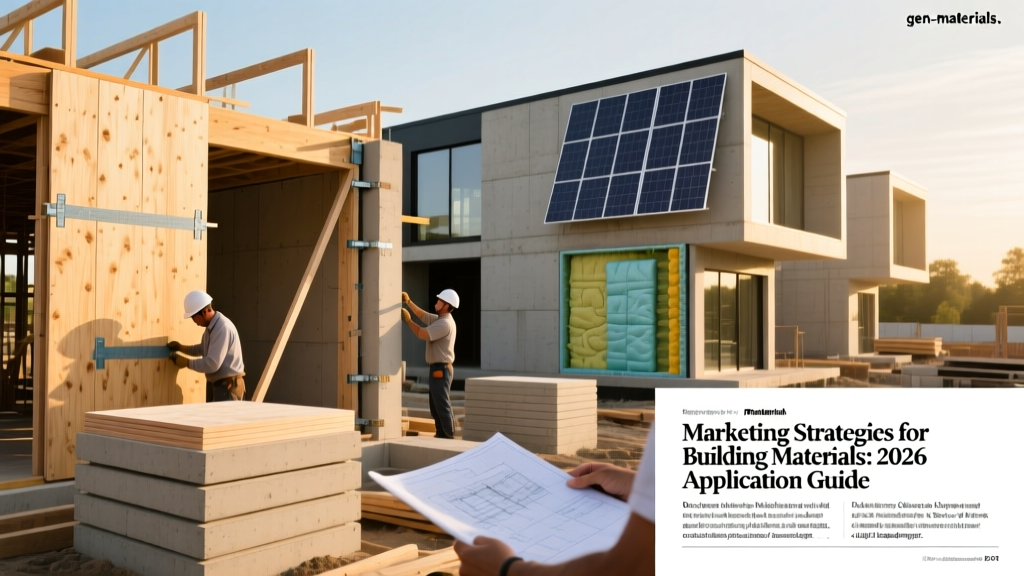
Marketing building materials requires navigating a notoriously complex B2B ecosystem. Unlike standard SaaS or consumer goods, the construction materials sector involves elongated sales cycles (often 12 to 24 months), stringent regulatory compliance, and a fragmented buyer journey. A single product specification might require buy-in from an architect, a structural engineer, a general contractor, and a facility owner. To succeed in 2026, building material manufacturers and distributors must abandon generic lead-generation tactics and adopt highly segmented, technically rigorous marketing frameworks.
The Dual-Audience Matrix: Specifiers vs. Builders
The most common failure in construction material marketing is treating the "buyer" as a monolith. Your messaging must bifurcate to address the distinct motivations of Specifiers (Architects/Engineers) and Builders (General Contractors/Subcontractors). According to industry data from the Dodge Construction Network, projects that utilize advanced digital specifications and BIM integration experience up to 30% fewer RFIs (Requests for Information) during the construction phase, a metric that heavily influences contractor material preferences.
| Audience Segment | Primary Motivation | Key Content Format | Buying Cycle Stage |
|---|---|---|---|
| Architects & Designers | Aesthetics, compliance, LEED/WELL certification, design intent | BIM Objects, CAD details, MasterFormat specs, AIA CES courses | Early Design & Schematic (Months 1-6) |
| Structural/MEP Engineers | Load capacities, thermal performance, ASTM/ANSI testing data | EPDs (Environmental Product Declarations), structural span tables | Design Development (Months 4-9) |
| General Contractors | Procurement speed, installed cost, labor availability, supply chain reliability | Installation time-lapses, total cost of ownership (TCO) calculators | Bidding & Procurement (Months 8-14) |
| Facility Owners | Lifecycle maintenance, warranty terms, operational efficiency | Case studies, lifecycle cost analysis, maintenance manuals | Post-Occupancy & Retrofit (Ongoing) |
Leveraging BIM and Technical Specifications for Inbound Leads
In modern commercial construction, if your product is not in the Building Information Model (BIM), it effectively does not exist. Architects rely on Revit families and ArchiCAD objects to populate their models. Creating high-quality, parametric BIM objects is no longer optional; it is a foundational marketing strategy for building materials.
Step-by-Step BIM Integration Strategy
- Audit Existing Assets: Evaluate your current digital library. Ensure all 3D models are parametric (allowing users to adjust dimensions and materials dynamically) rather than static "dumb" blocks.
- Optimize File Size: A common grievance among architects is "heavy" Revit families that crash their models. Keep individual family files under 1.5 MB. Use symbolic lines for 2D representations instead of 3D geometry where possible.
- Embed Metadata (COBie): Embed critical data directly into the BIM object, including MasterFormat numbers, OmniClass classifications, and URL links to your technical data sheets. This ensures your brand remains attached to the product even if the model is stripped of visual textures.
- Distribute via Aggregators: Host your libraries on platforms like BIMobject or NBS National BIM Library, but always gate the highest-value, project-specific configurations behind a lead-capture form on your own domain.
Cost Expectation: Developing a high-quality, parametric Revit family with embedded COBie data typically costs between $1,500 and $3,500 per product line when outsourced to specialized BIM content agencies in 2026.
Account-Based Marketing (ABM) for Top-Tier Contractors
For high-value building materials (e.g., specialized curtain wall systems, mass timber framing, or advanced HVAC chillers), mass marketing is a waste of capital. Instead, deploy Account-Based Marketing (ABM) to target the top 100 ENR (Engineering News-Record) ranked general contractors.
ABM flips the traditional marketing funnel. Instead of casting a wide net, you identify specific accounts (e.g., Turner Construction, Skanska, Clark Construction), map their key decision-makers (VDC Managers, Chief Estimators, Procurement Directors), and deliver hyper-personalized campaigns.
- Intent Data Activation: Utilize platforms like Bombora or 6sense to monitor when target accounts are actively researching topics related to your materials (e.g., a spike in searches for "cross-laminated timber fire resistance").
- Custom Landing Pages: Build un-gated, personalized landing pages for specific accounts. Example: "Mass Timber Supply Chain Reliability for [Target Company Name] West Coast Projects."
- Direct Mail "Lumpy" Packages: Send physical, high-end material sample boxes with integrated QR codes linking to a custom ROI calculator specifically calibrated to the target contractor's typical project typology.
Field Marketing and the AIA CES Ecosystem
Digital strategies must be anchored by in-person credibility. The American Institute of Architects (AIA) Continuing Education System (CES) remains one of the most powerful lead-generation tools for building material manufacturers. Architects are required to complete annual Health, Safety, and Welfare (HSW) learning hours. By becoming an AIA CES Registered Provider, you gain authorized access to architectural firms to present lunch-and-learn sessions.
Application Tactics for AIA CES:
- Do not pitch your product. The AIA strictly prohibits overt sales pitches during CES courses. Instead, teach a broader technical concept (e.g., "Managing Moisture Intrusion in Rainscreen Assemblies") and use your product as the case study example.
- Invest in course development. A professionally designed, AIA-approved HSW course costs roughly $6,000 to $12,000 to research, write, and register. However, a single national roadshow presenting this course to 20 top-tier firms can yield millions in specified pipeline revenue.
- Track specifications post-presentation. Integrate your CRM with construction project databases (like ConstructConnect or Dodge) to monitor if the firms you educated actually specify your materials in their upcoming projects.

2026 Budget Allocation Model for Material Manufacturers
How should a mid-sized building material manufacturer allocate a $150,000 quarterly marketing budget? The following framework prioritizes high-intent technical enablement over broad brand awareness.
| Channel / Initiative | Allocation (%) | Budget ($) | Primary KPI |
|---|---|---|---|
| Technical Content & BIM Asset Creation | 30% | $45,000 | BIM downloads, Spec-inclusion rate |
| Account-Based Marketing (Top 50 GCs) | 25% | $37,500 | Account engagement score, Pipeline velocity |
| Field Marketing & AIA CES Roadshows | 20% | $30,000 | Architectural firm presentations, CE credits issued |
| Technical SEO & High-Intent PPC | 15% | $22,500 | Cost per Qualified Lead (CPQL), Organic spec traffic |
| Trade Shows (Regional & Niche) | 10% | $15,000 | Booth-to-meeting conversion, Post-show pipeline |
Frequently Asked Questions
How long is the typical sales cycle for commercial building materials?
The sales cycle from initial architectural specification to final procurement by the general contractor typically ranges from 12 to 24 months for commercial projects. Marketing attribution models must be adjusted to multi-touch, time-decay models rather than last-click attribution, which heavily undervalues early-stage technical content and BIM downloads.
Should we gate our technical data sheets and CAD details?
No. In 2026, gating foundational technical data (TDS, SDS, basic CAD details) creates friction and drives specifiers to competitor websites that offer open access. Gate only high-value, proprietary assets such as custom BIM configurators, proprietary design software plugins, or in-depth lifecycle cost analysis tools.
What is the most effective trade show strategy for material suppliers?
Avoid massive, generalist expos where you compete for attention with thousands of vendors. Instead, sponsor niche, application-specific conferences (e.g., a specialized building envelope symposium or a mass timber engineering summit). Host private, invite-only dinners for the lead architects and VDC managers attending the event, focusing on peer-to-peer networking rather than booth demonstrations.
Written by
Priya KapoorPriya Kapoor is a real estate market analyst and construction economics researcher with expertise in housing affordability, development feasibility, and infrastructure investment. She holds a Master of Regional Planning from Cornell University and previously worked as a senior analyst at CBRE's Investment Properties group, where she modeled returns for $4B in mixed-use development pipelines. Priya now runs an independent research practice advising developers, municipalities, and REITs on construction cost forecasting and market timing. She publishes the quarterly "BuildMat Market Pulse" report tracking material price indices across 12 commodity categories. Based in Austin, TX, Priya serves on the board of Habitat for Humanity Austin and is a marathon runner.
More from Priya Kapoor
View all
Construction Cost
Cost to Build a 1600 Sq Ft Home in 2026: Full Breakdown
Accurate 2026 cost to build a 1600 sq ft home—material, labor, and regional pricing breakdowns included. Plan your budget with real-time estimates.
Aug 11, 2026

Wood & Lumber
Name the Types of Wood for Pressure Treatment and Preservation
Learn how to name the types of wood best suited for pressure treatment. Compare species treatability, chemical retention levels, and 2026 preservation costs.
Aug 4, 2026

Stone & Masonry
Stone Veneer Suppliers Lindenhurst: 2026 Cost Analysis
Analyze 2026 stone veneer costs in Lindenhurst, NY. Compare local supplier pricing, delivery fees, and Suffolk County installation labor rates.
Aug 4, 2026