Building Materials News October 2025: 2026 Selection Guide
Translate building materials news October 2025 into actionable 2026 selection strategies for Type IL concrete, mass timber, and steel framing.
The October 2025 Market Shifts: What They Mean for Material Selection
The building materials news October 2025 cycle was defined by three distinct market realities: the final stabilization of Portland Limestone Cement (Type IL) pricing, the aggressive expansion of North American Cross-Laminated Timber (CLT) manufacturing, and the implementation of new tariff structures on imported cold-formed steel. For general contractors, architects, and procurement managers, these headlines are not just macroeconomic trivia—they dictate the exact specifications you should be writing into your 2026 project bids.
Relying on pre-2025 material schedules will result in either overpaying for legacy products or missing out on newly stabilized supply chains. This selection guide translates the critical October 2025 market developments into a concrete decision framework for your upcoming builds.
Material Selection Matrix: Post-October 2025 Pricing & Performance
Before diving into specific product specifications, review this decision matrix based on the October 2025 pricing and supply chain data. This framework helps you determine which material categories warrant immediate substitution in your current design sets.
| Material Category | Oct 2025 Market Shift | 2026 Selection Verdict | Optimal Application |
|---|---|---|---|
| Type IL Concrete | Reached price parity with Type I/II Portland cement. | MANDATORY SWITCH | All flatwork, foundations, and non-prestressed structural elements. |
| Cross-Laminated Timber (CLT) | Lead times dropped from 14 weeks to 6 weeks due to new plant capacities. | HIGHLY RECOMMENDED | Mid-rise commercial, multi-family residential (Type IV construction). |
| Cold-Formed Steel (CFS) | Import tariffs increased baseline costs by 8-12%. | VALUE ENGINEER | Limit to interior non-load-bearing partitions; seek domestic alternatives for structural studs. |
| Polyiso Insulation | Raw material (MDI) supply normalized; prices dropped 4%. | MAINTAIN SPEC | Continuous exterior insulation (ci) and commercial roofing assemblies. |
Deep Dive 1: Specifying Portland Limestone Cement (Type IL)
The most actionable takeaway from the building materials news October 2025 cycle was the widespread adoption of Type IL cement. Historically, the 5-8% price premium deterred budget-sensitive projects. With that premium eliminated, specifying Type I/II is now an outdated practice that unnecessarily inflates a project's embodied carbon footprint without offering financial savings.
Technical Selection Criteria for Type IL
When updating your master specifications (e.g., MasterFormat Division 03), ensure your engineering team adheres to the following parameters to avoid field failures:
- Standard Compliance: Must meet ASTM C595 or AASHTO M 240. Ensure the mix design specifies a limestone content between 10% and 15%.
- Carbon Reduction: Expect a verified 10% reduction in embodied CO2 compared to traditional OPC (Ordinary Portland Cement), crucial for meeting 2026 IECC and local green building mandates.
- Water-to-Cement Ratio: Maintain a strict w/cm ratio of 0.45 or lower for exterior flatwork to mitigate the slightly higher permeability inherent to limestone-blended cements.
Type IL concrete exhibits a marginally slower early strength gain in temperatures below 40°F (4°C). If pouring in late autumn or winter, specify a Type IL (MH) or require the batch plant to include a non-chloride accelerating admixture (ASTM C494 Type E) to maintain your form-stripping schedules.
Deep Dive 2: Mass Timber Procurement and Moisture Management
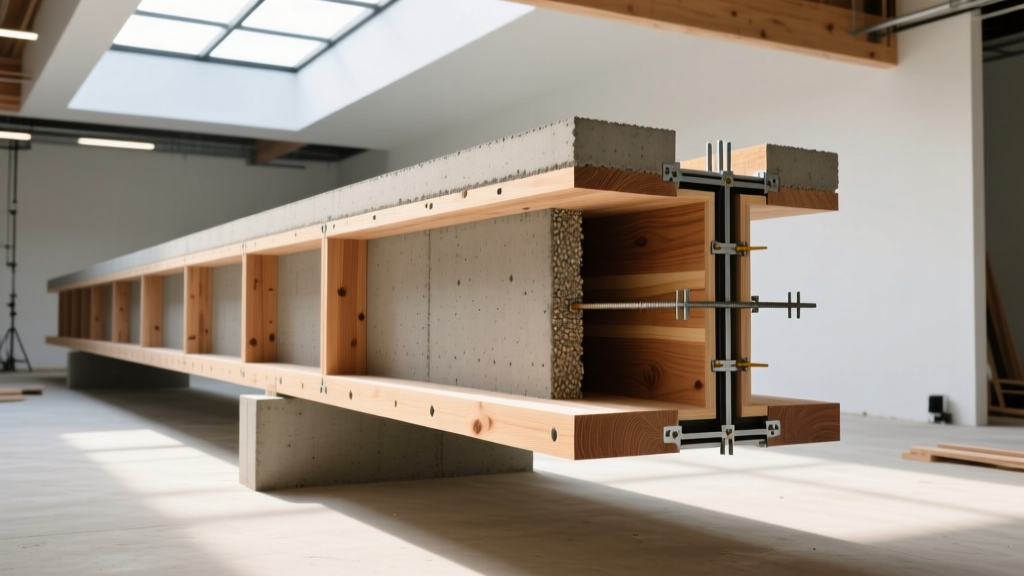
October 2025 saw the online commissioning of two major CLT manufacturing facilities in the North American South and Midwest. This broke the regional monopolies that previously caused massive freight surcharges. With lead times now averaging 6 to 8 weeks, mass timber is a viable selection for fast-track 2026 commercial projects.
The Procurement Checklist for CLT and Glulam
Do not simply specify "Mass Timber." Your bid documents must include exact moisture and grading tolerances to prevent the warping and checking that plagues poorly managed timber sites.
- Grade Stamp Verification: Require PRG 320 (Standard for Performance-Rated Cross-Laminated Timber) certification. For floor diaphragms, specify V3 or E2 grades to ensure adequate shear capacity.
- Moisture Content (MC) Caps: Mandate a maximum MC of 12% at the time of factory shipment. Require the supplier to apply a breathable, vapor-permeable surface sealant (e.g., Siga Majrex or Pro Clima Intello) prior to shipping to protect against transit rain.
- Hardware Selection: Pair CLT panels with specialized self-tapping timber screws (e.g., Rothoblaas or Simpson Strong-Tie SDS series). Standard lag bolts will cause splitting in the edge-grain of the lamellas.
Pros and Cons of Switching to CLT for Mid-Rise Cores
Advantages
- Reduces structural dead load by up to 25%, allowing for smaller foundation footings.
- Eliminates wet trades on upper floors, accelerating the dry-in schedule by 3-4 weeks.
- Prefabricated CNC precision reduces MEP coordination clashes in the field.
Challenges & Edge Cases
- Acoustic transmission (IIC/STC) requires decoupling layers; bare CLT fails multifamily codes.
- Shrinkage perpendicular to grain requires specialized slip-tracks for interior steel stud partitions.
- Firestopping penetrations requires specific UL-listed intumescent collars designed for wood, not concrete.
Navigating the Cold-Formed Steel (CFS) Tariff Environment
For decades, light-gauge steel framing (33 ksi and 50 ksi) was the default, cost-neutral choice for commercial interiors and exterior backup walls (EBW). The October 2025 trade adjustments altered this calculus. With imported coil steel facing steeper duties, domestic CFS prices have structurally reset at a higher baseline.
Value Engineering Strategies for Steel Framing
Rather than absorbing the 8-12% cost increase, proactive procurement teams are utilizing the following strategies:
- Optimize Stud Gauge and Spacing: Transition from 16" on-center 20-gauge studs to 24" on-center 18-gauge studs where wind-load engineering permits. This reduces the total linear footage of steel required while maintaining structural integrity.
- Hybridize Interior Partitions: For non-load-bearing demising walls that do not require the sheer impact resistance of steel, substitute with structural composite lumber (SCL) or heavy-gauge aluminum framing, which bypassed the October 2025 tariff adjustments.
- Direct-to-Mill Purchasing: For projects exceeding 50,000 square feet of wall area, bypass regional distributors. Engage directly with domestic roll-forming mills (e.g., ClarkDietrich or MarinoWARE) utilizing the Cold-Formed Steel Engineers Association load tables to validate custom coil orders.
Strategic Sourcing: Locking in Q1 2026 Pricing
The ultimate lesson from the building materials news October 2025 cycle is that passive procurement is a liability. To protect your project margins, implement the following sourcing protocols immediately:
"The contractors who win bids in 2026 aren't just estimating based on today's lumber and steel prices; they are underwriting the carbon-compliance premiums and leveraging the newly stabilized mass timber supply chains that the market ignored until late 2025." — Industry Procurement Analysis, Construction Dive
The 30-60-90 Day Procurement Plan
| Timeline | Action Item | Target Material Focus |
|---|---|---|
| 30 Days Out | Finalize mix designs with local batch plants; secure Type IL commitments. | Concrete, Masonry Grout |
| 60 Days Out | Release CLT/Glulam shop drawings for CNC milling; lock in freight rates. | Mass Timber, Structural Steel |
| 90 Days Out | Execute bulk-buy contracts for Polyiso and gypsum; warehouse locally. | Insulation, Drywall, CFS |

Frequently Asked Questions
Can Type IL concrete be used in post-tensioned slab-on-grade applications?
Yes, but with strict caveats. Type IL achieves its 28-day compressive strength equivalently to Type I, but the early strength gain (3-day and 7-day) can be 10-15% lower. In post-tensioned slabs, the stressing of tendons is usually dictated by concrete strength (e.g., reaching 3,000 psi). You must coordinate with the structural engineer to either adjust the stressing timeline or utilize early-strength accelerating admixtures to prevent schedule delays.
How do the October 2025 steel tariffs affect metal decking and joists?
Open-web steel joists and composite metal decking, heavily reliant on hot-rolled coil, saw proportional price increases. However, because these items are typically bundled into the broader structural steel package, general contractors should demand line-item transparency from steel fabricators to separate raw material escalation from fabrication markup, allowing for accurate tracking against your contingency budget.
Is CLT viable for high-moisture environments like natatoriums?
Generally, no. Even with surface sealants, the constant high humidity and chlorine exposure in natatoriums present severe long-term risks for moisture entrapment and fastener corrosion within the CLT lamellas. For these specific environments, stick to traditional cast-in-place concrete or heavily galvanized structural steel with specialized anti-corrosion coatings.
Written by
Priya KapoorPriya Kapoor is a real estate market analyst and construction economics researcher with expertise in housing affordability, development feasibility, and infrastructure investment. She holds a Master of Regional Planning from Cornell University and previously worked as a senior analyst at CBRE's Investment Properties group, where she modeled returns for $4B in mixed-use development pipelines. Priya now runs an independent research practice advising developers, municipalities, and REITs on construction cost forecasting and market timing. She publishes the quarterly "BuildMat Market Pulse" report tracking material price indices across 12 commodity categories. Based in Austin, TX, Priya serves on the board of Habitat for Humanity Austin and is a marathon runner.
More from Priya Kapoor
View all
Construction Cost
Cost to Build a 1600 Sq Ft Home in 2026: Full Breakdown
Accurate 2026 cost to build a 1600 sq ft home—material, labor, and regional pricing breakdowns included. Plan your budget with real-time estimates.
Aug 11, 2026

Wood & Lumber
Name the Types of Wood for Pressure Treatment and Preservation
Learn how to name the types of wood best suited for pressure treatment. Compare species treatability, chemical retention levels, and 2026 preservation costs.
Aug 4, 2026

Stone & Masonry
Stone Veneer Suppliers Lindenhurst: 2026 Cost Analysis
Analyze 2026 stone veneer costs in Lindenhurst, NY. Compare local supplier pricing, delivery fees, and Suffolk County installation labor rates.
Aug 4, 2026