Resource Building Materials Stanton: 2026 Sourcing Guide
Comprehensive 2026 guide to resource building materials in Stanton. Explore local pricing, Title 24 compliance, ADU supply chains, and staging logistics.

Navigating the Stanton Building Material Supply Chain
Sourcing construction supplies in Orange County requires a strategic approach to local logistics, regional building codes, and fluctuating wholesale markets. When contractors and developers seek to resource building materials in Stanton, they are operating in a unique micro-market characterized by high-density infill projects, a booming Accessory Dwelling Unit (ADU) sector, and strict California environmental mandates. In 2026, the local supply chain has stabilized compared to the early 2020s, but procurement requires precise timing and vendor diversification to maintain project margins.
Stanton's geographic position—bordering Anaheim, Garden Grove, and Westminster—means that material staging and delivery routing must account for heavy commercial traffic along Beach Boulevard and Katella Avenue. Furthermore, the local soil composition, which features pockets of expansive clay, dictates specific foundation material requirements that differ from coastal Orange County builds. This guide provides a comprehensive framework for procuring, pricing, and managing building materials for residential and light commercial projects in the Stanton area.
For Stanton ADU projects under 1,200 sq ft, bypass traditional stick-building procurement. Sourcing pre-cut structural framing kits from regional fabricators in Anaheim reduces on-site waste by 18% and cuts framing labor time by up to 30%, a critical margin-saver given local labor rates averaging $85-$110 per hour in 2026.
2026 Core Material Pricing & Lead Time Matrix
Accurate budgeting requires up-to-date localized pricing. The following matrix reflects Q1 2026 wholesale and contractor-tier pricing for high-volume materials sourced from regional distributors servicing the Stanton zip codes (90680). Prices assume standard contractor discount tiers (typically 12-18% off retail) and do not include local delivery surcharges.
| Material Category | Specification / Grade | 2026 Unit Cost | Avg. Lead Time |
|---|---|---|---|
| Framing Lumber | DF-L #2 2x4x8 (Kiln-Dried) | $4.85 / board | 3-5 Days |
| Engineered Lumber | LVL 1-3/4" x 11-7/8" (2800Fb) | $72.00 / linear ft | 7-10 Days |
| Ready-Mix Concrete | 4000 PSI w/ Fiber Mesh (Bulk) | $165 / cubic yard | 48 Hours |
| Drywall | 5/8" Type X Firecode (USG) | $17.25 / 4x8 sheet | 2-4 Days |
| Roofing Shingles | GAF Timberline HDZ (Cool Roof) | $145 / square | 5-7 Days |
Foundation Materials for Expansive Soils
Stanton's inland soil profiles frequently exhibit moderate to high expansion indices. Standard 3000 PSI concrete is insufficient for structural slabs in these zones. Procurement teams must spec 4000 PSI mixes with a minimum slump of 4 inches, supplemented by synthetic macro-fibers (such as W.R. Meadows FIBERMESH) to mitigate micro-cracking. For post-tension slab foundations, sourcing 270ksi low-relaxation PT tendons requires a 14-day lead time from specialized suppliers in Santa Fe Springs or Anaheim, as local generalist yards rarely stock them.
Strategic Sourcing: Big Box vs. Specialized Local Yards
A common mistake among out-of-area developers is relying entirely on big-box retailers located along Beach Blvd for structural and finish materials. While convenient for emergency hardware and small-volume consumables, big-box stores lack the commercial logistics required for mid-scale residential builds.
Big Box Retailers (e.g., Home Depot, Lowe's)
- Pros: Immediate availability of finish hardware, standard dimensional lumber, and basic PEX plumbing.
- Cons: No boom-truck delivery for roof loads; limited engineered lumber stock; retail pricing destroys framing budgets.
- Best For: Punch-list items, ADU interior finishes, emergency fasteners.
Specialized OC Lumber & Roofing Yards
- Pros: Articulating boom trucks for precise staging; dedicated commercial estimators; direct mill allocation.
- Cons: Requires opening commercial credit accounts; minimum delivery fees ($150-$250) apply.
- Best For: Structural framing, roof trusses, exterior cladding, bulk insulation.
Logistics, Delivery, and Job Site Staging
Stanton's urban footprint is largely built out, meaning new construction primarily involves infill lots, teardowns, and ADU backyard builds. These sites present severe staging constraints that directly impact material procurement strategies.
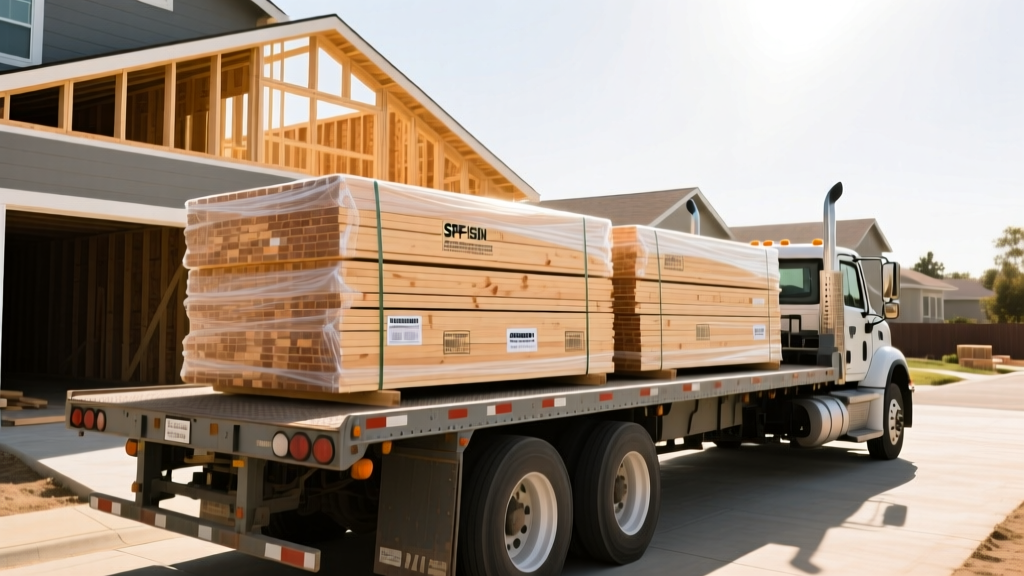
- Crane-Assisted Roof Loads: For backyard ADUs where driveway access is blocked by existing structures, standard boom trucks cannot reach the pad. You must order roof trusses and LVL beams bundled specifically for crane lifts, and rent a mobile crane (typically a 30-ton all-terrain crane costing $180-$220/hour with a 4-hour minimum in Orange County).
- Short-Load Concrete Fees: Batch plants servicing Stanton (often located in neighboring Anaheim or Irvine) impose severe short-load fees for orders under 7 cubic yards. For small footings or flatwork, switch to volumetric concrete mixers or high-yield bulk bags (like Quikrete 5000 bulk sacks) to avoid $150+ penalties.
- Just-In-Time (JIT) Drywall Delivery: Storing drywall on infill sites risks moisture damage and theft. Coordinate with suppliers for JIT delivery, ensuring the hanging crew is scheduled to begin within 24 hours of the boom-truck dropping the pallets directly onto the second-floor deck.
"In dense Orange County markets like Stanton, the cost of material procurement is only half the equation. The other half is the cost of moving that material from the curb to the point of installation. If you aren't factoring in crane rentals, forklift rough-terrain surcharges, and double-handling labor, your material budget is fundamentally flawed."
— Regional Logistics Director, Southern California Building Supply Association
California Code Compliance: Title 24 & CARB2
Procurement in Stanton is strictly governed by state-level environmental and energy codes. Failing to source compliant materials will result in failed inspections and halted projects.
Title 24 Energy Standards
California's Title 24 energy code mandates strict thermal performance. When sourcing insulation, standard R-13 fiberglass batts are no longer sufficient for 2x4 exterior walls in Climate Zone 10 (which encompasses Stanton). Procurement must specify R-15 high-density batts or 2x6 framing with R-19 batts. Furthermore, roofing materials must meet Cool Roof requirements; you must source shingles with a minimum Solar Reflectance Index (SRI) of 16 for steep-slope roofs. The California Energy Commission's Title 24 portal provides the exact compliance matrices required for local plan checks.
Indoor Air Quality & Formaldehyde
All composite wood products—including plywood subfloors, MDF baseboards, and particleboard cabinetry—must comply with CARB2 (California Air Resources Board Phase 2) formaldehyde emission limits, which are now harmonized with the federal EPA TSCA Title VI standards. When ordering millwork or cabinet boxes from out-of-state fabricators, ensure the purchase order explicitly requires TSCA Title VI / CARB2 compliant stock, as importing non-compliant materials across state lines carries severe liability.
Do not purchase off-the-shelf vinyl windows from national chains without verifying the NFRC label. Stanton's climate zone requires a maximum U-Factor of 0.30 and a maximum Solar Heat Gain Coefficient (SHGC) of 0.23 for west-facing glazing. Standard dual-pane clear glass will fail inspection.
Frequently Asked Questions (FAQ)
What are the standard delivery fees for lumber yards servicing Stanton?
Most regional yards in North Orange County charge a flat boom-truck delivery fee ranging from $175 to $250 for loads under 15,000 lbs. Deliveries requiring specialized equipment, such as a Moffett forklift for off-road unloading on dirt lots, will incur an additional $125 surcharge.
How far in advance should I order custom roof trusses for a Stanton build?
In 2026, engineered roof truss fabricators in the greater Southern California region require a minimum lead time of 3 to 4 weeks from the moment the sealed engineering drawings are approved. For complex hip roofs or attic trusses, expect a 5-week lead time.
Where can I dispose of construction debris from Stanton infill projects?
Stanton enforces strict Construction and Demolition (C&D) debris recycling ordinances. You must source roll-off bins from licensed haulers who provide diversion reports proving at least 65% of the waste was recycled. Local transfer stations in Anaheim and Irvine accept mixed C&D loads for approximately $85 to $110 per ton, significantly cheaper than mixed-municipal landfill rates.
Final Procurement Strategy
Successfully managing resource building materials in Stanton hinges on blending localized supply chain knowledge with strict adherence to California's evolving building codes. By establishing commercial accounts with specialized regional yards, engineering your material specs to combat local expansive soils, and staging deliveries to accommodate tight infill lots, contractors can protect their margins and maintain aggressive build schedules. According to recent data on builder margins from the National Association of Home Builders, optimized material procurement and logistics management can reduce overall project hard costs by up to 6%, a vital advantage in Southern California's competitive construction market.
Written by
Priya KapoorPriya Kapoor is a real estate market analyst and construction economics researcher with expertise in housing affordability, development feasibility, and infrastructure investment. She holds a Master of Regional Planning from Cornell University and previously worked as a senior analyst at CBRE's Investment Properties group, where she modeled returns for $4B in mixed-use development pipelines. Priya now runs an independent research practice advising developers, municipalities, and REITs on construction cost forecasting and market timing. She publishes the quarterly "BuildMat Market Pulse" report tracking material price indices across 12 commodity categories. Based in Austin, TX, Priya serves on the board of Habitat for Humanity Austin and is a marathon runner.
More from Priya Kapoor
View all
Construction Cost
Cost to Build a 1600 Sq Ft Home in 2026: Full Breakdown
Accurate 2026 cost to build a 1600 sq ft home—material, labor, and regional pricing breakdowns included. Plan your budget with real-time estimates.
Aug 11, 2026

Wood & Lumber
Name the Types of Wood for Pressure Treatment and Preservation
Learn how to name the types of wood best suited for pressure treatment. Compare species treatability, chemical retention levels, and 2026 preservation costs.
Aug 4, 2026

Stone & Masonry
Stone Veneer Suppliers Lindenhurst: 2026 Cost Analysis
Analyze 2026 stone veneer costs in Lindenhurst, NY. Compare local supplier pricing, delivery fees, and Suffolk County installation labor rates.
Aug 4, 2026