Salem Building Materials in Salem, IL: Sourcing & Application Guide
Discover how to source and apply Salem building materials in Salem, IL. Expert guide on climate-specific selections, local codes, and installation steps.

Climate-Driven Material Selection for Marion County
Salem, Illinois, sits squarely in IECC Climate Zone 4A (Mixed-Humid), presenting a unique set of environmental stressors for building envelopes. When specifying Salem building materials in Salem, IL, contractors and architects must account for high summer humidity, sub-zero winter temperatures, and an average of 45 to 55 freeze-thaw cycles annually. Furthermore, Marion County lies on the periphery of Tornado Alley, necessitating strict adherence to wind-uplift and impact-resistance standards.
Selecting generic, big-box inventory without considering these regional variables leads to premature material failure. Efflorescence in masonry, asphalt shingle tearing during microbursts, and moisture trapping in wall cavities are the most common failure modes in Southern Illinois construction. This application guide details the exact material specifications, sourcing logistics, and installation protocols required for durable projects in the Salem area.
- IECC Climate Zone: 4A (Mixed-Humid)
- Basic Wind Speed (ASCE 7-22): 115 mph (Ultimate Design)
- Average Annual Freeze-Thaw Cycles: ~50
- Ground Snow Load: 20 psf
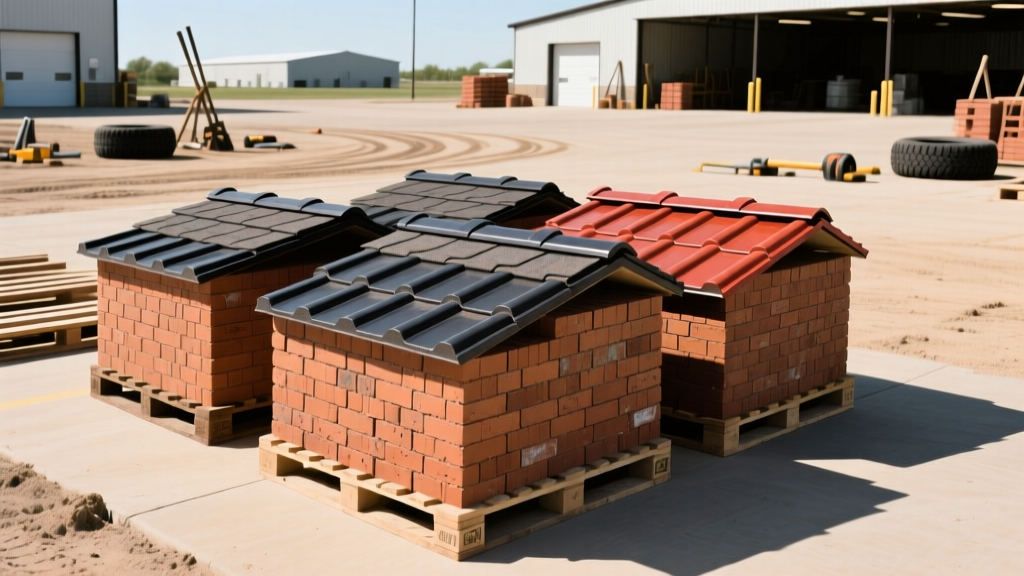
Material Application Matrix: What Works in Salem, IL
The following matrix outlines the minimum performance thresholds for exterior materials used in Salem residential and light commercial projects. Upgrading from baseline code minimums to the recommended specifications drastically reduces lifecycle maintenance costs.
| Material Category | Baseline Code Minimum | Recommended Salem Spec | Estimated 2026 Cost |
|---|---|---|---|
| Roofing Shingles | ASTM D3462 (Standard Fiberglass) | UL 2218 Class 4 Impact / ASTM D7158 Class H Wind | $190 - $260 / sq |
| Exterior Brick | ASTM C62 (Moderate Weathering) | ASTM C62 Severe Weathering (SW) / <12% Absorption | $550 - $750 / 1000 pcs |
| Wall Insulation | R-20 Cavity (2x4 framing) | R-20 + R-5ci (Continuous Exterior Rigid Foam) | $1.85 - $2.40 / sq ft |
| Housewrap | Standard Non-Woven Polyolefin | Drainable Mesh-Backed WRB (e.g., HydroGap) | $0.45 - $0.65 / sq ft |
For comprehensive guidance on thermal barriers in this specific region, refer to the Department of Energy Insulation Guidelines, which detail the necessity of continuous insulation (ci) to prevent thermal bridging and condensation in Zone 4A wall assemblies.
Sourcing Strategy: Securing Salem Building Materials in Salem, IL
Procuring specialized Salem building materials in Salem, IL requires a hybrid approach to supply chain management. While local lumber yards and hardware suppliers can fulfill framing, drywall, and basic trim requirements, high-performance exterior cladding and specialized structural components often require regional routing.
1. Leverage Regional Distribution Hubs
For bulk masonry, engineered lumber (LVL/I-Joists), and commercial roofing membranes, local Salem yards typically operate on a transfer basis from larger distribution centers in Mt. Vernon or Marion, IL. When placing orders for ASTM C62 Severe Weathering brick or Class 4 architectural shingles, request direct-drop shipping from the manufacturer's regional hub to the job site via US-50 or I-57 freight corridors. This eliminates double-handling fees and reduces lead times from 14 days to roughly 4 to 6 days.
2. Consolidate Specialty Orders
Freight minimums for specialized materials often exceed 15,000 lbs. If your project requires specific housewraps, rigid foam insulation, or specialized masonry ties, consolidate these orders through a single regional building envelope distributor rather than piecing them out. Many distributors serving the Marion County area offer tiered pricing, dropping freight surcharges entirely once the order volume crosses $8,500.
3. Verify Inventory Certifications Upon Delivery
Supply chain substitutions are a major risk in Midwestern construction. When the delivery truck arrives in Salem, immediately verify the mill certificates for masonry and the UL labels on roofing bundles. A supplier substituting Moderate Weathering (MW) brick for Severe Weathering (SW) brick will not be visually obvious on the pallet, but it will cause catastrophic spalling within three Illinois winters. For more on masonry durability standards, consult the Brick Industry Association Technical Notes on Freeze-Thaw Resistance.
Application Guide: Installing Freeze-Thaw Resistant Masonry
Specifying the correct brick is only half the battle; the application methodology dictates the wall's longevity in Salem's climate. Moisture trapped in the mortar joint is the primary catalyst for freeze-thaw spalling. Follow this strict protocol for masonry installation in Southern Illinois.
- Select Type S or Type N Mortar: Do not use high-compressive-strength Type M mortar for exterior veneer in Salem. Type M is too rigid and will not accommodate the thermal expansion and contraction of the brick, leading to micro-cracking that invites water ingress. Type S (ASTM C270) offers the ideal balance of compressive strength (1,800 psi) and flexural bond strength.
- Tool the Joints Correctly: Joints must be tooled to a concave or V-shape profile. This compresses the mortar against the brick edge, creating a dense, water-shedding surface. Crucial Timing: In Salem's high-summer humidity, tooling must occur when the mortar is 'thumbprint hard' (typically 45 to 90 minutes after laying). Tooling too early traps bleed water at the surface, weakening the paste.
- Implement a 2-Inch Air Cavity: Never lay brick directly against the weather-resistant barrier (WRB). Maintain a strict 2-inch air cavity between the back of the brick and the sheathing. This cavity allows hydrostatic pressure to equalize and provides a drainage plane for any moisture that penetrates the masonry.
- Install Weep Holes at 16-Inch Intervals: Use open-head joints or manufactured plastic weep vents at the base of the wall and above all lintels. Space them no more than 16 inches apart. Blockage of weep holes by mortar droppings (snots) is the most common masonry failure in the region; use a mortar-catching mesh inside the cavity to keep the drainage path clear.
Navigating Local Building Codes and Wind Loads
Salem building officials enforce the Illinois State Building Code, which incorporates ASCE 7-22 for structural wind design. Because Marion County is subject to severe convective storms and localized tornadic activity, the building envelope must be treated as a unified structural system.
"In regions subject to high-wind events, the continuous load path from the roof diaphragm to the foundation is the most critical factor in preventing catastrophic structural failure. Component and cladding elements must be rated for localized uplift pressures that significantly exceed the basic wind speed."
— Adapted from FEMA Building Science Publications regarding high-wind retrofit and construction.
To meet local inspection requirements, ensure that your roof-to-wall connections utilize structural hurricane ties (e.g., Simpson Strong-Tie H2.5A or equivalent) rather than standard toe-nailing. For roof decking, specify 5/8-inch CDX plywood or OSB with ring-shank nails (8d common) spaced at 6 inches on center at the edges and 12 inches in the field. This nailing pattern is mandatory for achieving the necessary uplift resistance to pass final framing inspections in Salem.
Final Quality Assurance
Before scheduling the final municipal inspection, perform a localized water test on all window penetrations and masonry transitions. Using a garden hose, apply water to the head flashing of windows for 15 minutes. In Climate Zone 4A, the transition between window flanges and the drainable housewrap is the most frequent source of interior moisture damage. Verifying these details ensures your application of Salem building materials will withstand the region's demanding environmental profile for decades.
Written by
Priya KapoorPriya Kapoor is a real estate market analyst and construction economics researcher with expertise in housing affordability, development feasibility, and infrastructure investment. She holds a Master of Regional Planning from Cornell University and previously worked as a senior analyst at CBRE's Investment Properties group, where she modeled returns for $4B in mixed-use development pipelines. Priya now runs an independent research practice advising developers, municipalities, and REITs on construction cost forecasting and market timing. She publishes the quarterly "BuildMat Market Pulse" report tracking material price indices across 12 commodity categories. Based in Austin, TX, Priya serves on the board of Habitat for Humanity Austin and is a marathon runner.
More from Priya Kapoor
View all
Construction Cost
Cost to Build a 1600 Sq Ft Home in 2026: Full Breakdown
Accurate 2026 cost to build a 1600 sq ft home—material, labor, and regional pricing breakdowns included. Plan your budget with real-time estimates.
Aug 11, 2026

Wood & Lumber
Name the Types of Wood for Pressure Treatment and Preservation
Learn how to name the types of wood best suited for pressure treatment. Compare species treatability, chemical retention levels, and 2026 preservation costs.
Aug 4, 2026

Stone & Masonry
Stone Veneer Suppliers Lindenhurst: 2026 Cost Analysis
Analyze 2026 stone veneer costs in Lindenhurst, NY. Compare local supplier pricing, delivery fees, and Suffolk County installation labor rates.
Aug 4, 2026