Freeway Building Materials: Pavement and Structural Guide
Comprehensive technical overview of freeway building materials, covering rigid and flexible pavements, subgrade geosynthetics, and structural bridge specs.

Engineering a high-speed, heavy-load freeway requires a fundamentally different material matrix than standard commercial or municipal road construction. Freeway building materials must withstand continuous dynamic loading, extreme thermal cycling, and aggressive de-icing chemicals while maintaining a 30- to 50-year design life. This overview details the exact specifications, performance grades, and structural requirements for the core materials used in modern freeway infrastructure.
Rigid vs. Flexible Pavement Systems
The selection between rigid (concrete) and flexible (asphalt) pavement dictates the entire supply chain for a freeway project. While both systems are viable, their material compositions and failure modes differ drastically. According to the Federal Highway Administration (FHWA), the choice often hinges on initial capital expenditure versus lifecycle maintenance intervals.
| Parameter | Portland Cement Concrete (PCC) | Hot Mix Asphalt (HMA) |
|---|---|---|
| Primary Binder | Type I/II Portland Cement (ASTM C150) | Performance Graded (PG) Asphalt Binder |
| Design Life | 30 - 50 years | 15 - 20 years (before major overlay) |
| 2026 Material Cost | $130 - $185 per cubic yard | $90 - $140 per ton |
| Load Transfer | Steel dowel bars at transverse joints | Aggregate interlock and binder cohesion |
| Primary Failure Mode | Joint spalling and faulting | Rutting and fatigue cracking |
Portland Cement Concrete (PCC) Specifications
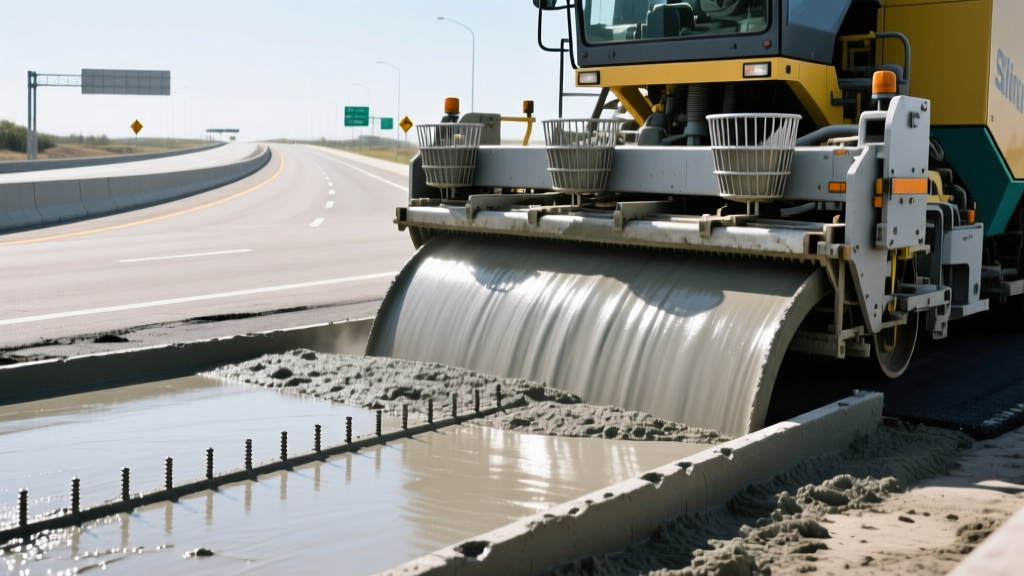
Freeway PCC is typically placed using slip-form pavers, which demands a highly specific mix design. The concrete must possess a low slump (1 to 2.5 inches) to support the paver's extrusion process without collapsing. To survive freeze-thaw cycles, the mix must incorporate air-entraining admixtures per ASTM C260, targeting a total air content of 5% to 8%.
The water-cementitious materials ratio (w/cm) is strictly capped at 0.45 to ensure high compressive strength (typically exceeding 4,500 psi at 28 days) and low permeability. Load transfer across transverse joints is managed by epoxy-coated steel dowel bars (usually 32mm to 38mm in diameter), which must be perfectly aligned using automated dowel bar inserters (DBI) to prevent joint locking and subsequent mid-panel cracking.
Hot Mix Asphalt (HMA) and Polymer Modifiers
Flexible freeway pavements rely on Superpave (Superior Performing Asphalt Pavements) mix designs. For high-traffic interstate routes, standard asphalt binders are insufficient. Engineers specify polymer-modified binders, such as PG 76-22. The '76' indicates the binder can withstand a maximum seven-day average pavement temperature of 76°C without rutting, while the '-22' ensures it remains flexible at -22°C to prevent thermal cracking.
Subgrade Stabilization and Geosynthetics
The pavement structure is only as stable as the subgrade beneath it. In areas with expansive clays or weak soils, traditional lime or cement stabilization is increasingly being supplemented or replaced by geosynthetic materials.
Biaxial and triaxial geogrids are deployed at the base-subgrade interface. These polymeric grids (typically extruded polypropylene or high-density polyethylene) interlock with the aggregate base course, creating a mechanically stabilized layer. This confinement effect reduces lateral spreading of the aggregate under heavy wheel loads, effectively increasing the structural number of the base layer and allowing for a 15% to 20% reduction in aggregate thickness.
"The integration of triaxial geogrids in freeway base courses has demonstrated a 200% to 300% increase in the fatigue life of the overlying asphalt layers by mitigating tensile strains at the bottom of the base."
Structural Materials for Overpasses and Interchanges
Freeway networks are defined by their grade separations. The materials used in bridge decks, piers, and abutments face extreme environmental exposure and dynamic vibration. The FHWA High-Performance Concrete (HPC) initiative mandates stringent durability criteria for these structures.
Ultra-High Performance Concrete (UHPC)
For bridge deck joints, link slabs, and precast girder connections, UHPC has become the standard. Unlike conventional concrete, UHPC contains no coarse aggregate; it relies on a precise matrix of fine sand, silica fume, and steel micro-fibers. This yields compressive strengths exceeding 21,000 psi and exceptional tensile ductility. Its near-zero permeability effectively eliminates chloride ingress from de-icing salts, protecting the underlying rebar.
Weathering Steel and Epoxy-Coated Rebar
For structural girders, ASTM A709 Grade 50W weathering steel is heavily utilized. This high-strength, low-alloy steel forms a dense, protective oxide patina when exposed to the atmosphere, halting further corrosion and eliminating the need for costly, high-VOC protective paint systems. For the reinforced concrete substructures, fusion-bonded epoxy-coated rebar (ASTM A775) or solid stainless steel rebar (ASTM A955) is specified in splash zones where de-icing salt runoff is concentrated.
Drainage Aggregates and Edge Support
Water is the primary catalyst for pavement failure. Freeway drainage systems require highly specific, open-graded aggregates to facilitate rapid water egress from the pavement structure.
- ASTM D448 Size No. 57: (1 inch to No. 4 sieve) Used extensively for French drains and longitudinal edge drains due to its high void ratio and resistance to clogging.
- ASTM D448 Size No. 8: (No. 4 to No. 8 sieve) Utilized as a filter fabric backing and in permeable asphalt base courses (PABC) to intercept water infiltrating through the surface course.
- Treated Permeable Base (TPB): Open-graded aggregate bound with a lean cement slurry (cement-to-aggregate ratio of 1:15) to provide structural support while maintaining a minimum permeability rate of 300 feet per day.
Lifecycle Cost and Failure Mode Matrix
Understanding how specific freeway building materials fail is critical for specifying the correct preventative treatments. The Asphalt Institute and various state DOTs track these failure mechanisms to optimize material selection.
| Failure Mechanism | Material Affected | Root Cause | Material-Specific Mitigation |
|---|---|---|---|
| Rutting | HMA (Flexible) | Binder shear failure under heavy, slow-moving loads at high temperatures. | Upgrade to PG 76-22 polymer-modified binder; utilize Stone Matrix Asphalt (SMA). |
| Joint Faulting | PCC (Rigid) | Erosion of subbase material due to poor load transfer, causing differential settlement at joints. | Specify epoxy-coated dowel bars; implement cement-treated or asphalt-treated permeable bases. |
| Alkali-Silica Reaction (ASR) | Bridge Concrete | Reactive silica in aggregates reacting with alkali hydroxides in cement, causing expansive cracking. | Use Class F fly ash (20-30% replacement) or slag cement; avoid known reactive local aggregate sources. |
| Reflective Cracking | HMA Overlays | Existing cracks in the underlying PCC or old HMA propagating upward through the new overlay. | Install a high-strain asphalt interlayer (e.g., fiberglass paving mat) or a rubberized asphalt stress-absorbing membrane interlayer (SAMI). |
Selecting the correct freeway building materials requires balancing initial procurement costs with long-term structural resilience. By strictly adhering to performance-graded binder specifications, precise air-entrainment levels for rigid pavements, and advanced geosynthetic subgrade reinforcements, engineers can deliver infrastructure that safely supports modern freight and commuter volumes for decades.
Written by
Marcus ChenMarcus Chen is a licensed structural engineer (PE) and building materials analyst with over 12 years of experience across residential, commercial, and industrial construction. He holds a Master of Science in Civil Engineering from UC Berkeley and spent six years at Thornton Tomasetti before transitioning to independent consulting and technical writing. Marcus specializes in material selection for seismic-prone regions, concrete reinforcement strategies, and lifecycle cost analysis. His work has been cited by the American Concrete Institute (ACI) and the Structural Engineers Association of California (SEAOC). When he is not on a job site or at his desk, you will find him hiking the Sierra Nevada or restoring a 1920s craftsman bungalow in Oakland, CA.
More from Marcus Chen
View all
Construction Cost
How Much Did the Eiffel Tower Cost to Build?
How much did the Eiffel Tower cost to build in 1889? We adjust for inflation and compare its budget to modern skyscraper construction.
Aug 4, 2026

Fire Resistance
What Is a Fire Resistant Material? Testing & Certification Guide
Discover what is a fire resistant material through ASTM and UL testing. Learn how fire ratings, certifications, and assemblies work in construction.
Aug 4, 2026

Construction Cost
How Much Did the Burj Khalifa Cost to Build?
How much did the Burj Khalifa cost to build? We break down the $1.5B project and extract 5 money-saving strategies for your next build.
Jul 30, 2026