Bridge Building Materials Cost Analysis & 2026 Trends
Analyze 2026 bridge building materials costs, from ASTM A709 steel to UHPC. Compare initial procurement, lifecycle expenses, and logistics impacts.

2026 Baseline Procurement Costs: Steel, Concrete, and Composites
Evaluating bridge building materials requires moving beyond simple per-ton or per-cubic-yard metrics. In 2026, the cost landscape is heavily influenced by advanced metallurgy, high-performance concrete admixtures, and composite manufacturing scalability. Initial procurement costs set the baseline, but material density, fabrication complexity, and required structural volume dictate the true capital expenditure.
| Material Type | Specification / Grade | 2026 Est. Unit Cost | Primary Application |
|---|---|---|---|
| Structural Steel | ASTM A709 Grade 50 | $1,350 - $1,550 / ton (fabricated) | Main girders, cross-frames |
| Weathering Steel | ASTM A588 Grade A | $1,600 - $1,850 / ton (fabricated) | Unpainted girder systems |
| Standard HPC | 8,000 psi (ASTM C94) | $180 - $240 / cubic yard | Substructures, standard decks |
| Ultra-High-Performance Concrete (UHPC) | 20,000+ psi (ASTM C1856) | $2,800 - $3,500 / cubic yard | Deck overlays, field-cast joints |
| GFRP Rebar | ASTM D7957 | $2.20 - $3.10 / linear foot (#5 bar) | Corrosion-prone deck slabs |
While UHPC appears prohibitively expensive on a per-volume basis, its compressive strength allows for a reduction in deck thickness from a standard 8.5 inches to just 2.5 inches. This dead-load reduction cascades into smaller, lighter steel girders and reduced substructure requirements, frequently resulting in a net-zero or net-positive initial cost impact for medium-span structures.
The Hidden Costs of Corrosion and Maintenance
In northern climates, chloride ion penetration from de-icing salts destroys standard black steel rebar (ASTM A615) within 15 to 20 years. The cost of a full bridge deck replacement ranges from $450 to $650 per square foot, not including traffic control and user delay costs. Specifying corrosion-resistant reinforcement upfront is not an option; it is a mathematical necessity for lifecycle viability.
Reinforcement Showdown: Epoxy vs. Stainless vs. GFRP
When designing bridge decks, engineers must select reinforcement that survives the exposure environment. According to guidelines from the Federal Highway Administration (FHWA), lifecycle cost analysis must account for the anticipated maintenance of the deck system.
- Epoxy-Coated Steel (ASTM A775): Costs roughly 15-20% more than black steel. However, handling damage during installation often compromises the coating, leading to localized galvanic corrosion that accelerates failure. It is increasingly viewed as a legacy solution.
- Stainless Steel Clad / MMFX (ASTM A1035): Priced at 2.5x to 3x the cost of black steel. It offers exceptional corrosion resistance and high tensile strength (100 ksi yield), allowing for wider bar spacing and reduced steel tonnage.
- Glass Fiber Reinforced Polymer (GFRP): Priced competitively with stainless steel on a per-project basis due to weight savings. GFRP weighs 25% as much as steel, drastically reducing shipping costs and crane time. It is completely immune to chloride corrosion, making it the optimal choice for coastal or heavy-snow regions.
Weathering Steel vs. Painted Steel: A 50-Year Perspective
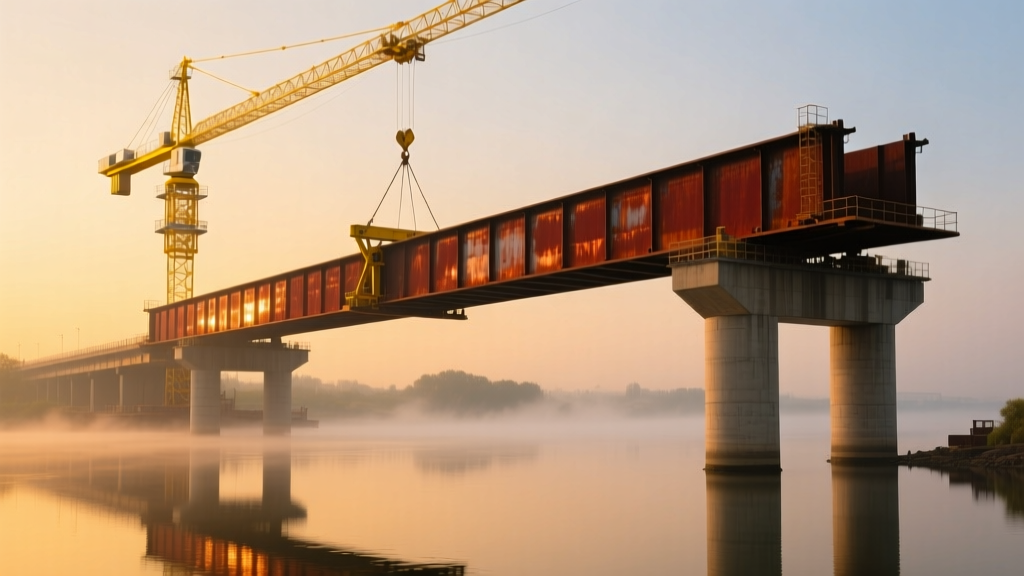
The National Steel Bridge Alliance (NSBA) heavily advocates for the use of unpainted weathering steel (ASTM A588) in appropriate environments. The initial material premium for weathering steel is typically 8% to 12% over standard carbon steel. However, this premium is immediately offset by the elimination of the initial paint system, which costs between $150 and $250 per square foot of steel surface area.
Over a 50-year lifecycle, a painted steel bridge requires at least two full containment and repaint cycles. Each cycle costs roughly 300% to 400% of the original painting cost due to inflation, environmental containment regulations, and traffic staging. Weathering steel forms a dense, protective oxide patina that halts further corrosion, effectively reducing superstructure maintenance costs to near zero for the first half-century, provided the structure is not exposed to continuous saltwater spray or trapped moisture.
Life Cycle Cost Analysis (LCCA) Framework for Bridge Decks
To systematically evaluate bridge building materials, project managers should apply a strict LCCA framework. This moves the decision-making process away from lowest-bidder initial costs toward total cost of ownership.
- Define the Exposure Environment: Quantify the annual chloride application rate and marine proximity. High-chloride environments mandate UHPC overlays or GFRP reinforcement.
- Calculate User Delay Costs: If the bridge is on a high-traffic arterial, lane closure costs can exceed $50,000 per day. This justifies the use of Accelerated Bridge Construction (ABC) materials, such as precast modular decks.
- Model Maintenance Intervals: Map out expected interventions. Standard HPC decks with epoxy rebar require overlay replacements at Year 25. UHPC or GFRP decks push the first major intervention past Year 50.
- Apply the Discount Rate: Use the state DOT's mandated real discount rate (typically 3% to 5%) to calculate the Net Present Value (NPV) of all future maintenance and rehabilitation costs.
Supply Chain, Logistics, and Accelerated Bridge Construction (ABC)
Material costs do not exist in a vacuum; logistics frequently break the budget. The shift toward Accelerated Bridge Construction (ABC) utilizing Prefabricated Bridge Elements and Systems (PBES) has fundamentally altered how materials are priced and procured.
Logistics Cost Multipliers to Watch in 2026
- Oversized Load Permits & Escorts: Transporting 120-foot continuous steel girders requires multi-state permitting, pilot cars, and nighttime travel restrictions, adding $15,000 to $30,000 per girder in logistics costs.
- Staging and Laydown Areas: Urban bridge replacements lack laydown space. Materials must be delivered 'just-in-time,' requiring premium freight rates and precise crane scheduling.
- Modularization Premiums: Precast concrete deck panels manufactured in a controlled plant environment carry a 20% fabrication premium over cast-in-place concrete. However, this is offset by reducing on-site deck closure time from 45 days to 48 hours, saving millions in user delay penalties.
Data from the Portland Cement Association (PCA) highlights that precast, prestressed concrete girders remain the most economically viable solution for spans between 60 and 140 feet. The ability to cast these girders regionally minimizes the long-haul freight costs associated with structural steel, which is often milled in specialized facilities far from the project site.
Expert Verdict: Strategic Material Allocation
Optimizing bridge building materials in 2026 requires a bifurcated approach based on span length and environmental exposure. For short-to-medium spans (under 120 feet) in aggressive chloride environments, precast prestressed concrete girders paired with a GFRP-reinforced UHPC deck overlay provide the lowest 75-year Net Present Value. For long spans (over 250 feet), ASTM A588 weathering steel plate girders remain the undisputed champion, provided the detailing prevents moisture traps and the aesthetic of the rust patina is acceptable to local stakeholders. Procurement teams must stop negotiating purely on initial tonnage and start negotiating on fabricated, delivered, and lifecycle-adjusted metrics.
Written by
Priya KapoorPriya Kapoor is a real estate market analyst and construction economics researcher with expertise in housing affordability, development feasibility, and infrastructure investment. She holds a Master of Regional Planning from Cornell University and previously worked as a senior analyst at CBRE's Investment Properties group, where she modeled returns for $4B in mixed-use development pipelines. Priya now runs an independent research practice advising developers, municipalities, and REITs on construction cost forecasting and market timing. She publishes the quarterly "BuildMat Market Pulse" report tracking material price indices across 12 commodity categories. Based in Austin, TX, Priya serves on the board of Habitat for Humanity Austin and is a marathon runner.
More from Priya Kapoor
View all
Construction Cost
Cost to Build a 1600 Sq Ft Home in 2026: Full Breakdown
Accurate 2026 cost to build a 1600 sq ft home—material, labor, and regional pricing breakdowns included. Plan your budget with real-time estimates.
Aug 11, 2026

Wood & Lumber
Name the Types of Wood for Pressure Treatment and Preservation
Learn how to name the types of wood best suited for pressure treatment. Compare species treatability, chemical retention levels, and 2026 preservation costs.
Aug 4, 2026

Stone & Masonry
Stone Veneer Suppliers Lindenhurst: 2026 Cost Analysis
Analyze 2026 stone veneer costs in Lindenhurst, NY. Compare local supplier pricing, delivery fees, and Suffolk County installation labor rates.
Aug 4, 2026