Importing Building Materials: 2026 Tariffs, Logistics & Landed Costs
Master the complexities of importing building materials in 2026. Explore HS codes, Section 232 tariffs, Incoterms, and hidden port demurrage costs.

The Economics of Importing Building Materials in 2026
Global supply chains for construction materials have transitioned from pandemic-era volatility to a new baseline defined by geopolitical friction, regionalized sourcing, and stringent environmental compliance. For general contractors, developers, and specialized distributors, importing building materials is no longer just about finding the lowest FOB (Free on Board) mill price. The true metric of success is the fully burdened landed cost, which encompasses ocean freight, port handling, customs duties, and inland drayage.
In 2026, freight rate stabilization on trans-Pacific routes has been offset by increased regulatory scrutiny and persistent anti-dumping margins on specific commodity classes. Procurement teams must now navigate a complex matrix of Harmonized Tariff Schedule (HTS) classifications and trade enforcement actions to avoid catastrophic margin erosion on large-scale commercial and residential projects.
Decoding HTS Codes and Tariff Schedules for Construction Supplies
The foundation of any international building material procurement strategy is accurate HTS classification. Misclassifying a shipment to secure a lower duty rate is a primary trigger for U.S. Customs and Border Protection (CBP) audits, resulting in severe financial penalties and cargo seizures. The U.S. International Trade Commission (USITC) maintains the official database, but understanding the intersection of base duties and punitive tariffs is critical.
| HTS Code | Material Category | Base Duty Rate | Section 232 / 301 Impact (2026) |
|---|---|---|---|
| 7208.50 | Flat-rolled steel (hot-rolled) | Free - 3.5% | +25% (Section 232 Steel Tariff) |
| 6908.10 | Glazed ceramic flags/paving tiles | Free - 19% | +25% (Section 301 China Tariff) |
| 4407.11 | Coniferous lumber (Pine/Fir) | Free | Subject to Softwood Lumber ADD/CVD |
| 6810.11 | Cement blocks and building bricks | Free - 12% | Standard MFN rates apply |
Incoterms 2020: Selecting the Right Freight Agreement
When negotiating with overseas manufacturers of drywall, structural steel, or architectural glass, the chosen Incoterm dictates exactly where risk and cost transfer from the seller to the buyer. Selecting the wrong term for heavy, low-value-density materials like cement board or clay bricks can destroy project margins.
| Incoterm | Best Used For | Buyer Risk Profile | 2026 Strategic Recommendation |
|---|---|---|---|
| FOB (Free on Board) | Bulk steel, lumber, raw aggregates | Medium (Buyer controls ocean freight) | Optimal for buyers with established NVOCC contracts to control container space. |
| CIF (Cost, Insurance, Freight) | High-value fixtures, HVAC units, glass | High (Seller controls routing, hidden markups) | Avoid for heavy commodities; sellers often use cheap carriers with poor port discharge records. |
| DDP (Delivered Duty Paid) | Specialized architectural finishes | Low (Seller handles all customs and delivery) | Only use if the foreign supplier has a registered U.S. importer of record entity. |
Material-Specific Loading and Packaging Standards
Importing heavy building materials introduces severe cargo shifting risks during maritime transit. A 40-foot High Cube (HC) container loaded with porcelain tiles or structural steel beams must adhere to the IMO/ILO/UNECE Code of Practice for Packing of Cargo Transport Units (CTU Code).
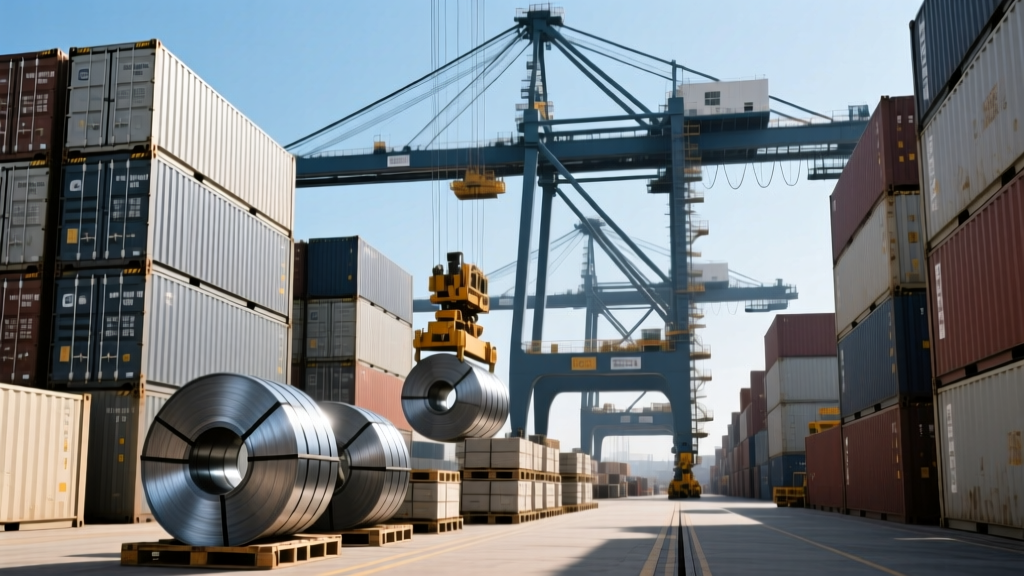
- Steel Coils and Beams: Must be secured using heavy-duty steel banding and wooden dunnage nailed to the container floor. Improper bracing leads to floor punctures, rendering the container out-of-service and triggering repair fees exceeding $2,500.
- Cement and Drywall: Highly susceptible to condensation damage (container rain). Mandate the use of kraft paper lining and minimum 8-10 desiccant poles (calcium chloride based) per 40ft container to maintain internal humidity below 50%.
- Ceramic and Porcelain Tiles: Pallets must be shrink-wrapped with corner protectors and loaded in a tight block pattern to prevent lateral movement. Edge protectors are mandatory to prevent strap damage to the tile cartons.
Navigating Anti-Dumping and Countervailing Duties (ADD/CVD)
Anti-Dumping Duties (ADD) and Countervailing Duties (CVD) are the most financially dangerous variables in importing building materials. These duties are designed to penalize foreign manufacturers selling goods below fair market value or benefiting from state subsidies. Unlike standard tariffs, ADD/CVD margins can range from 15% to over 300% of the commercial invoice value.
For example, importing steel nails (HTS 7317.15) or wooden bedroom furniture from specific Asian markets frequently triggers ADD/CVD orders. The critical error procurement teams make is assuming the supplier will disclose these liabilities. Under U.S. law, the Importer of Record is solely liable for all retroactive duty assessments. Before issuing a purchase order, always cross-reference the supplier's exact corporate entity against the CBP ADD/CVD case database to verify their specific cash deposit rate.
Step-by-Step Customs Clearance Workflow for Bulk Freight
Efficient clearance requires precise documentation sequencing. Delays in this workflow directly trigger port storage fees.
- ISF Filing (10+2 Rule): The Importer Security Filing must be submitted to CBP at least 24 hours before the cargo is laden on the vessel at the origin port. Late ISF filings result in $5,000 liquidated damages per violation.
- Arrival Notice and Document Retrieval: Upon vessel departure, obtain the Bill of Lading (B/L), Commercial Invoice, Packing List, and Mill Test Certificates (for metals) from the supplier.
- Entry Summary (CBP Form 7501): Your licensed customs broker will file the entry summary up to 15 days before the vessel arrives. This document calculates the estimated duties and taxes.
- Intensive Exam or VACIS Hold: CBP may flag the container for a Non-Intrusive Inspection (NII) via X-ray or a physical devanning exam. Physical exams for construction materials often cost $1,000 to $2,500 and add 5-7 days to the transit time.
- Release and Drayage Dispatch: Once customs holds are lifted and terminal handling charges are paid, the container is released for inland trucking to the job site or distribution warehouse.
Hidden Landed Costs: Demurrage, Detention, and Chassis Fees
The quoted ocean freight rate is only a fraction of the logistical reality. When importing high-volume, low-turnover materials like roofing shingles or insulation, supply chain bottlenecks can generate crippling secondary fees.
Demurrage
Definition: Fees charged by the marine terminal when a full container sits inside the port yard beyond the allotted free time (typically 3-5 days).
2026 Cost: $150 to $350 per day, per TEU. Escalates exponentially after day 7.
Detention (Per Diem)
Definition: Fees charged by the shipping line when the empty container is not returned to the depot after being unpacked at your construction site.
2026 Cost: $100 to $250 per day. Construction sites often struggle with empty returns due to lack of staging space.
Chassis Split & Lease
Definition: If the trucker must source a chassis from an off-terminal pool because the port is depleted, a split fee and daily lease apply.
2026 Cost: $40-$80 split fee + $25-$40 daily chassis lease rate.
Sourcing Strategy: Direct Mill vs. Consolidated Forwarders
When deciding how to structure your import operations, the volume and variability of your material needs dictate the optimal model.
Direct Mill Purchasing: Best for mega-projects requiring 50+ containers of a single SKU (e.g., structural steel for a high-rise). This eliminates trading company margins (typically 8-12%) but requires your team to manage all export documentation, origin port drayage, and quality control inspections. You must employ third-party inspection services like SGS or Bureau Veritas at the origin port before the container is sealed.
Consolidated Forwarders (NVOCC): Ideal for mid-sized developers importing mixed loads (LCL or buyer-consolidated FCL). A consolidation forwarder will combine your ceramic tiles, plumbing fixtures, and lighting into a single 40ft container at an origin warehouse. While you pay a consolidation fee ($35-$50 per CBM), you avoid the massive capital outlay of full-container minimum order quantities (MOQs) and significantly reduce your exposure to port demurrage by controlling a single, fully optimized shipment.
Mastering the importation of building materials requires treating logistics and customs compliance as core engineering disciplines. By rigorously verifying HTS classifications, enforcing strict CTU packaging standards, and modeling all potential demurrage risks into your initial project budgets, procurement teams can secure reliable, cost-effective global supply chains that keep construction schedules on track.
Written by
David NakamuraDavid Nakamura is a licensed architect (AIA) and construction technology writer focused on sustainable building methods, mass timber engineering, and high-performance building envelopes. He holds a Master of Architecture from the University of Washington and is a certified Passive House Consultant (CPHC). David spent eight years at the Seattle firm Mithun, where he led the design of three LEED Platinum projects, before founding his own practice specializing in net-zero residential design. He serves on the editorial advisory board of GreenBuilder Magazine and has authored peer-reviewed papers on cross-laminated timber (CLT) connections for the Journal of Structural Engineering. In his spare time, David teaches woodworking at Pratt Fine Arts Center and kayaks the Puget Sound.
More from David Nakamura
View all
Construction Cost
Labor Cost to Build a Deck Per Sq Ft: 2026 Installation Guide
Discover the exact labor cost to build a deck per sq ft in 2026. This installation guide breaks down contractor rates, complexity factors, and hidden fees.
Aug 4, 2026

Construction Cost
How Much Does It Cost to Build a 3 Bedroom House? Financing Guide
Learn exactly how much it costs to build a 3 bedroom house and explore 2026 financing options, construction loan types, and budget frameworks for your build.
Aug 4, 2026

Construction Cost
Cost to Build a Tennis Court: 2026 Guide
How much does it cost to build a tennis court in 2026? Breakdowns for asphalt, concrete, and synthetic surfaces plus fencing and lighting.
Jul 30, 2026