Building Material for the Washington Monument: NYT Clue & Stone Comparison
Exploring the building material for the Washington Monument (NYT clue) with a deep masonry comparison of its historical marble, gneiss, and aluminum.

The Crossword Clue vs. The Masonry Reality
If you have ever searched for the building material for the washington monument nyt, you were likely looking for the answer to a popular New York Times crossword puzzle clue. The accepted five-letter answer is MARBLE. However, from a structural engineering and architectural masonry perspective, reducing this 555-foot obelisk to a single material ignores one of the most fascinating geological and supply-chain stories in American construction history.
Search Intent Note: The NYT Connection
The query "building material for the washington monument nyt" consistently trends due to its frequent appearance in NYT crosswords and historical retrospectives. While marble is the primary cladding, the monument actually utilizes three distinct primary materials: bluestone gneiss, two geologically distinct types of marble, and cast aluminum. This comparison review breaks down how these materials perform against each other and against modern 2026 monument standards.
Deconstructing the Obelisk: A Material Comparison
Constructed in two distinct phases (1848–1854 and 1879–1884), the Washington Monument serves as an unintentional case study in long-term stone weathering, quarry bed consistency, and load-bearing masonry. Below, we compare the specific materials used and evaluate their historical performance.
The Foundation: Bluestone Gneiss vs. Modern Mass Concrete
The original foundation, laid in 1848, relies on bluestone gneiss quarried from Port Deposit, Maryland. This metamorphic rock was chosen for its immense compressive strength. During the 1879 reinforcement phase, the Army Corps of Engineers under Lt. Col. Thomas Lincoln Casey expanded the foundation using a combination of the original gneiss and early Portland cement concrete.
- Bluestone Gneiss (1848): Compressive strength exceeding 20,000 psi. Highly resistant to moisture wicking, though susceptible to spalling if freeze-thaw cycles penetrate micro-fissures.
- Modern Equivalent (2026): Today, civic monuments utilize high-performance mass concrete (often 10,000+ psi mix designs with fly ash or slag) paired with deep-driven steel micropiles. Modern foundations eliminate the differential settlement issues that forced Casey to underpin the original gneiss footing.
The Great Marble Divide: Maryland vs. Massachusetts
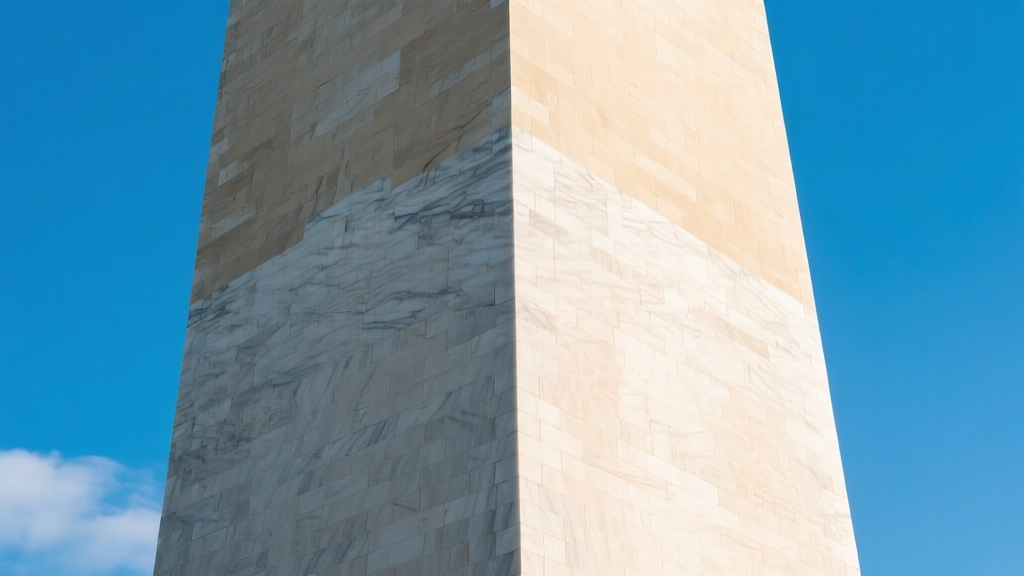
The most visible evidence of the monument's interrupted construction is the distinct color line roughly 152 feet up the shaft. This is not a design choice; it is a geological mismatch. When construction resumed in 1879, the original Texas, Maryland quarry could not supply marble that matched the weathered lower section, forcing a switch to Sheffield, Massachusetts marble (and later, a different bed from the Cockeysville, Maryland formation).
| Feature | Lower Section (Texas, MD Marble) | Upper Section (Sheffield, MA Marble) |
|---|---|---|
| Geological Composition | High-purity calcite marble (Cockeysville Formation) | Dolomitic marble with higher silica/mica impurities |
| Initial Color Profile | Brilliant, uniform bright white | Slightly warmer, faint grayish-blue undertones |
| Weathering Response | Highly susceptible to sulfation (black gypsum crusts from urban pollution) | Weathers more evenly; retains original hue longer due to dolomite content |
| Porosity | Low initial porosity, but grain-boundary dissolution increases water ingress over time | Slightly higher initial porosity, but more stable long-term crystalline structure |
According to data archived by the National Park Service, the visual discrepancy became permanent as the two stones reacted differently to the humid, polluted air of the Potomac basin. For modern masons and conservationists, this highlights a critical rule in natural stone specification: always source cladding from the exact same quarry bed for a single elevation.
The Apex: 1884 Aluminum vs. Modern Capstones
The 8.9-pound, 100-ounce cast aluminum capstone placed on December 6, 1884, was a marvel of metallurgy. At the time, aluminum was considered a precious metal, valued alongside silver, because the Hall-Héroult electrolytic extraction process had not yet been invented. William Frishmuth’s foundry cast the apex to serve as a lightning rod and a symbolic crown.
How Modern Monuments Handle the Apex
In 2026, aluminum is an abundant, inexpensive commodity. If a similar obelisk were commissioned today, the material choice for the capstone would differ based on structural and maintenance priorities:
- Solid Bronze or Copper: Preferred for traditional civic monuments. These materials develop a protective patina and do not suffer from the galvanic corrosion risks that aluminum faces when in contact with moisture and iron armatures.
- Stainless Steel (Grade 316L): The standard for modern lightning protection systems integrated into masonry spires, offering superior tensile strength and zero oxidation in high-altitude, high-wind environments.
- Engineered Quartz/Granite Composites: Used when a seamless visual continuation of the stone shaft is required, reinforced with internal carbon-fiber rods.
Sourcing Monument Stone in 2026: Lessons Learned
The Washington Monument’s material history provides a masterclass in the limitations of 19th-century supply chains. Today, the Natural Stone Institute provides rigorous testing standards (such as ASTM C97 for absorption and bulk specific gravity) that prevent the kind of visual and structural mismatches seen on the obelisk.
Actionable Specification Advice for Architects
When specifying natural stone for large-scale vertical applications or modern monuments, mandate the following in your contract documents:
- Quarry Bed Mapping: Require the supplier to provide a geological bed map. Do not accept "blend" batches from multiple quarry depths.
- Accelerated Weathering Tests: Request ASTM G154 UV and freeze-thaw cycling data specific to the exact block being harvested, not just generic regional averages.
- Anchor Compatibility: The Washington Monument relies on gravity and friction for much of its lower cladding. Modern codes require stainless steel (Type 304 or 316) gravity and dowel anchors, isolated from the stone with neoprene pads to prevent point-loading and spalling.
Frequently Asked Questions
Why is there a line on the Washington Monument?
The line, visible at the 152-foot mark, is caused by a change in the building material. Construction halted in 1854 due to funding issues. When it resumed in 1879, the original Maryland marble quarry could not provide stone that matched the weathered lower section, resulting in the use of Massachusetts marble and a different Maryland bed for the upper section.
Is the Washington Monument made of limestone?
No. While the NYT crossword clue answer is simply "marble," the structure is primarily clad in calcite and dolomitic marble, built upon a bluestone gneiss foundation. It does not utilize the Indiana Limestone (Salem formation) that became the standard for American civic buildings in the early 20th century.
How much did the aluminum capstone cost in 1884?
The 100-ounce aluminum capstone cost $225 at the time of its casting in 1884. Adjusted for inflation, this is roughly equivalent to $7,000 today. However, the relative scarcity of aluminum in the 1880s made it a status symbol, chosen specifically to demonstrate American industrial and metallurgical prowess.
Written by
Priya KapoorPriya Kapoor is a real estate market analyst and construction economics researcher with expertise in housing affordability, development feasibility, and infrastructure investment. She holds a Master of Regional Planning from Cornell University and previously worked as a senior analyst at CBRE's Investment Properties group, where she modeled returns for $4B in mixed-use development pipelines. Priya now runs an independent research practice advising developers, municipalities, and REITs on construction cost forecasting and market timing. She publishes the quarterly "BuildMat Market Pulse" report tracking material price indices across 12 commodity categories. Based in Austin, TX, Priya serves on the board of Habitat for Humanity Austin and is a marathon runner.
More from Priya Kapoor
View all
Construction Cost
Cost to Build a 1600 Sq Ft Home in 2026: Full Breakdown
Accurate 2026 cost to build a 1600 sq ft home—material, labor, and regional pricing breakdowns included. Plan your budget with real-time estimates.
Aug 11, 2026

Wood & Lumber
Name the Types of Wood for Pressure Treatment and Preservation
Learn how to name the types of wood best suited for pressure treatment. Compare species treatability, chemical retention levels, and 2026 preservation costs.
Aug 4, 2026

Stone & Masonry
Stone Veneer Suppliers Lindenhurst: 2026 Cost Analysis
Analyze 2026 stone veneer costs in Lindenhurst, NY. Compare local supplier pricing, delivery fees, and Suffolk County installation labor rates.
Aug 4, 2026