How to Source and Apply Free Building Materials Safely
Learn how to source, evaluate, and apply free building materials from demolition sites and surplus networks for structural and finish work.
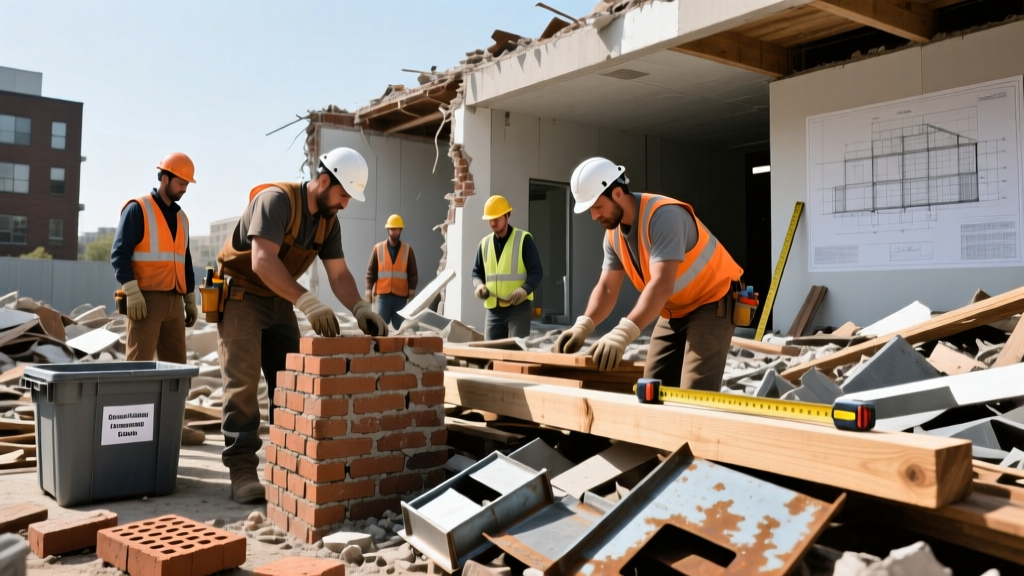
The Reality of Salvaged and Surplus Construction Supply
The construction and demolition (C&D) sector generates over 600 million tons of debris annually in the United States alone. According to the Environmental Protection Agency (EPA), a significant portion of this consists of high-quality, reusable dimensional lumber, architectural millwork, and masonry. For builders, renovators, and DIYers, sourcing free building materials is not merely a cost-saving tactic; it is a strategic supply chain alternative that provides access to old-growth timber and discontinued architectural profiles that are no longer available at commercial lumberyards.
However, integrating salvaged materials requires rigorous inspection, specific remediation techniques, and an understanding of hidden processing costs. This guide details the exact methodologies for sourcing, evaluating, and applying free construction materials to active building projects.

Strategic Sourcing: Where to Find Free Materials
Finding free building materials requires moving beyond standard consumer marketplaces and tapping into commercial waste streams and municipal diversion programs. The Building Materials Reuse Association (BMRA) emphasizes that the highest quality salvage occurs during "soft demolition"—the manual deconstruction of interiors prior to heavy machinery wrecking.
Digital and Physical Sourcing Matrix
| Sourcing Channel | Best Material Types | Effort Level | Success Rate |
|---|---|---|---|
| Demolition Contractor Direct | Dimensional lumber, structural beams, brick | High (Requires site visits and negotiation) | Very High |
| Municipal Transfer Stations | Cabinetry, doors, windows, fixtures | Medium (Requires monitoring reuse zones) | Medium |
| Habitat ReStore (Clearance) | Finish hardware, lighting, trim, appliances | Low (Retail clearance racks) | High |
| Online Curb Alerts / Freecycle | Pallet wood, scrap plywood, landscaping stone | Low (Digital monitoring) | Low to Medium |
When contacting demolition contractors, do not ask for "free wood." Offer to perform free manual labor to clear the interior framing before their excavators arrive. Contractors pay for dumpster hauling by the ton; by removing heavy lumber and masonry manually, you reduce their disposal fees. Frame your request as a mutual waste-diversion partnership.
Application Guide: Integrating Salvaged Materials
Once materials are secured, they must be processed and applied according to their specific material properties. Salvaged materials often behave differently than newly milled, kiln-dried stock.
Dimensional Lumber and Structural Framing
Old-growth Douglas Fir and Southern Yellow Pine salvaged from pre-1970s structures possess higher density and tighter growth rings than modern plantation lumber. However, applying this lumber requires strict moisture and fastener management.
- Moisture Equilibrium: Use a pin-type moisture meter. Salvaged framing stored outdoors may read 20%+ moisture content (MC). For interior conditioned spaces, the lumber must be stickered and acclimated until it reaches 8-12% MC. Installing high-MC lumber into a framed wall will result in severe twisting and drywall fastener pops as the wood dries.
- De-nailing Protocol: Never run salvaged lumber through a planer without first scanning it with a handheld metal detector (e.g., Garrett SuperScanner). A single hidden cut nail will destroy a set of high-speed steel (HSS) planer blades instantly. Use a nail punch and a heavy framing hammer to drive nails entirely through the board rather than pulling them out, which splinters the surrounding grain.
- Structural Grading: The International Residential Code (IRC) requires structural framing lumber to bear a grade stamp. If salvaged lumber lacks a visible stamp, it cannot legally be used for load-bearing walls or roof rafters in permitted construction. Restrict un-stamped salvaged lumber to non-structural applications: interior partition walls, blocking, furring strips, and exterior cladding.
Masonry and Salvaged Brick
Applying salvaged brick requires an understanding of historic mortar chemistry. Bricks manufactured before 1930 were fired at lower temperatures and are significantly softer and more porous than modern extruded brick.
Critical Failure Mode: If you lay soft historic brick using modern Portland cement mortar (Type M or Type S), the rigid mortar will trap moisture. During freeze-thaw cycles, the moisture will expand, and because the mortar is harder than the brick, the brick face will spall and shatter. Always use a lime-based Type O or Type N mortar when troweling salvaged historic masonry.
Architectural Millwork and Solid Core Doors
Salvaged solid core wood doors and custom trim offer premium architectural details at zero material cost. The primary application challenge is adapting non-standard historic dimensions to modern rough openings.
- Door Sizing: Historic doors are often 82 inches or 84 inches tall, whereas modern pre-hung standards are 80 inches. Instead of cutting the door down (which ruins the bottom rail proportions), raise the header in your rough framing by adding a 2x4 or 2x6 flat above the jack studs.
- Hinge Mortising: Salvaged doors often have existing hinge mortises that will not align with your new jamb. Fill the old mortises with epoxy wood filler mixed with fine sawdust, sand flush, and route new mortises using a standardized hinge template and a plunge router.
Any salvaged painted wood, trim, or doors originating from structures built before 1978 must be tested for lead-based paint before sanding or cutting. Use an EPA-recognized test kit (such as 3M LeadCheck swabs). If lead is present, the material must either be encapsulated with a bonding primer like Stix or Peal Bond, or disposed of according to local hazardous waste regulations. Never dry-sand salvaged trim without a HEPA-filtered dust extraction system.
Material Inspection and Remediation Checklist
Before transporting free materials to your job site, execute this four-point field inspection to ensure the material is viable for application.
- Visual Rot Inspection: Check the end-grain of lumber and the bottom 6 inches of any vertical trim. Dark, spongy wood or a mushroom-like odor indicates advanced fungal decay. Discard immediately.
- Insect Frass Check: Look for fine, sawdust-like powder (frass) or 1/8-inch exit holes in structural beams, which indicate active powderpost beetle or carpenter ant infestations.
- Hardware Functionality: For salvaged windows, test the sash balance mechanism. If the original weight-and-pulley system is broken, plan to retrofit the jambs with modern spring-loaded sash liners (e.g., Marvin or Andersen replacement kits).
- Dimensional Verification: Measure the actual thickness and width of salvaged framing. Pre-1960s "2x4" lumber is often a true 2" x 4", whereas modern lumber is 1.5" x 3.5". Mixing the two on the same framing plane will result in severe drywall bowing.
The Hidden Costs of Free Materials
While the acquisition cost is zero, the processing, transport, and remediation costs can quickly erode the ROI if not accurately calculated during the estimating phase. Use the table below to budget for the hidden costs of salvage integration.
| Cost Factor | Specific Expense | Estimated Mitigation Cost |
|---|---|---|
| Transportation | U-Haul 15ft box truck rental | $19.95 base + $0.79 per mile |
| Tool Wear / Blades | Replacing planer blades after hidden nail strike | $45 (HSS) to $110 (Carbide) |
| Chemical Testing | Lead paint and asbestos testing kits | $12 - $45 per testing area |
| Labor (De-nailing) | Manual labor to pull nails and strip hardware | Approx. 15-20 minutes per 10-foot board |
| Milling / Sizing | Planing and jointing to achieve parallel faces | High time cost; requires 8"+ jointer access |
According to data from Habitat for Humanity ReStore networks, the most cost-effective free materials to salvage are those that require minimal re-milling: finish hardware, light fixtures, solid surface countertops, and pre-finished architectural elements. Raw framing lumber, while abundant, carries the highest hidden labor cost due to de-nailing and re-sizing requirements.
Frequently Asked Questions
Can I use salvaged lumber for structural roof rafters?
Only if the lumber retains its original, legible grade stamp from a recognized milling association, and a local building inspector approves its condition. Otherwise, restrict it to non-load-bearing applications.
How do I clean salvaged brick without damaging it?
Avoid muriatic acid, which can stain historic bricks and degrade soft lime mortar. Use a specialized masonry cleaner like Prosoco Sure Klean Restoration Cleaner, applied with a low-pressure (under 500 PSI) garden sprayer and a natural bristle brush.
Written by
Priya KapoorPriya Kapoor is a real estate market analyst and construction economics researcher with expertise in housing affordability, development feasibility, and infrastructure investment. She holds a Master of Regional Planning from Cornell University and previously worked as a senior analyst at CBRE's Investment Properties group, where she modeled returns for $4B in mixed-use development pipelines. Priya now runs an independent research practice advising developers, municipalities, and REITs on construction cost forecasting and market timing. She publishes the quarterly "BuildMat Market Pulse" report tracking material price indices across 12 commodity categories. Based in Austin, TX, Priya serves on the board of Habitat for Humanity Austin and is a marathon runner.
More from Priya Kapoor
View all
Construction Cost
Cost to Build a 1600 Sq Ft Home in 2026: Full Breakdown
Accurate 2026 cost to build a 1600 sq ft home—material, labor, and regional pricing breakdowns included. Plan your budget with real-time estimates.
Aug 11, 2026

Wood & Lumber
Name the Types of Wood for Pressure Treatment and Preservation
Learn how to name the types of wood best suited for pressure treatment. Compare species treatability, chemical retention levels, and 2026 preservation costs.
Aug 4, 2026

Stone & Masonry
Stone Veneer Suppliers Lindenhurst: 2026 Cost Analysis
Analyze 2026 stone veneer costs in Lindenhurst, NY. Compare local supplier pricing, delivery fees, and Suffolk County installation labor rates.
Aug 4, 2026