Mycelium Building Material vs Traditional Insulation: 2026 Review
Compare mycelium building material against fiberglass and mineral wool. We analyze R-values, acoustic performance, moisture risks, and 2026 costs.

Thermal Resistance and Material Composition
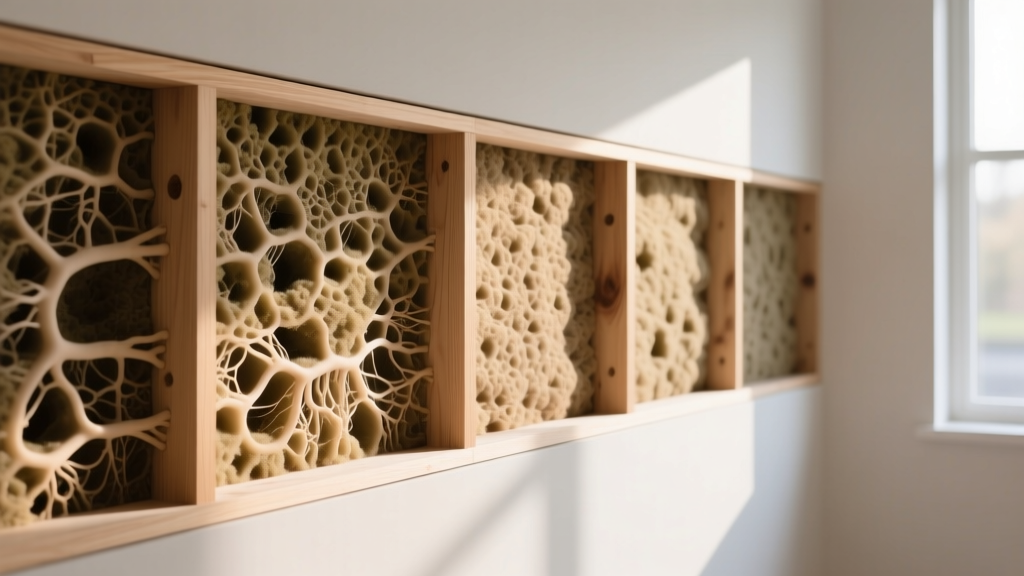
Mycelium building materials have transitioned from experimental bio-fabrication to commercially viable architectural products. By utilizing the root structure of fungi to bind agricultural byproducts like hemp hurd, wood chips, and corn stover, manufacturers produce carbon-negative composites. The mycelium network digests the lignin and cellulose in the substrate, creating a dense, chitinous matrix that is naturally fire-resistant and highly insulative.
When evaluating thermal performance, mycelium insulation typically achieves an R-value of 3.8 to 4.2 per inch. This places it slightly above standard fiberglass batts (R-2.2 to R-2.7) and on par with expanded polystyrene (EPS) foam (R-3.6 to R-4.2), though it remains below closed-cell spray foam (R-6.0+). However, mycelium boards are significantly denser (approximately 10-15 lbs/ft³) compared to fiberglass (0.5-1.2 lbs/ft³), providing superior thermal mass but adding structural dead load to wall assemblies.
| Material | R-Value per Inch | Density (pcf) | Embodied Carbon | Fire Rating (ASTM E84) |
|---|---|---|---|---|
| Mycelium Composite | 3.8 - 4.2 | 10 - 15 | Carbon Negative | Class A (Treated) |
| Fiberglass Batt | 2.2 - 2.7 | 0.5 - 1.2 | High | Class A |
| Mineral Wool | 3.0 - 3.3 | 2.5 - 4.0 | Moderate | Class A (Inherent) |
| EPS Foam | 3.6 - 4.2 | 1.0 - 2.0 | Very High | Class B/C (Treated) |
Acoustic Dampening Capabilities
The porous, chitinous cellular structure of mycelium excels at sound absorption, making it a premium choice for interior architectural treatments. Commercial products, such as the acoustic panels manufactured by Mogu, achieve Noise Reduction Coefficients (NRC) of 0.85 to 0.95. This outperforms standard PET (polyester) acoustic panels, which typically range from 0.70 to 0.80 NRC.
Mycelium panels are particularly effective at absorbing mid-to-high frequency sounds (500 Hz to 4000 Hz), which are common in open-plan offices and commercial lobbies. For low-frequency bass trapping, however, the material requires thicker profiles (4+ inches) or strategic air gaps behind the panels to match the performance of specialized mineral wool bass traps.
The Moisture Vulnerability: Real-World Failure Modes
Mycelium is inherently hydrophilic. If installed in a wall assembly sealed with a standard 6-mil polyethylene vapor barrier in a mixed-humid climate, summer moisture drive can condense on the barrier. This traps moisture inside the mycelium, leading to competitive mold growth and structural degradation. Always specify smart vapor retarders (like Pro Clima Intello) with variable permeability, and design the assembly for outward drying using vapor-open exterior sheathing.
While mycelium is resistant to liquid water intrusion during short-term exposure, prolonged high humidity (above 80% RH) can reactivate dormant fungal networks or invite secondary mold colonization. Builders must ensure that mycelium insulation is kept completely dry during the construction phase and stored in climate-controlled environments prior to installation.
Fire Resistance and Chemical Treatments
Raw, untreated mycelium is combustible. To meet commercial building codes and achieve a Class A flame spread index (less than 25 per ASTM E84), manufacturers treat the composites with borates or ammonium polyphosphate. Borate treatments are preferred in the bio-material space because they maintain the non-toxic, Red List-free profile required for Living Building Challenge (LBC) certification. However, borates are water-soluble; if the material suffers a bulk water leak, the fire-retardant treatment can leach out, compromising both the fire rating and the biological stability of the panel.
Structural Limitations and Load-Bearing Realities
A common misconception in sustainable architecture is that mycelium bricks can be used for load-bearing walls. In reality, mycelium composites possess a compressive strength of only 20 to 40 psi. Compared to traditional concrete (3,000 to 5,000 psi) or even structural hempcrete (100 to 200 psi), mycelium is strictly a non-load-bearing material. It functions exclusively as infill insulation, acoustic cladding, or partition walling. Attempting to use mycelium blocks in structural applications will result in catastrophic crushing and settlement under standard roof and floor loads.
2026 Cost Analysis and Procurement Realities
Mycelium remains a premium bio-material, and its pricing reflects a nascent, scaling supply chain rather than mass-market commoditization. As of 2026, procurement costs are structured as follows:
- Mycelium Insulation Boards: $3.50 to $5.20 per board foot.
- Mycelium Acoustic Panels: $12.00 to $18.00 per square foot (finished, decorative face).
- Mineral Wool (Baseline): $1.50 to $2.10 per board foot.
- Fiberglass (Baseline): $0.80 to $1.20 per board foot.
While the upfront material cost is 3x to 4x higher than fiberglass, projects targeting LEED v4.1 or the Living Building Challenge often absorb the premium to secure Materials and Resources (MR) credits. Furthermore, according to EPA Sustainable Materials Management guidelines, utilizing bio-based, compostable materials drastically reduces end-of-life demolition costs, as mycelium can be safely composted on-site or returned to agricultural soil, eliminating landfill tipping fees.
Specification Decision Matrix
Architects and general contractors should use the following framework to determine if a mycelium building material is appropriate for their specific assembly.
Where Mycelium Wins
- Interior Acoustic Treatments: High-end corporate offices, recording studios, and auditoriums where NRC ratings and biophilic design aesthetics are paramount.
- Non-Load-Bearing Partition Walls: Interior demising walls where thermal mass and sound dampening are required without structural demands.
- Sustainable Showcase Projects: Net-zero and Living Building Challenge projects requiring carbon-negative material documentation.
- Dry-Climate Exterior Assemblies: Arid regions where the risk of bulk water intrusion and high-humidity condensation is minimal, provided breathable wraps are used.
Where to Avoid Mycelium
- Below-Grade Foundations: Any contact with soil or hydrostatic pressure will rapidly degrade the material.
- High-Humidity Zones: Bathrooms, indoor pools, and commercial kitchens where ambient RH consistently exceeds 70%.
- Structural Applications: Load-bearing walls, structural insulated panels (SIPs) requiring high shear strength, or flooring underlayments.
- Unconditioned Construction Sites: If the project timeline requires materials to sit exposed to the elements for weeks before the building envelope is sealed, mycelium is too high-risk.
Pioneers like Ecovative Design have proven the viability of mycelium composites at scale, primarily in packaging and specialized building products. When specifying mycelium for large commercial builds in 2026, contractors must account for 8-to-12-week lead times, as bio-fabrication facilities require precise environmental controls and biological growth cycles that cannot be artificially rushed to meet sudden supply demands.
Written by
Elena RodriguezElena Rodriguez is a civil engineer and technical writer specializing in concrete technology, masonry systems, and ASTM/ACI compliance. She earned her B.S. in Civil Engineering from Texas A&M University and spent a decade at a materials testing laboratory, performing over 2,000 concrete compressive strength tests and masonry prism evaluations. Elena is an ACI-certified Field Testing Technician (Grade I) and a member of ASTM Committee C12 on Natural Building Stone. She currently consults on forensic engineering cases involving concrete failures and moisture intrusion. Based in San Antonio, TX, Elena is a proud member of the Society of Women Engineers (SWE) and coaches her daughter's FIRST Robotics team.
More from Elena Rodriguez
View all
Walls & Panels
Cost Analysis: Light Gauge Steel Framing Advantages and Disadvantages
Evaluate light gauge steel framing advantages and disadvantages through a strict cost analysis lens, comparing material, labor, and lifecycle expenses.
Aug 4, 2026

Walls & Panels
Gypsum Board Types: Exact Specifications, Thickness & Dimensions
Compare standard, Type X, and moisture-resistant gypsum board types. Get exact specifications, thicknesses, dimensions, and ASTM standards for your project.
Aug 4, 2026

Fire Resistance
Best Fire-Resistant Outdoor Decking Materials: 2026 Buyer Guide
Discover the best fire-resistant outdoor decking materials for 2026. Compare Class A PVC, aluminum, and hardwood options for WUI compliance and safety.
Aug 4, 2026