Selecting Bamboo Rod Building Supplies for Structural Framing
Learn to select bamboo rod building supplies for structural framing, covering species grading, moisture content, and preservation treatment specs.

The Structural Paradigm of Raw Bamboo
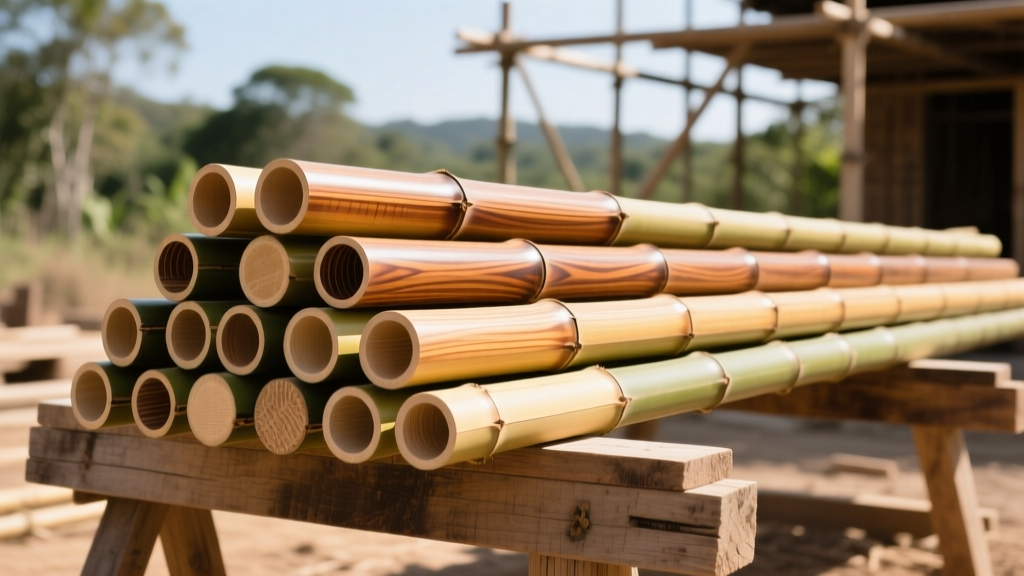
Raw bamboo culms offer a tensile strength-to-weight ratio that rivals mild steel, making them a highly viable alternative to traditional timber in modern sustainable architecture. However, selecting the correct bamboo rod building supplies for load-bearing applications requires navigating complex biological and mechanical variables. Unlike dimensional lumber, bamboo is a tapered, hollow, anisotropic grass. Its structural integrity depends entirely on species selection, harvest timing, preservation methodology, and moisture equilibrium. This guide provides the technical specifications required to procure, grade, and specify bamboo rods for structural framing, trusses, and architectural space frames.
Species Selection Matrix for Load-Bearing Applications
Not all bamboo is structural. While over 1,400 species exist, only a handful possess the necessary wall thickness, vascular bundle density, and culm straightness for construction. When sourcing bamboo rod building supplies, restrict your procurement to the following proven structural species.
| Species | Common Name | Tensile Strength (MPa) | Compressive Strength (MPa) | Primary Use Case |
|---|---|---|---|---|
| Guadua angustifolia | Guadua | 400 - 450 | 80 - 95 | Primary structural framing, trusses, bridges |
| Phyllostachys edulis | Moso | 250 - 300 | 60 - 75 | Scaffolding, secondary framing, purlins |
| Dendrocalamus asper | Giant Bamboo | 200 - 250 | 50 - 65 | Heavy columns, architectural pillars |
| Bambusa balcooa | Beema / Female Bamboo | 180 - 220 | 45 - 55 | Light framing, wall studs, trellises |
For primary load-bearing structures in the Americas, Guadua angustifolia is the undisputed standard, recognized by the International Bamboo and Rattan Organization (INBAR) in ISO 22156 (Bamboo Structural Design). In Asian markets, Phyllostachys edulis (Moso) dominates due to its abundance and established supply chains, though its thinner walls require larger diameters to achieve equivalent load capacities.
Grading, Dimensions, and Tolerances
Because bamboo grows as a tapered cylinder, structural grading requires measuring both the base and tip diameters, as well as the wall thickness at the narrowest point. When reviewing supplier manifests for bamboo rod building supplies, enforce the following dimensional tolerances:
- Base Diameter: For primary columns, specify a minimum base diameter of 100 mm (4 inches). For truss chords, 80 mm to 100 mm is standard.
- Wall Thickness: The wall thickness at the top (narrowest) end must never be less than 10 mm for load-bearing members. Thinner walls are prone to local buckling under compressive loads.
- Taper Limit: Reject culms where the diameter decreases by more than 10% over the first 3 meters of length. Excessive taper complicates joinery and creates uneven stress distribution.
- Internode Length: Longer internodes (300 mm - 450 mm) are preferred. Nodes (the solid diaphragms) act as natural stiffeners, but closely spaced nodes indicate younger, weaker growth or stunted environmental conditions.
Bamboo must be harvested between 4 and 5 years of age. Culms younger than 3 years have high starch content (up to 6%), which attracts the powderpost beetle (Dinoderus minutus). These insects can reduce a structural culm to dust in under 18 months. Culms older than 7 years become brittle, lose tensile flexibility, and are highly susceptible to longitudinal splitting during joinery. Always require a harvest age certificate from your supplier.
Preservation and Moisture Content Specifications
Untreated bamboo has a natural lifespan of 1 to 3 years when exposed to weather and soil. To achieve a 30+ year structural lifespan, the culms must undergo rigorous preservation. According to guidelines published by the Food and Agriculture Organization (FAO), chemical treatment is non-negotiable for permanent structures.
The Boucherie Method vs. Bath Immersion
For freshly harvested bamboo, the Boucherie method (sap displacement) is the gold standard. A 5% solution of borax and boric acid (1:1 ratio) is pumped under pressure into the base of the freshly cut culm, forcing the natural sap out through the tip. This ensures the preservative penetrates the inner vascular bundles.
For air-dried bamboo rod building supplies, hot-cold bath immersion is required. The culms are submerged in a heated borate solution (60°C) for 48 hours, then transferred to a cold bath for another 48 hours. The thermal shock forces the preservative deep into the culm wall.
Target Moisture Content (MC)
Bamboo must be air-dried in shaded, well-ventilated yards for 6 to 12 months until it reaches an equilibrium moisture content (EMC) of 12% to 15%. Avoid suppliers who use aggressive kiln-drying; rapid moisture loss causes severe longitudinal checking (splitting) along the vascular bundles, instantly compromising the culm's structural grade.
Connection Hardware and Joinery Compatibility
The most common point of failure in bamboo construction is the connection. Standard timber fasteners (nails, wood screws, lag bolts) are strictly prohibited. Driving a nail into bamboo rod building supplies forces the hollow fibers apart, causing immediate longitudinal splitting due to the lack of cross-grain structural integrity.
Specify the following connection methodologies in your structural plans:
- Threaded Rods with Epoxy Injection: Drill through the culm and insert M10 or M12 galvanized threaded rods. Inject a two-part structural epoxy into the hollow internode cavity before tightening the nuts. The epoxy creates a solid internal plug, preventing the culm from crushing under bolt tension.
- Mortar-Filled Nodes: For traditional joinery, drill a hole at the node and inject a non-shrink cementitious grout. Once cured, the solid node can be carved and notched like hardwood to accept mortise and tenon joints.
- External Hose Clamps and Gussets: For tension members, wrap the bamboo tip in a rubber sleeve, apply heavy-duty stainless steel hose clamps, and bolt a steel gusset plate to the clamps. This relies on friction and compression rather than penetrating the culm wall.
Sourcing, Logistics, and Cost Breakdown
Procuring high-grade bamboo rod building supplies involves navigating international agricultural export laws. The Bamboo Foundation notes that phytosanitary certification is mandatory for crossing international borders to prevent the spread of agricultural pests.
| Cost Factor | Estimated Range (USD) | Notes |
|---|---|---|
| Guadua Culm (10-12m, 10cm base) | $18.00 - $25.00 / each | FOB South America (Colombia/Ecuador) |
| Moso Culm (8-10m, 8cm base) | $12.00 - $16.00 / each | FOB China (Zhejiang/Fujian provinces) |
| Borate Treatment (Boucherie) | $3.50 - $5.00 / linear ft | Includes chemical and labor |
| Specialized Freight & Phytosanitary | $8.00 - $14.00 / linear ft | Requires 40ft High Cube container |
When vetting suppliers, request third-party lab reports verifying the borate retention level (minimum 15 kg/m³ of culm volume) and the exact moisture content at the time of container loading. Container condensation during ocean freight can trigger mold growth if the MC exceeds 16%.
Frequently Asked Questions
Can I use locally harvested wild bamboo for structural framing?
Only if you can positively identify the species, verify its age (4-5 years), and perform your own Boucherie treatment. Wild bamboo in North America (such as Arundinaria gigantea) is generally too small in diameter and thin-walled for primary structural loads. It is better suited for light trellises, fencing, or interior decorative elements.
Does bamboo require fire retardant treatments?
Raw bamboo has a high silica content, which gives it a slightly better fire resistance than softwood timber, but it will still burn. For commercial structures, building codes typically require the application of an intumescent fire-retardant coating. Ensure the coating is vapor-permeable; sealing the bamboo completely traps internal moisture and accelerates internal fungal decay.
How do I store bamboo rod building supplies on the job site?
Never store bamboo directly on soil or concrete, as capillary action will draw moisture into the culm base, leading to rot. Stack the rods on elevated timber dunnage (minimum 6 inches off the ground), cover them with a breathable canvas tarp (never use plastic sheeting, which traps condensation), and ensure air can circulate freely through the stack.
Written by
James ThorntonJames Thornton is a construction industry veteran with 25 years of hands-on experience in wood framing, lumber grading, and residential building codes. He started as a framing carpenter in rural Oregon, earned his ICC Residential Building Inspector certification, and eventually became a senior plan reviewer for the City of Portland Bureau of Development Services. James holds a B.S. in Wood Science & Technology from Oregon State University and is a certified lumber grader through the West Coast Lumber Inspection Bureau (WCLIB). He has inspected over 3,000 residential construction sites and authored the city's internal guide on advanced framing techniques (2x6 at 24" O.C.). James lives in Bend, OR, where he builds custom timber-frame cabins and competes in lumberjack sports.
More from James Thornton
View all
Insulation
Best Home Insulation Materials: Complete 2026 Guide
Compare top home insulation materials for 2026. Find R-values, installed costs per square foot, and best uses for fiberglass, spray foam, and mineral wool.
Aug 4, 2026

Sustainable Building
Certify Your Green Building Material for LEED and WELL
Step-by-step guide to certifying a green building material for LEED v5 and WELL v2. Master EPDs, HPDs, and VOC limits for 2026 project specifications.
Aug 4, 2026

Stone & Masonry
Veneer Stacked Stone Panels: Interior Design & Style Showcase
Discover how veneer stacked stone panels transform interiors. Explore modern design profiles, material pairings, and technical installation specs.
Aug 4, 2026