True Cost of a Bamboo House Build: 2026 Price Comparison
Compare the true costs of a bamboo house build in 2026. Detailed pricing for structural poles, engineered panels, labor, and timber alternatives.

The True Economics of a Bamboo House Build
Calculating the exact cost of a bamboo house build requires moving beyond simplistic per-square-foot averages. Unlike conventional stick framing, where material and labor costs are highly standardized, bamboo construction introduces unique variables: species selection, preservation methodologies, and specialized joinery. In 2026, as engineered bamboo products gain market share and international building codes like ISO 22156 become more widely adopted by local jurisdictions, the financial landscape of bamboo architecture has shifted from niche experimentation to a quantifiable, competitive alternative to timber and steel.
This guide breaks down the real-world costs of structural bamboo, comparing raw culm construction against engineered bamboo lumber (EBL), while factoring in the hidden expenses of treatment, logistics, and specialized labor.
Raw Material Pricing: Culms vs. Engineered Lumber
The most critical cost decision in a bamboo house build is choosing between traditional round pole (culm) construction and modern engineered bamboo. Round poles, primarily Guadua angustifolia from South America or Dendrocalamus asper from Southeast Asia, offer exceptional compressive strength but require custom joinery. Engineered Bamboo Lumber (EBL), typically laminated from Phyllostachys edulis (Moso), behaves like traditional dimensional lumber, allowing standard carpentry techniques but at a higher material premium.
| Material Type | Unit | Avg Cost (2026) | Best Structural Application |
|---|---|---|---|
| Treated Guadua Culms (4-6" dia) | Per linear ft | $4.50 - $7.00 | Primary columns, roof trusses |
| Moso Bamboo LVL (Engineered) | Per board ft | $14.00 - $19.00 | Beams, floor joists, headers |
| Douglas Fir #2 (Timber Baseline) | Per board ft | $9.00 - $13.00 | Conventional framing comparison |
| Structural Bamboo Plywood | Per 4x8 sheet | $85 - $120 | Shear walls, subflooring, gussets |
While raw Guadua poles appear significantly cheaper per linear foot than engineered alternatives, this metric is deceptive. A single 6-inch diameter Guadua pole contains vastly more structural volume than a 2x4 board foot measurement. When calculating the cost per load-bearing capacity, high-quality treated Guadua often undercuts Douglas Fir by 15% to 22% in material costs alone.
The Hidden Costs: Treatment, Joinery, and Logistics
Budgeting for a bamboo house build fails when developers treat bamboo like wood. Bamboo contains high levels of starch and sugars, making it highly susceptible to powderpost beetles and fungal decay if left untreated. Furthermore, its hollow, tapered geometry complicates shipping and connection design.
Never purchase untreated structural bamboo to save on upfront costs. Untreated culms exposed to the elements or ground moisture will degrade structurally within 2 to 4 years. Properly treated bamboo, however, easily achieves a 50+ year lifespan, matching or exceeding pressure-treated pine.
Preservation and Treatment Costs
Commercial structural bamboo must undergo a borax and boric acid bath (typically a 5-7% concentration) via the Boucherie method or vertical soak diffusion. This replaces the plant’s natural sap with insect-repellent salts. Expect to pay an additional $1.50 to $3.00 per linear foot for professionally treated, kiln-dried, and graded structural poles. If you are sourcing raw, green bamboo locally to cut costs, budget approximately $150 to $250 per 100 poles for the chemical baths, soaking tanks, and the 3-to-5-day labor required for the curing process.
Logistics and the "Shipping Air" Penalty
Because round bamboo poles are hollow and tapered, shipping them long distances means paying freight rates to transport empty space. A 40-foot shipping container can hold roughly 800 to 1,000 structural Guadua poles. If your build site is far from a port or a dedicated bamboo distributor, overland freight can inflate your material budget by 30% to 45%. Sourcing engineered bamboo (which stacks densely like standard lumber) mitigates this logistics penalty for inland projects.
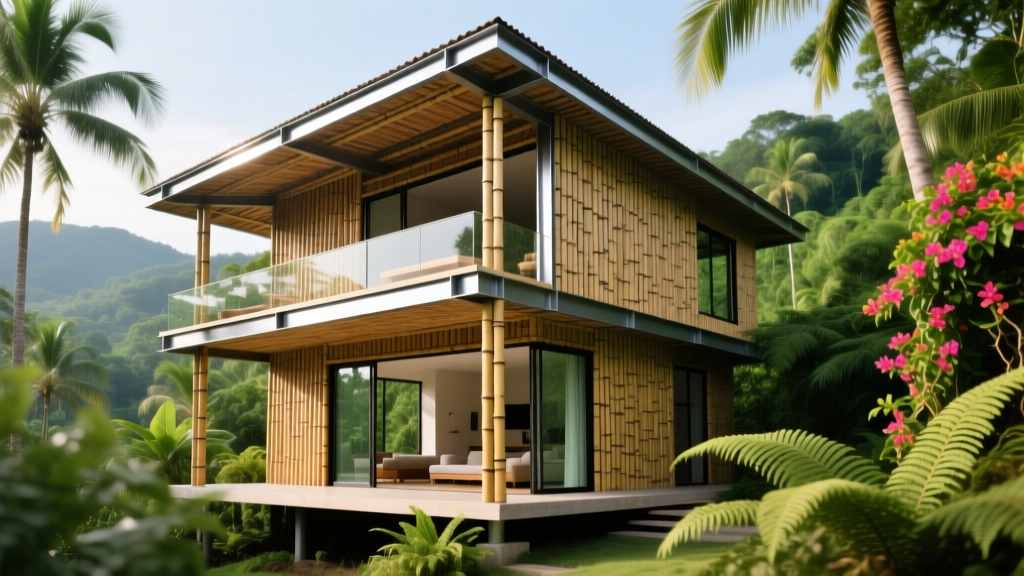
Specialized Labor and Engineering Fees
The labor market for bamboo construction is bifurcated. If you are building with round poles, you cannot rely on standard framing crews. Traditional bamboo joinery—such as the fish-mouth joint, mortar-filled connections with rebar dowels, and bolted steel gusset plates—requires specialized artisans. In 2026, specialized bamboo carpenters command $65 to $95 per hour, compared to the $45 to $65 average for conventional stick framers.
"The structural design of bamboo requires a paradigm shift. Unlike timber, which is homogeneous, every bamboo culm is a unique, tapered tube. Engineers must design connections that accommodate these geometric variations without crushing the hollow walls, often requiring internal concrete or epoxy grout plugs at the nodes."
— Structural Guidelines adapted from INBAR Bamboo Standards
Furthermore, securing building permits for a bamboo house build often requires a licensed structural engineer familiar with specific bamboo codes, such as the Colombian NSR-10 G.12 (the global gold standard for bamboo engineering) or ISO 22156. Because fewer engineers hold this specific expertise, expect engineering and architectural design fees to run 15% to 25% higher than a comparable timber-frame project.
Direct Comparison: Bamboo vs. Traditional Timber Framing
To contextualize the financial commitment, here is a direct comparison matrix evaluating a 2,000 sq. ft. residential build using treated Guadua round poles versus conventional Douglas Fir timber framing.
| Cost & Performance Metric | Bamboo House Build (Guadua) | Timber Frame (Douglas Fir) |
|---|---|---|
| Primary Frame Material Cost | $18,000 - $24,000 | $26,000 - $34,000 |
| Framing Labor Cost | $28,000 - $35,000 | $22,000 - $28,000 |
| Engineering & Permitting | $6,500 - $9,000 | $4,000 - $5,500 |
| Foundation Requirements | Lighter (Pier/Grade Beam) | Standard (Full Perimeter) |
| Seismic Load Resistance | Exceptional (High Flexibility) | Good (Requires Shear Walls) |
| Carbon Sequestration | High (Rapid 3-5 yr harvest cycle) | Moderate (20-40 yr harvest cycle) |
As the matrix illustrates, a bamboo house build shifts the financial burden from materials to labor and engineering. You save significantly on the raw skeleton of the house, but you pay a premium for the specialized craftsmanship required to assemble it safely and legally.
Foundation Savings and Site Preparation
One area where a bamboo house build consistently recoups its specialized labor costs is in the foundation. Bamboo possesses an extraordinary strength-to-weight ratio. A structural bamboo frame weighs roughly 30% to 40% less than a comparable timber or steel frame. This dramatic reduction in dead load, combined with bamboo’s natural flexibility and high tensile strength, makes it highly resilient in seismic zones.
Because the structure is lighter, engineers can often specify elevated pier foundations or localized grade beams rather than massive, continuous concrete trench foundations. According to sustainability and structural guidelines outlined by the FAO Bamboo Forestry division, minimizing concrete use not only reduces the project's carbon footprint but can slash foundation excavation and pouring costs by 15% to 20%. Additionally, building codes mandate that bamboo structural elements maintain a minimum 18-inch clearance from the ground to prevent moisture wicking; pier foundations naturally facilitate this requirement without the need for expensive stem walls.
Long-Term ROI: Insurance, Maintenance, and Energy
The lifecycle cost of a bamboo house build extends far beyond the initial construction phase. Homeowners must navigate the realities of property insurance and long-term maintenance.
- Insurance Premiums: In regions where bamboo is not explicitly covered by local prescriptive building codes, insurers may classify the home as a "non-standard" build, resulting in a 10% to 15% premium hike. To avoid this, ensure your engineer stamps the plans using ISO 22156 compliance and provides a comprehensive structural calculation package to the underwriter.
- Maintenance: Unlike steel, which requires anti-rust coatings, or wood, which requires periodic termite treatments, boron-treated bamboo is highly stable. The primary maintenance cost involves inspecting and resealing the exterior UV-protective coatings (such as specialized penetrating oils or boron-infused varnishes) every 5 to 7 years if the frame is exposed.
- Thermal Performance: Bamboo culms have a natural hollow core, providing inherent thermal breaks. When combined with modern infill systems (like hempcrete or light clay straw), bamboo frames achieve exceptional energy efficiency, lowering long-term HVAC costs.
Final Cost Verdict for 2026
A bamboo house build is not inherently a "cheap" alternative to conventional construction, nor is it an unattainable luxury. It is a reallocation of capital. By choosing bamboo, you are investing less in extractive, high-carbon materials and more in specialized human craftsmanship, advanced engineering, and sustainable logistics. For developers and homeowners willing to navigate the specialized labor market and rigorous engineering requirements, bamboo offers a structurally superior, highly resilient, and architecturally distinct building system that holds its value exceptionally well in the modern real estate market.
Written by
David NakamuraDavid Nakamura is a licensed architect (AIA) and construction technology writer focused on sustainable building methods, mass timber engineering, and high-performance building envelopes. He holds a Master of Architecture from the University of Washington and is a certified Passive House Consultant (CPHC). David spent eight years at the Seattle firm Mithun, where he led the design of three LEED Platinum projects, before founding his own practice specializing in net-zero residential design. He serves on the editorial advisory board of GreenBuilder Magazine and has authored peer-reviewed papers on cross-laminated timber (CLT) connections for the Journal of Structural Engineering. In his spare time, David teaches woodworking at Pratt Fine Arts Center and kayaks the Puget Sound.
More from David Nakamura
View all
Construction Cost
Labor Cost to Build a Deck Per Sq Ft: 2026 Installation Guide
Discover the exact labor cost to build a deck per sq ft in 2026. This installation guide breaks down contractor rates, complexity factors, and hidden fees.
Aug 4, 2026

Construction Cost
How Much Does It Cost to Build a 3 Bedroom House? Financing Guide
Learn exactly how much it costs to build a 3 bedroom house and explore 2026 financing options, construction loan types, and budget frameworks for your build.
Aug 4, 2026

Construction Cost
Cost to Build a Tennis Court: 2026 Guide
How much does it cost to build a tennis court in 2026? Breakdowns for asphalt, concrete, and synthetic surfaces plus fencing and lighting.
Jul 30, 2026