How to Build a Bamboo Trellis: Structural Joinery & Load Guide
Learn how to build a bamboo trellis using structural joinery, proper species selection, and load-bearing calculations for long-lasting garden architecture.

The Engineering Behind Bamboo Trellises
Most DIY bamboo trellises fail within three years due to rot at the soil line, joint shear, or longitudinal splitting. When you build a bamboo trellis for heavy climbing plants like wisteria, kiwi, or mature grapevines, you must treat the culms as engineered lumber rather than decorative garden stakes. Bamboo possesses extraordinary tensile strength—often exceeding that of mild steel—but its hollow, anisotropic structure requires specific structural joinery and foundation techniques to transfer loads safely without crushing the internodes.
This guide details the structural mechanics, species selection, and precision joinery required to construct a load-bearing bamboo trellis that will withstand lateral wind loads and vertical dead loads for decades.
Species Selection for Structural Loads
Not all bamboo is suitable for structural applications. The structural integrity of a trellis depends heavily on the species' modulus of rupture (MOR) and modulus of elasticity (MOE). According to the International Bamboo and Rattan Organization (INBAR), structural bamboo must meet specific grading criteria based on wall thickness and density.
- Guadua angustifolia: The gold standard for tropical/subtropical structural bamboo. Tensile strength up to 400 MPa. Ideal for primary vertical posts and heavy load-bearing beams.
- Phyllostachys edulis (Moso): Best for temperate climates. Excellent compressive strength and thick walls. Requires rigorous curing to prevent starch-related insect attacks.
- Bambusa oldhamii: Giant timber bamboo with thick walls, suitable for horizontal cross-members and secondary lathing.
Load-Bearing Calculations and Span Limits
When designing the grid of your trellis, you must calculate the maximum unsupported span to prevent sagging under the weight of wet foliage and winter snow loads. The ISO 22156:2021 Bamboo Structural Design standard provides frameworks for calculating these deflection limits. Below is a practical span matrix for mature, properly cured bamboo (minimum 4 years harvest age).
| Culm Diameter | Min. Wall Thickness | Max Vertical Post Height | Max Horizontal Span |
|---|---|---|---|
| 2.0 - 3.0 in (50-75mm) | 0.25 in (6mm) | 6 ft (1.8m) | 3 ft (0.9m) |
| 3.0 - 4.0 in (75-100mm) | 0.40 in (10mm) | 9 ft (2.7m) | 5 ft (1.5m) |
| 4.0 - 5.5 in (100-140mm) | 0.60 in (15mm) | 12 ft (3.6m) | 8 ft (2.4m) |
Structural Joinery: Moving Beyond Basic Lashing
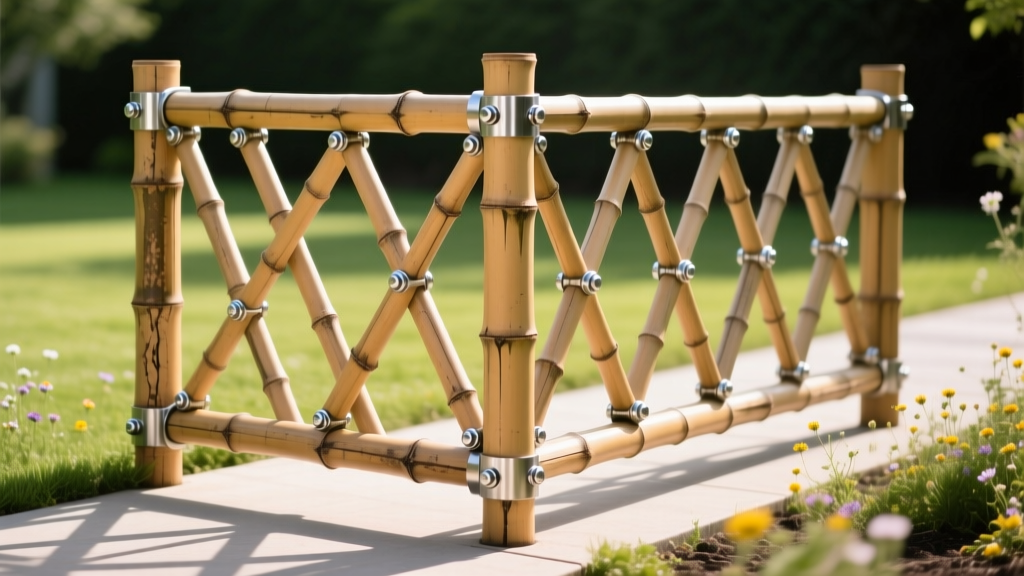
Traditional jute or synthetic lashing is insufficient for permanent, high-load trellises. Lashing allows for micro-movements that degrade the fibers over time and loosen under fluctuating humidity. For structural permanence, you must use mechanical fasteners combined with traditional node-bearing cuts.
1. The Mortise and Tenon "Fish-Mouth" Joint
When attaching horizontal rails to vertical posts, never simply butt the round culms together. This creates a minimal contact patch and concentrates shear stress on the fastener. Instead, carve a "fish-mouth" (copa) joint into the horizontal member so it perfectly cradles the radius of the vertical post. This transfers the vertical dead load directly into the compressive strength of the bamboo wall, leaving the fastener to only manage lateral shear and wind uplift.
2. Bolted Connections and Splitting Prevention
Bamboo's silica-rich outer epidermis and hollow internodes make it highly susceptible to longitudinal splitting when fastened incorrectly.
Always pre-drill pilot holes that are 1/16-inch larger than the shank of your bolt. Use 1/2-inch 304 stainless steel threaded rods with oversized fender washers. The washers distribute the clamping force across the curved epidermis, preventing the nut from pulling through the softer inner pith.
Step-by-Step: Erecting the Primary Frame
Follow this precise sequence to ensure structural plumbness and foundational longevity.
- Excavate and Prepare Footings: Dig post holes 24 inches deep and 10 inches in diameter. Do not use concrete collars. Concrete traps moisture against the bamboo, accelerating fungal decay at the ground node. Instead, fill the hole with 3/4-inch washed crushed gravel, tamping it every 6 inches with a steel post tamper. This provides structural rigidity while allowing water to drain away from the culm.
- Set the Primary Posts: Use Guadua or Moso culms with a minimum 4-inch diameter for vertical posts. Ensure the lowest node of the bamboo sits at least 2 inches above the gravel line to prevent wicking.
- Carve the Fish-Mouth Joints: Using a hole saw or coping saw, cut the intersecting profile into the horizontal beams. Sand the contact patch to ensure a flush fit against the vertical post.
- Drill and Bolt: Drill completely through both the horizontal and vertical members. Insert the 304 stainless steel threaded rod, apply a bead of exterior-grade polyurethane sealant around the bolt entry point to prevent water ingress, and tighten with fender washers and nylon-insert lock nuts.
- Install Diagonal Bracing: To resist lateral wind loads, install 2-inch diameter bamboo diagonal braces at a 45-degree angle at every corner, utilizing the same bolted fish-mouth technique.
Preservation and Treatment Protocols
Raw, untreated bamboo contains high levels of starch and sugars, making it a prime target for powderpost beetles and fungal rot. Before assembling your trellis, the culms must undergo preservation treatment.
For structural outdoor applications, a cold-soak or Boucherie displacement method using a 5% Borax and 5% Boric acid solution is the industry standard. This non-toxic salt mixture penetrates the vascular bundles of the bamboo, rendering the starch unpalatable to insects and inhibiting fungal growth. After treatment, the bamboo must be air-dried in a shaded, well-ventilated area for a minimum of 30 days to reach an equilibrium moisture content of 12-15% before structural loads are applied.
Finally, apply a penetrating UV-inhibiting tung oil or a specialized bamboo sealer (such as Bamboo Shield) to the exterior surface. Reapply this coating every 24 months to protect the silica layer from UV degradation and moisture cycling.
Written by
James ThorntonJames Thornton is a construction industry veteran with 25 years of hands-on experience in wood framing, lumber grading, and residential building codes. He started as a framing carpenter in rural Oregon, earned his ICC Residential Building Inspector certification, and eventually became a senior plan reviewer for the City of Portland Bureau of Development Services. James holds a B.S. in Wood Science & Technology from Oregon State University and is a certified lumber grader through the West Coast Lumber Inspection Bureau (WCLIB). He has inspected over 3,000 residential construction sites and authored the city's internal guide on advanced framing techniques (2x6 at 24" O.C.). James lives in Bend, OR, where he builds custom timber-frame cabins and competes in lumberjack sports.
More from James Thornton
View all
Insulation
Best Home Insulation Materials: Complete 2026 Guide
Compare top home insulation materials for 2026. Find R-values, installed costs per square foot, and best uses for fiberglass, spray foam, and mineral wool.
Aug 4, 2026

Sustainable Building
Certify Your Green Building Material for LEED and WELL
Step-by-step guide to certifying a green building material for LEED v5 and WELL v2. Master EPDs, HPDs, and VOC limits for 2026 project specifications.
Aug 4, 2026

Stone & Masonry
Veneer Stacked Stone Panels: Interior Design & Style Showcase
Discover how veneer stacked stone panels transform interiors. Explore modern design profiles, material pairings, and technical installation specs.
Aug 4, 2026