Building With Bamboo: Essential Treatment Methods For Durability
Discover proven treatment methods for building with bamboo. Learn about borax soaking, Boucherie techniques, and moisture control for structural longevity.

Building with bamboo offers exceptional tensile strength, rapid renewability, and a high strength-to-weight ratio. However, its biological composition makes it highly susceptible to degradation. Untreated Guadua angustifolia or Phyllostachys edulis (Moso) culms will typically succumb to powderpost beetles and fungal rot within two to four years when exposed to the elements. To achieve a structural lifespan of 30 to 50 years, rigorous chemical, thermal, and architectural protocols must be applied. This guide details the exact treatment methodologies and field detailing required to ensure long-term durability.
The Biological Vulnerability of Untreated Bamboo
Unlike timber, which relies on lignin and cellulose for structural integrity, bamboo culms contain high concentrations of starch and sugars within their parenchyma cells. In species like Guadua, starch content can reach 6% to 8% of the dry weight. This carbohydrate profile acts as a primary food source for the bamboo borer (Dinoderus minutus) and various wood-decaying fungi.
Primary Chemical Treatment Protocols
Chemical preservation is the most reliable method for replacing the culm's internal starches with toxic or unpalatable compounds. The industry standard relies on boron-based salts due to their low mammalian toxicity, high water solubility, and effectiveness against both insects and fungi.
The Borax-Boric Acid (BBA) Bath
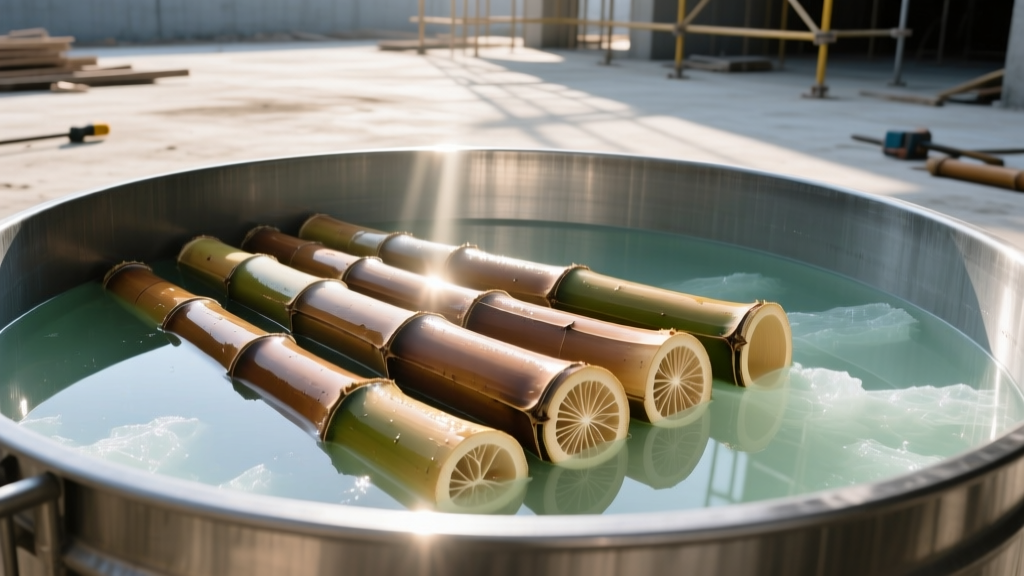
The BBA vertical soaking method is the most accessible and widely adopted technique for structural bamboo. The International Bamboo and Rattan Organization (INBAR) recommends a specific formulation for optimal penetration:
- Ratio: Mix 1 part borax (sodium tetraborate decahydrate) to 1 part boric acid by weight.
- Concentration: Dissolve the mixture in water to achieve a 5% to 8% total salt concentration.
- Temperature: Heat the solution to 60°C (140°F). Heating reduces the liquid's surface tension and expands the bamboo's vascular bundles, accelerating absorption.
- Duration: Submerge culms vertically. Thin-walled species require 5 to 7 days; thick-walled structural species like Guadua require 10 to 14 days.
The Boucherie Displacement Method
For freshly cut, green bamboo (harvested within the last 48 hours), the Boucherie method utilizes the plant's own vascular system. A pressure pump is attached to the base of the unsplit culm, forcing the BBA solution through the xylem and phloem, pushing out the natural sap.
Apply 15 to 25 PSI of continuous pressure. To verify complete penetration, add a non-toxic, water-soluble dye to the BBA tank. When the dyed solution begins to weep from the top nodes and the cut apical end, the treatment is complete. This method takes only 2 to 4 hours per culm but requires the bamboo to be completely unseasoned.
| Method | Best Application | Processing Time | Penetration Depth |
|---|---|---|---|
| BBA Vertical Soak | Air-dried or partially seasoned culms | 7 - 14 Days | Full wall thickness (via diffusion) |
| Boucherie Displacement | Freshly harvested green culms (< 48 hrs) | 2 - 4 Hours | Vascular bundles only |
Thermal Modification and Non-Chemical Alternatives
For projects where chemical treatments are restricted (e.g., interior furniture, children's play structures), thermal modification offers a viable alternative. According to research referenced by the Food and Agriculture Organization (FAO), heating bamboo in an oxygen-depleted kiln to temperatures between 180°C and 200°C (356°F - 392°F) permanently alters its chemical structure.
This process, known as caramelization or torrefaction, breaks down the hemicellulose and starches into complex, indigestible polymers. Thermally modified bamboo achieves an Equilibrium Moisture Content (EMC) of roughly 6% to 8%, making it highly resistant to fungal decay and dimensional swelling. However, thermal modification reduces the culm's bending strength (Modulus of Rupture) by approximately 15% to 20%, meaning engineers must upsize the culm diameter when specifying it for load-bearing beams. Expect thermal modification to add $1.20 to $2.00 per linear foot to material costs compared to standard air-dried bamboo.
Architectural Detailing: Defending Against Moisture
Chemical treatment protects against insects and internal rot, but poor architectural detailing will destroy treated bamboo through chronic moisture entrapment. The traditional bamboo building maxim—"give it a good hat and good shoes"—remains the governing principle of modern bamboo engineering.
"Bamboo does not rot from the rain; it rots from the splashback and the trapped condensation. If a culm cannot dry out within 24 hours of getting wet, no amount of borax will save it from soft rot."
Base and Foundation Detailing
Never embed bamboo directly into concrete. The alkaline environment of curing concrete degrades the bamboo's silica layer, while the porous concrete wicks ground moisture directly into the culm's end-grain. Instead, elevate the bamboo a minimum of 12 inches (300mm) above finished grade. Use cast concrete piers topped with galvanized or 316 stainless steel base plates. Secure the culm using a steel dowel pin driven through the node diaphragm, and seal the top of the culm with a flexible polyurethane cap to prevent water ingress into the hollow internode cavities.
Joinery and Fasteners
Bamboo is highly prone to splitting along its longitudinal fibers. When bolting through culms, always pre-drill holes 1/16 inch larger than the bolt diameter to allow for thermal expansion and moisture-induced swelling. Use neoprene or EPDM rubber washers between the steel gusset plates and the bamboo surface to distribute clamping forces evenly and prevent crushing the outer epidermis. For coastal or high-humidity environments, specify 316 marine-grade stainless steel fasteners; standard galvanized hardware will corrode and stain the bamboo within three years.
Expected Lifespan and Maintenance Cycles
The longevity of a bamboo structure is a direct function of the treatment applied and the environmental exposure it faces. The American Bamboo Society and structural engineers generally classify bamboo lifespan into the following tiers:
- Untreated, Ground Contact: 1 to 2 years before structural failure from rot.
- Treated, Exposed to Weather: 10 to 15 years. Requires bi-annual sealing.
- Treated, Protected (Under Roof, Off Ground): 30 to 50+ years. Functionally equivalent to protected timber framing.
For exterior elements that remain exposed to UV radiation and rain, apply a penetrating UV-inhibiting sealer (such as specialized bamboo oils or high-solids tung oil blends) every 24 to 36 months. Avoid film-forming finishes like polyurethane on exterior bamboo; as the culm expands and contracts with seasonal humidity shifts, film finishes will micro-crack, trapping moisture beneath the surface and accelerating localized decay.
Written by
Sarah WhitfieldSarah Whitfield is a chartered quantity surveyor (MRICS) and construction cost analyst with 15 years of experience in material pricing, procurement strategy, and project budgeting. She earned her degree in Construction Management from the University of Reading (UK) and has worked on projects ranging from $2M custom homes to $180M mixed-use developments across North America and Europe. Sarah currently leads cost estimating for BuildMat Insight, maintaining a proprietary database of 4,000+ material price points updated quarterly. She is a frequent contributor to RSMeans cost data panels and has presented at the International Cost Engineering Council (ICEC) congress. Based in Denver, CO, Sarah is an avid trail runner and volunteer mentor for Women in Construction.
More from Sarah Whitfield
View all
Wood & Lumber
What Are the Different Types of Wood? A Builder's Guide
Compare structural softwoods, finish hardwoods, and engineered lumber. Analyze Janka ratings, MOE values, and 2026 pricing for construction.
Aug 4, 2026

Walls & Panels
Steel Framing vs Wood Framing: Corrosion and Moisture Defense
Compare steel framing vs wood framing for moisture resistance. Learn about galvanized coatings, condensation risks, and corrosion protection strategies.
Jul 21, 2026

Stone & Masonry
How to Cut Stone Veneer: Wet Saw vs Grinder Comparison
Compare the best tools for cutting stone veneer. We review wet saws, angle grinders, and chop saws to help you achieve clean, chip-free cuts.
Jul 21, 2026