Structural Insights from Top Bamboo Fly Rod Building Classes
Discover how bamboo fly rod building classes teach micro-structural engineering, taper design, and heat-treating Tonkin cane for optimal flex and strength.

The Micro-Structural Marvel of Tonkin Cane
While macro-scale bamboo construction focuses on load-bearing columns and trusses, the most precise structural application of the material occurs on a micro-scale. Enrolling in bamboo fly rod building classes is essentially taking a masterclass in advanced cantilever beam engineering. The primary material used is Arundinaria amabilis, commonly known as Tonkin cane. Unlike timber bamboo species used in scaffolding, Tonkin cane possesses an exceptionally dense, uniform vascular bundle distribution that makes it ideal for dynamic cyclic loading.
In a fly rod, the bamboo blank acts as a tapered, hexagonal cantilever beam subjected to immense bending moments and rapid recovery cycles. The outer 30% of the culm wall contains nearly 80% of the structural fiber sheaths (vascular bundles). Expert rod makers meticulously plane away the softer, pith-filled interior to maximize the high-modulus outer enamel and dense longitudinal fibers. This selective material removal optimizes the strength-to-weight ratio, a principle directly mirrored in aerospace composite manufacturing.
Tonkin Cane Structural Baseline Metrics
- Specific Gravity: 0.75 – 0.85 (oven-dry)
- Modulus of Elasticity (MOE): 1.5 – 2.2 million psi
- Modulus of Rupture (MOR): 16,000 – 22,000 psi
- Moisture Content (Equilibrium): 6% – 8% (post-tempering)
Data synthesized from material testing referenced by the USDA Forest Products Laboratory and empirical rod-maker telemetry.
Thermodynamics of Heat Treatment and Lignin Crystallization
A core curriculum component of any reputable bamboo fly rod building class is the thermodynamics of heat treating. Raw bamboo is hygroscopic and prone to plastic deformation under sustained loads. To stabilize the blank, makers must alter the lignin matrix—the natural polymer that binds the cellulose fibers.
Oven Tempering vs. Flame Treating
Lignin reaches its glass transition temperature at approximately 350°F (176°C). In controlled oven tempering, the milled hexagonal blank is baked at 375°F for 15 to 22 minutes. This process drives off residual bound moisture and reorganizes the lignin into a more rigid, crystalline structure. The result is a permanent increase in the Modulus of Elasticity and the 'setting' of the blank's straightness memory.
Conversely, flame treating involves passing the blank rapidly over an alcohol flame. While this caramelizes the sugars in the bamboo and creates a highly prized amber aesthetic, it introduces a steep thermal gradient. If the core temperature does not reach the lignin glass transition point uniformly, the rod will suffer from asymmetric recovery rates, causing the tip to twist laterally during the casting stroke. Structural purists generally favor oven tempering for predictable, homogenous material properties.
Taper Design and Bending Moment Distribution
The taper of a fly rod dictates how the bending moment is distributed along the cantilever beam during a cast. A rod is measured at 5-inch stations, with dimensions typically ranging from 0.320 inches at the grip to 0.060 inches at the tip. These measurements are taken across the flats of the hexagon, requiring tolerances of 0.001 inches.
According to beam theory, the stress at any given point is proportional to the bending moment divided by the section modulus. Because the bending moment is highest at the grip and approaches zero at the tip, the rod must taper down to prevent the tip from acting as a rigid lever that snaps the mid-section.
| Station (Inches) | Dimension Across Flats | Structural Function |
|---|---|---|
| 00 (Grip) | 0.320' | Maximum section modulus; absorbs peak bending moment. |
| 15 | 0.265' | Transition zone; initiates the primary flex curve. |
| 35 (Mid) | 0.185' | Hinge point; dictates the rod's action (fast vs. parabolic). |
| 55 | 0.110' | High-stress flex zone; requires flawless node staggering. |
| 80 (Tip) | 0.065' | Terminal recovery; relies on high fiber density for snap. |
Adhesive Shear Strength: Managing the Glue Lines
A hexagonal bamboo rod consists of six equilateral triangular strips. This creates six continuous glue lines running the length of the blank. During a casting stroke, the rod undergoes rapid compression on the inside of the curve and extreme tension on the outside. The glue lines sit precisely at the neutral axis and the outer edges, subjecting the adhesive to severe shear and peel stresses.
- Resorcinol-Formaldehyde (e.g., Cascophen): The traditional standard. It offers exceptional shear strength, total waterproofing, and high UV resistance. However, it requires strict temperature control (minimum 70°F for 48 hours) and leaves a distinct dark purple glue line. It is brittle and requires perfectly milled strips with zero gaps.
- Aerospace-Grade Epoxies (e.g., System Three T-88): Modern structural epoxies provide gap-filling properties and longer open times, making them forgiving for students in bamboo fly rod building classes. While they exhibit slightly higher creep under sustained high-heat loads compared to resorcinol, their tensile shear strength easily exceeds the cohesive strength of the bamboo itself.
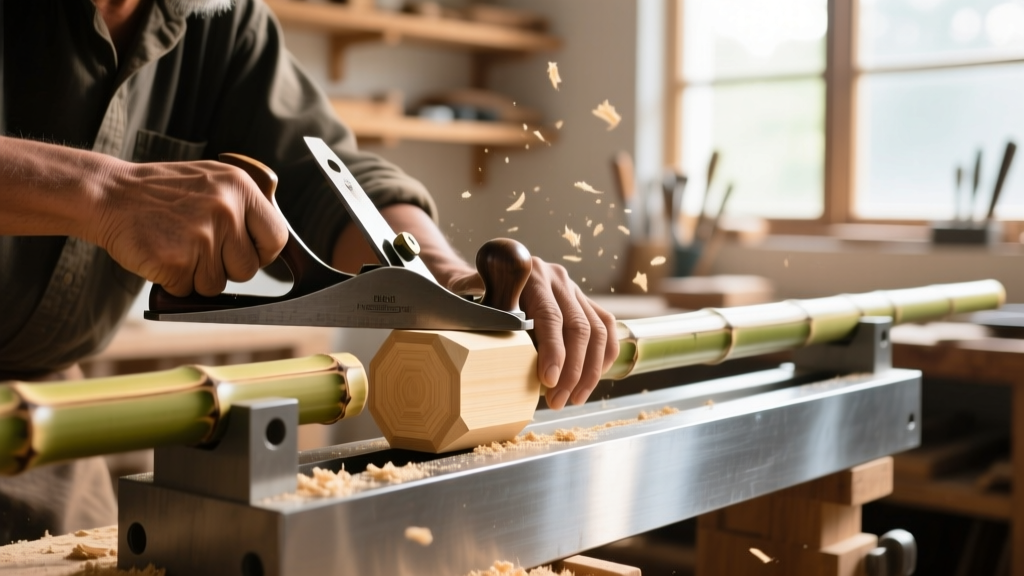
Node Staggering: Preventing Structural Hinge Points
In bamboo anatomy, the node is a structural discontinuity. The longitudinal vascular bundles deviate to form a cross-wall, creating a localized zone of high stiffness but low tensile continuity. If the nodes of the six individual strips align on the same horizontal plane, it creates a 'hinge point'—a severe stress concentration that will inevitably lead to a catastrophic delamination or snap under load.
'A properly staggered node pattern is non-negotiable. We teach the 2-2-2 or 3-3 spiral stagger to ensure that no single cross-section of the hexagon contains more than one node. You are essentially distributing the structural discontinuities across the Z-axis of the beam.'
— Master Rod Maker and Instructor, Fly Fishers International recognized guild.
Ferrule Engineering and Stress Concentrations
Fly rods are typically built in two or three sections, joined by metal ferrules (usually nickel silver). The transition from a flexible, anisotropic bamboo composite to a rigid, isotropic metal tube creates a massive stress concentration. If the bamboo is simply glued into a straight cylindrical ferrule, the bending moment will abruptly terminate at the metal edge, snapping the cane.
Advanced classes teach the 'swelled ferrule' design. The bamboo blank is deliberately swelled (tapered up) just before the ferrule station, increasing the section modulus to compensate for the localized stiffness of the metal. This creates a smooth, continuous parabolic transfer of energy across the joint, eliminating the dead spot and preventing shear failure at the ferrule edge.
Selecting the Right Bamboo Fly Rod Building Classes
When evaluating a curriculum, look beyond the romance of the craft and scrutinize the engineering depth. A superior program will not merely teach you how to push a hand plane; it will contextualize the material science behind the cuts. Ensure the syllabus covers the following structural competencies:
Curriculum Checklist for Structural Mastery
- Material Selection: How to tap and test raw culms for acoustic resonance and fiber density (specific gravity sorting).
- Enamel Preservation: Techniques for milling without cutting through the high-tensile outer enamel layer.
- Moisture Equilibrium: Protocols for storing milled strips in climate-controlled environments to prevent asymmetric warping prior to glue-up.
- Dynamic Testing: Methods for deflection-testing the finished blank to map the actual curve against the theoretical taper design.
For further reading on the botanical and structural properties of bamboo species used in specialized applications, the American Bamboo Society provides extensive archives on culm morphology and mechanical grading. Ultimately, mastering the structural application of Tonkin cane bridges the gap between ancient material use and modern precision engineering, yielding a tool that is as mathematically perfect as it is beautiful.
Written by
Sarah WhitfieldSarah Whitfield is a chartered quantity surveyor (MRICS) and construction cost analyst with 15 years of experience in material pricing, procurement strategy, and project budgeting. She earned her degree in Construction Management from the University of Reading (UK) and has worked on projects ranging from $2M custom homes to $180M mixed-use developments across North America and Europe. Sarah currently leads cost estimating for BuildMat Insight, maintaining a proprietary database of 4,000+ material price points updated quarterly. She is a frequent contributor to RSMeans cost data panels and has presented at the International Cost Engineering Council (ICEC) congress. Based in Denver, CO, Sarah is an avid trail runner and volunteer mentor for Women in Construction.
More from Sarah Whitfield
View all
Wood & Lumber
What Are the Different Types of Wood? A Builder's Guide
Compare structural softwoods, finish hardwoods, and engineered lumber. Analyze Janka ratings, MOE values, and 2026 pricing for construction.
Aug 4, 2026

Walls & Panels
Steel Framing vs Wood Framing: Corrosion and Moisture Defense
Compare steel framing vs wood framing for moisture resistance. Learn about galvanized coatings, condensation risks, and corrosion protection strategies.
Jul 21, 2026

Stone & Masonry
How to Cut Stone Veneer: Wet Saw vs Grinder Comparison
Compare the best tools for cutting stone veneer. We review wet saws, angle grinders, and chop saws to help you achieve clean, chip-free cuts.
Jul 21, 2026