Selecting Owens Corning Fiberglass Insulation: Types & R-Values
Compare Owens Corning fiberglass insulation types, R-values, and facings. Expert selection guide for batts, rolls, and blown-in glass fiber.
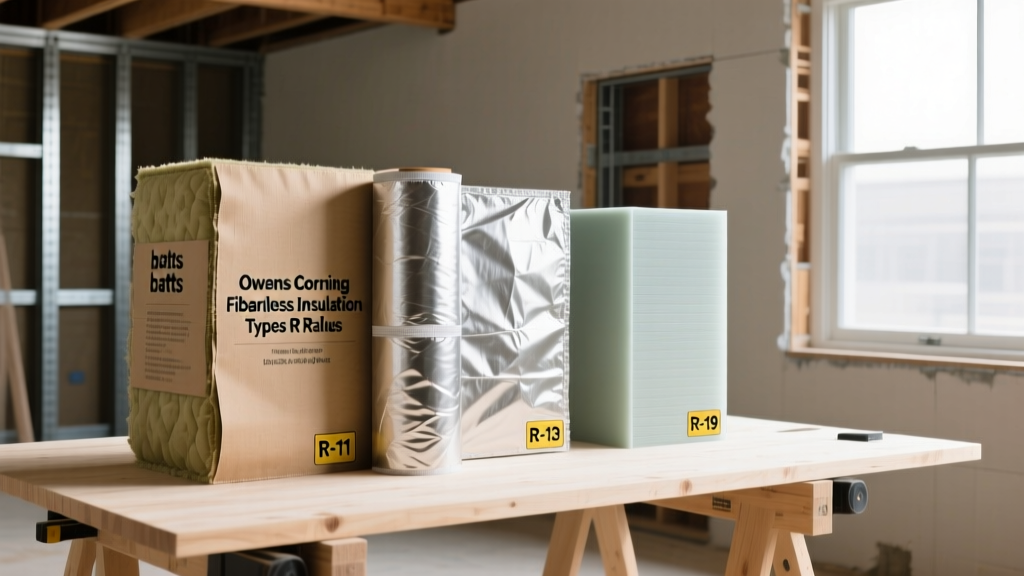
The Glass Origins: Why Fiberglass Dominates Thermal Envelopes
While often categorized simply as 'insulation,' fiberglass is fundamentally a glass building material. The manufacturing process involves melting silica sand, limestone, and recycled glass cullet at temperatures exceeding 2,500°F (1,370°C). This molten glass is then spun through micro-fine orifices to create continuous, interlocking fibers. This spun-glass matrix traps millions of microscopic air pockets, which restrict conductive and convective heat transfer. Understanding this glass-based material science is critical for architects and builders selecting thermal barriers, as the density, binder chemistry, and fiber orientation directly dictate both the R-value and acoustic performance of the final product.
Taxonomy of Owens Corning Fiberglass Insulation Products
Owens Corning structures its fiberglass portfolio around specific installation methods and density requirements. Selecting the correct product line requires matching the material's physical form to the framing geometry and the building's hygrothermal control strategy.
EcoTouch PINK Batts and Rolls (Standard & High-Density)
The EcoTouch line represents the industry standard for pre-cut batts and continuous rolls. The defining innovation of the modern EcoTouch line is its formaldehyde-free, bio-based binder (derived from corn starch and soybean oil), which replaces the phenol-formaldehyde resins used in legacy glass fiber products.
- Standard Density (R-13 / R-19): Designed for standard 2x4 and 2x6 framing. R-13 measures 3.5 inches thick, while R-19 measures 6.25 inches (often compressed to 5.5 inches in 2x6 cavities).
- High-Density (R-15 / R-21): Engineered with a tighter glass-fiber weave to achieve higher thermal resistance without increasing thickness. R-15 fits a 3.5-inch 2x4 cavity, and R-21 fits a 5.5-inch 2x6 cavity. This is mandatory for meeting modern IECC energy codes in mixed and cold climates without switching to exterior continuous foam.
PROPINK Blown-In Fiberglass
PROPINK is a loose-fill, unbonded glass fiber designed for pneumatic application. Unlike batts, blown-in fiberglass conforms to irregular framing, bypasses complex wiring and plumbing runs, and eliminates the thermal bridging gaps common with poorly cut batts. The L77 variant is specifically engineered for attic floor applications, requiring a minimum installed density of 2.5 lbs per cubic foot to prevent long-term settling, which would otherwise degrade the specified R-value over time.
Facing Selection Matrix: Kraft, FSK, and Unfaced
The facing applied to fiberglass batts is not merely a handling aid; it is a critical hygrothermal control layer. Misapplying a vapor-impermeable facing in a hot-humid climate can trap moisture inside wall cavities, leading to mold and structural rot. According to the Building Science Corporation, vapor retarder selection must align with the specific climate zone's drying potential.
| Facing Type | Permeability Rating | Vapor Retarder Class | Optimal Application |
|---|---|---|---|
| Kraft Paper | ~1.0 Perm | Class II | Cold/Mixed climates (facing interior drywall) |
| FSK (Foil-Scrim-Kraft) | ~0.02 Perm | Class I | Exterior sheathing, basement walls, metal buildings |
| Unfaced | ~30+ Perms | None (Permeable) | Hot-humid climates, interior partition walls, over existing insulation |
R-Value Selection Framework by Climate Zone
The U.S. Department of Energy mandates specific thermal resistance minimums based on IECC climate zones. When utilizing Owens Corning fiberglass, builders must account for the 'compression penalty'—forcing a thicker batt into a shallower cavity increases density but reduces the total trapped air, ultimately lowering the effective R-value.
- Zones 1-2 (Hot-Humid / Tropical): 2x4 walls require R-13 (Unfaced). Attics require R-30 to R-38 (Blown-in PROPINK). Vapor barriers should be avoided to allow inward drying.
- Zones 3-4 (Mixed / Marine): 2x4 walls require R-13 to R-15 (Kraft-faced). 2x6 walls require R-19 to R-21. Attics require R-38 to R-49.
- Zones 5-8 (Cold / Subarctic): 2x6 walls are mandatory, requiring R-21 High-Density (Kraft-faced). Attics require R-49 to R-60. In these zones, pairing R-21 cavity insulation with R-5 to R-10 exterior continuous rigid foam is highly recommended to mitigate thermal bridging through the wooden studs.
Cost Analysis and Installation Variables
Pricing for Owens Corning fiberglass fluctuates based on regional supply chains, facing materials, and density. The following data reflects average Q1 2026 national retail pricing for residential-grade materials.
| Product Specification | Thickness | Material Cost (per sq. ft.) | Installed Cost (per sq. ft.) |
|---|---|---|---|
| R-13 Kraft Faced Batts | 3.5" | $0.65 - $0.80 | $1.50 - $1.90 |
| R-15 High-Density Kraft | 3.5" | $0.95 - $1.15 | $1.80 - $2.20 |
| R-21 High-Density Unfaced | 5.5" | $1.20 - $1.45 | $2.10 - $2.60 |
| PROPINK Blown-In (R-38) | ~13.0" | $1.10 - $1.30 | $2.00 - $2.50 |
Acoustic Properties of Spun Glass
Beyond thermal resistance, the glass-fiber matrix is a highly effective acoustic dampener. While mass (like concrete or drywall) blocks sound transmission, porous absorbers like fiberglass dissipate sound wave energy by converting it into negligible amounts of heat via friction within the fiber web. Owens Corning unfaced fiberglass batts yield Noise Reduction Coefficients (NRC) between 0.90 and 1.05 depending on thickness. For interior partition walls requiring sound isolation (e.g., home theaters, bedrooms, multi-family demising walls), specifying unfaced R-13 or R-15 batts inside staggered-stud or resilient-channel assemblies is a cost-effective method to drastically reduce airborne speech and HVAC noise transmission.
Common Installation Failures with Spun Glass
The thermal performance of Owens Corning fiberglass is entirely dependent on proper installation. The Owens Corning technical documentation highlights that even a 4% gap in cavity coverage can reduce the overall wall R-value by up to 50% due to convective looping.
"Fiberglass insulation must completely fill the cavity without gaps, compressions, or voids. Stuffing a 6-inch batt into a 3-inch cavity does not yield R-19; it yields a degraded R-value due to the elimination of the insulating air pockets trapped within the glass matrix."
Edge Case Warning for Retrofits: When adding insulation to existing attics, never place faced batts directly over existing insulation with the facing pointing up. The Kraft or FSK facing will act as a vapor barrier mid-assembly, trapping rising interior moisture between the old and new layers, inevitably causing ceiling drywall rot. Always use unfaced batts or blown-in PROPINK for attic overlays, and install perpendicular to the existing joists to cap thermal bridging through the wood framing.