Complete Insulation R Value Chart & Material Performance Guide
Compare material performance with our comprehensive insulation R value chart. Explore real-world specs, thermal drift, and modern code requirements.
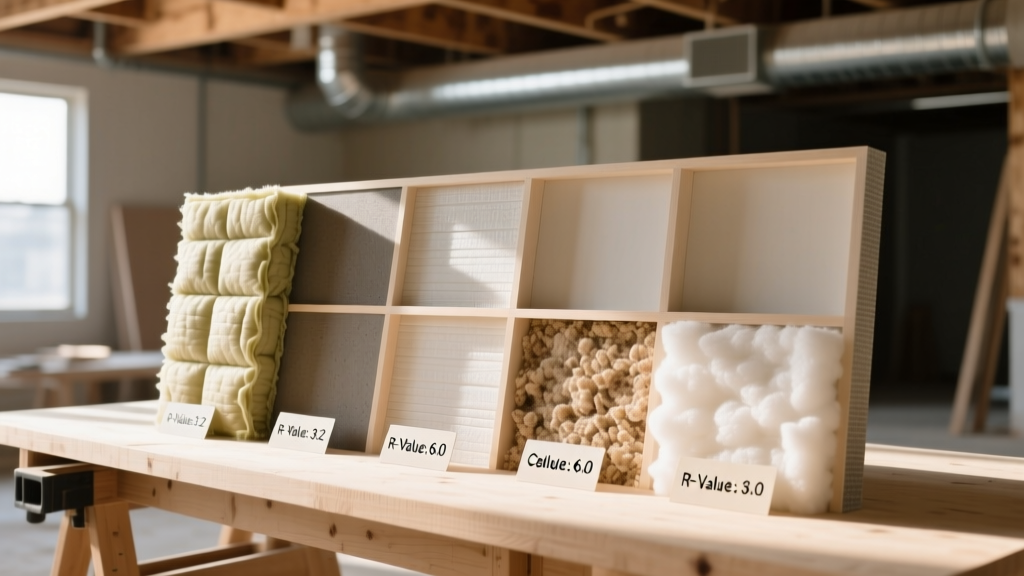
The Reality of Thermal Resistance: Lab vs. Field
The term "R-value" measures a material's resistance to conductive heat flow under strictly controlled laboratory conditions (typically at a mean temperature of 75°F). However, building assemblies operate in dynamic environments with fluctuating temperatures, moisture loads, and air infiltration. Relying solely on a manufacturer's printed R-value without understanding assembly dynamics, thermal bridging, and material-specific degradation leads to underperforming building envelopes and inflated energy costs.
This guide provides a definitive insulation R value chart paired with critical performance specifications, real-world failure modes, and cost-to-performance matrices required for modern building enclosure design.
The Master Insulation R Value Chart (2026 Specifications)
The following chart details the core thermal and moisture properties of primary insulation categories. Permeability ratings dictate whether a material acts as a vapor retarder, which is critical for preventing interstitial condensation in wall and roof assemblies.
| Material Type | R-Value Per Inch | Vapor Permeability | Primary Application & Notes |
|---|---|---|---|
| Closed-Cell Spray Foam (ccSPF) | R-6.5 to R-7.4 | Class II (Semi-Impermeable) | Rooflines, rim joists, flood zones. Provides structural racking strength and acts as an air/water barrier at 1.5+ inches. |
| Open-Cell Spray Foam (ocSPF) | R-3.5 to R-3.8 | Vapor Permeable | Interior wall cavities, attic underside. Excellent air sealant but requires a separate vapor retarder in cold climates. |
| Polyisocyanurate (Polyiso) | R-5.6 to R-6.5* | Class I (Impermeable) | Continuous exterior insulation (ci), commercial roofing. *Subject to thermal drift (see below). |
| Extruded Polystyrene (XPS) | R-5.0 | Class II (Semi-Impermeable) | Below-grade foundations, inverted roofs. High compressive strength; blowing agents are transitioning to low-GWP alternatives. |
| Expanded Polystyrene (EPS) | R-3.8 to R-4.4 | Vapor Permeable | Sub-slab insulation, exterior sheathing (GPS). R-value remains stable across extreme temperature ranges. |
| Mineral Wool (Stone Wool) | R-4.0 to R-4.3 | Vapor Permeable | Fire-stopping, exterior ci, acoustic isolation. Hydrophobic, non-combustible, and highly vapor open. |
| Fiberglass Batts (High-Density) | R-3.7 to R-4.3 | Vapor Permeable | Standard stud cavities. Requires meticulous air sealing (e.g., Airtight Drywall Approach) to prevent convective heat loss. |
| Cellulose (Dense-Packed) | R-3.6 to R-3.8 | Vapor Permeable | Retrofits, cathedral ceilings. Excellent air-blocking properties when packed at 3.5+ lbs/ft³; manages moisture well. |
Beyond the Label: Field vs. Laboratory Performance
A common specification error is assuming cavity insulation R-values translate directly to whole-wall performance. According to research by the Oak Ridge National Laboratory (ORNL), a standard 2x4 wood-framed wall with R-13 fiberglass batts actually yields a "whole-wall" R-value of approximately R-9. This 30% reduction is caused by thermal bridging—heat transferring rapidly through the solid wood studs, plates, and headers, which have an R-value of only ~R-1.25 per inch.
Specification Framework: Overcoming Thermal Bridging
To achieve true design R-values, modern building codes increasingly mandate continuous insulation (ci). By placing a layer of rigid mineral wool or EPS over the exterior sheathing, you break the thermal bridge. For example, a 2x6 wall (R-20 cavity) wrapped in 2 inches of exterior mineral wool (R-8.4) achieves a highly efficient whole-wall R-value exceeding R-25, drastically reducing condensation risk on the interior sheathing.
Thermal Drift and Cold-Weather Degradation
Not all R-values are static. Polyisocyanurate (Polyiso) rigid foam exhibits a phenomenon known as thermal drift. The blowing agents trapped in the foam's cells condense at lower temperatures, causing the material's R-value to drop significantly in cold weather. At a mean temperature of 25°F, a Polyiso board rated at R-6.5 per inch at 75°F may perform closer to R-4.5 per inch.
Actionable Advice: In Climate Zones 5 and higher (where winter design temperatures regularly drop below freezing), avoid using Polyiso as the primary exterior continuous insulation or below-grade insulation. Instead, specify Expanded Polystyrene (EPS) or Extruded Polystyrene (XPS), which maintain or slightly increase their R-value as temperatures drop. The Department of Energy explicitly outlines these temperature-dependent performance variations in their building enclosure guidelines.
Compression and Convective Looping Failures
Field installation errors routinely destroy theoretical R-values. Two primary failure modes dominate residential and light-commercial construction:
- Compression: Stuffing an R-21 (5.5-inch) fiberglass batt into a 2x4 (3.5-inch) wall cavity does not yield R-21. The compression increases the material's density but reduces its overall thermal resistance, resulting in an effective R-value of roughly R-14 to R-15, while simultaneously creating immense pressure against the interior drywall that can cause fastener pops.
- Convective Looping: Fiberglass and mineral wool are vapor-permeable and air-permeable. If the interior drywall and exterior sheathing are not perfectly sealed, wind washing and temperature differentials will create microscopic convective loops within the batt, stripping away up to 40% of the assembly's thermal resistance. Always pair air-permeable cavity insulation with a dedicated air barrier system.
Assembly Cost vs. Thermal Resistance Matrix
When budgeting an enclosure, evaluating materials strictly by "cost per board foot" is misleading. The metric that matters is installed cost per R-value achieved. Below is a comparative matrix based on 2026 national average installed costs for achieving an R-20 cavity assembly.
| Insulation Assembly (R-20 Target) | Approx. Installed Cost (per sq. ft.) | Air Sealing Included? | Space Penalty |
|---|---|---|---|
| High-Density Fiberglass Batts (2x6) | $1.80 - $2.40 | No (Requires separate membrane/caulking) | 5.5 inches |
| Dense-Packed Cellulose (2x6) | $2.20 - $2.90 | Partial (Reduces air movement) | 5.5 inches |
| Open-Cell Spray Foam (5.5 inches) | $3.50 - $4.50 | Yes (Monolithic air barrier) | 5.5 inches |
| Closed-Cell Spray Foam (3 inches) | $5.50 - $7.00 | Yes (Air, vapor, and water barrier) | 3.0 inches (Saves space) |
Warning: Acoustic vs. Thermal Misconceptions
Do not conflate acoustic insulation with thermal R-value. Products like Rockwool Safe'n'Sound are engineered with specific fiber orientations and densities to absorb sound waves (improving STC ratings). However, they are not tested or rated for thermal resistance. Using acoustic-specific batts in exterior thermal boundaries will result in uninspected, non-compliant wall assemblies. Always verify the ASTM C518 thermal rating on the product datasheet.
Navigating Code Requirements and Climate Zones
The transition toward the 2024 and 2026 International Energy Conservation Code (IECC) updates heavily favors the "Perfect Wall" concept. The EPA's Energy Star program aligns with these codes, pushing builders away from cavity-only insulation.
In Marine Climate 3 and Cold Climates 5-8, code now frequently requires that a specific percentage of the total wall R-value come from continuous, exterior insulation to prevent the dew point from occurring inside the structural sheathing. For a 2x6 wall in Climate Zone 6 (requiring R-20+ total), codes may mandate a minimum of R-7.5 to R-10 of continuous exterior rigid foam or mineral wool. Specifying interior vapor barriers (like polyethylene sheeting) in these "flash-and-batt" or ci assemblies is a critical failure mode that traps moisture; instead, rely on the exterior foam's inherent vapor resistance and use vapor-variable interior membranes (intelligent retarders) that allow the wall to dry inward during the cooling season.
Final Specification Checklist
Before finalizing your insulation schedule, verify the following parameters against your specific climate zone and architectural design:
- Dew Point Analysis: Have you calculated the condensing surface temperature to ensure the exterior sheathing remains above the dew point in winter?
- Blowing Agent GWP: Are your specified XPS or ccSPF products using next-generation HFO blowing agents to comply with evolving environmental regulations?
- Thermal Bridging: Have you accounted for the R-value reduction caused by framing members, balconies, and slab edges?
- Material Compatibility: Does the vapor permeability profile of your insulation stack allow the assembly to dry in at least one direction?