Choosing the Best Roof Insulation Material for Energy Efficiency
Discover the best roof insulation material for your building. Compare R-values, costs, and energy efficiency of spray foam, rigid boards, and mineral wool.

Thermal Dynamics and the Role of Roof Insulation Material
Heat transfer in roofing assemblies occurs via conduction through the deck, convection via air leaks, and radiation from solar gain. Selecting the correct roof insulation material requires addressing all three vectors simultaneously. According to the U.S. Department of Energy, a poorly insulated roof can account for up to 25% of a building's total heat loss in winter and equivalent cooling loads in summer. Modern energy codes, including the 2024 and upcoming 2026 IECC updates, mandate continuous insulation (ci) for commercial and high-performance residential roofs, pushing minimum R-value requirements to R-30 through R-49 depending on the climate zone.
This guide bypasses generic advice to provide a technical comparison of the three dominant roof insulation material categories used in modern construction: Closed-Cell Spray Polyurethane Foam (ccSPF), Polyisocyanurate (Polyiso) rigid boards, and Mineral Wool. We evaluate their real-world thermal performance, installed costs, and specific failure modes.
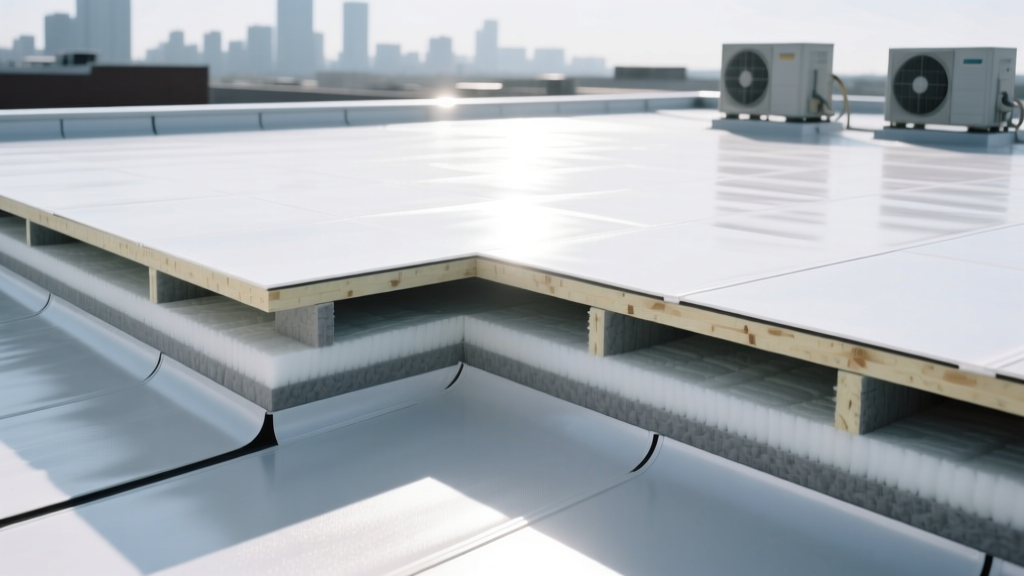
Comparative Analysis of Top Roof Insulation Material Options
The table below outlines the baseline specifications for the primary roofing insulation materials. Note that "Cost per Board Foot" reflects 2026 national averages for material only, excluding labor and substrate preparation.
| Material Type | R-Value per Inch | Cost per Board Ft | Vapor Permeability | Primary Use Case |
|---|---|---|---|---|
| Closed-Cell SPF | 6.5 - 7.0 | $1.80 - $2.50 | Class II (Semi-Impermeable) | Complex geometries, unvented attics |
| Polyiso Rigid Board | 5.6 - 6.5 (Temp Dependent) | $0.70 - $1.10 | Class I (Impermeable with foil) | Flat commercial roofs, above-deck ci |
| Mineral Wool Board | 4.0 - 4.3 | $1.10 - $1.60 | Vapor Permeable | Fire-rated assemblies, acoustic control |
1. Closed-Cell Spray Polyurethane Foam (ccSPF)
ccSPF is a two-component liquid that expands to 30 times its volume, curing into a rigid, high-density cellular matrix. Products like Demilec Heatlok Soya HPS or Gaco Western ProFill provide an aged R-value of approximately 6.8 per inch. Beyond thermal resistance, 2-inch thickness of ccSPF qualifies as a Class II vapor retarder and provides an air barrier that meets ASTM E2178 standards.
Application Specifics: ccSPF is the optimal roof insulation material for complex rooflines, cathedral ceilings, and unvented attic assemblies where rigid boards cannot achieve a continuous seal. It adheres directly to the roof deck, eliminating the convective loops that plague batt insulation. However, application requires certified professionals, and the installed cost is significantly higher, averaging $3.50 to $5.00 per square foot for a 3-inch application.
2. Polyisocyanurate (Polyiso) Rigid Boards
Polyiso is the most widely used commercial roof insulation material due to its high initial R-value (up to 6.5 per inch at 75°F) and cost-effectiveness. Brands like Johns Manville ACFoam and Hunter Panels Polyiso dominate the market. The foil facers on standard Polyiso boards provide an exceptional radiant barrier and a Class I vapor retarder.
Specifiers must account for "thermal drift" in Polyiso. The blowing agents used in the manufacturing process condense at extreme low temperatures. In winter conditions (below 40°F / 4°C), the effective R-value of Polyiso can drop by 20% to 25%. For buildings in IECC Climate Zones 5 through 8, relying solely on the labeled 75°F R-value will result in undersized assemblies and winter condensation risks. Always calculate winter heat loss using the material's cold-temperature R-value curve, or hybridize with a layer of EPS or XPS to maintain thermal resistance in freezing conditions.
3. Mineral Wool (Stone Wool) Boards
Mineral wool, such as ROCKWOOL Comfortboard 80 or Owens Corning Thermafiber, offers an R-value of roughly 4.2 per inch. While thermally inferior to foams, it is the premier roof insulation material for assemblies requiring high fire resistance and acoustic attenuation. Mineral wool is non-combustible (ASTM E136) and can withstand temperatures exceeding 1,800°F, making it mandatory in many parapet walls and fire-rated roof deck assemblies.
Furthermore, mineral wool is vapor-permeable, allowing roof assemblies to dry to the exterior. This makes it an excellent choice for "smart" roof designs in mixed-humid climates where trapping moisture inside the roof deck is a primary concern. It is typically installed in multiple layers with staggered joints to prevent thermal bridging through the board seams.
Hidden Failure Modes in Roof Insulation Assemblies
Selecting the right material is only half the battle; improper detailing leads to catastrophic energy loss. The EPA's ENERGY STAR program emphasizes that air sealing and thermal continuity are just as critical as the R-value of the material itself.
In mechanically attached flat roof systems, steel or heavy-duty plastic fasteners penetrate the continuous insulation to secure it to the steel or wood deck. A single uninsulated steel fastener can reduce the effective R-value of a 4-inch Polyiso roof assembly by up to 8%. Fix: Always specify a multi-layer installation. Use a base layer of Polyiso mechanically fastened to the deck, then adhere a top cover board and the primary insulation layer using low-rise polyurethane adhesive to eliminate fastener penetrations through the outer thermal layer.
- Moisture Entrapment in Cold Climates: Installing an interior vapor retarder (like polyethylene) below a roof deck in a cold climate, combined with an impermeable exterior roof membrane, traps construction moisture inside the assembly. Use variable-permeability smart membranes (e.g., Intello Plus) on the warm-in-winter side to allow seasonal drying.
- Compression of Batts: If fiberglass or mineral wool batts are compressed to fit into shallow rafter bays, their R-value plummets. A 6-inch R-19 batt compressed into a 5.5-inch 2x6 cavity yields an effective R-value of roughly R-17, while simultaneously blocking the necessary ventilation channel required for vented roof designs.
Climate Zone Selection Framework
To optimize energy efficiency and prevent moisture-related degradation, match your roof insulation material to your specific IECC Climate Zone:
Hot-Humid Zones (1-3)
Recommended Material: ccSPF or Foil-Faced Polyiso.
Strategy: The primary goal is blocking solar radiation and preventing exterior humid air from condensing on cool, air-conditioned interior surfaces. Use an unvented roof assembly with ccSPF sprayed directly to the underside of the roof deck, or a fully adhered exterior Polyiso assembly above the deck. Ensure the interior side remains vapor-permeable to allow inward drying.
Mixed-Humid and Marine Zones (4)
Recommended Material: Hybrid Polyiso and Mineral Wool.
Strategy: These zones experience both severe cooling and heating loads. A hybrid approach utilizing exterior Polyiso for high R-value, coupled with an interior layer of vapor-permeable mineral wool, provides thermal resistance while allowing the assembly to dry in both directions depending on the season.
Cold and Very Cold Zones (5-8)
Recommended Material: XPS/EPS base layer with Polyiso top layer, or thick ccSPF.
Strategy: Due to the cold-temperature R-value drop of Polyiso, it is critical to use a "flash and batt" or hybrid rigid board approach. Place a layer of Extruded Polystyrene (XPS) or Expanded Polystyrene (EPS) directly against the cold side of the deck to maintain baseline R-value and prevent condensation, then layer Polyiso above it to achieve the massive R-49+ thicknesses required by code without excessive material cost.
Ultimately, the best roof insulation material is not a single product, but a meticulously detailed assembly. By understanding the thermal limitations of Polyiso in cold weather, the air-sealing superiority of ccSPF, and the fire-safe permeability of mineral wool, builders can design roof systems that perform exactly as modeled, securing long-term energy efficiency and structural durability.
Written by
Marcus ChenMarcus Chen is a licensed structural engineer (PE) and building materials analyst with over 12 years of experience across residential, commercial, and industrial construction. He holds a Master of Science in Civil Engineering from UC Berkeley and spent six years at Thornton Tomasetti before transitioning to independent consulting and technical writing. Marcus specializes in material selection for seismic-prone regions, concrete reinforcement strategies, and lifecycle cost analysis. His work has been cited by the American Concrete Institute (ACI) and the Structural Engineers Association of California (SEAOC). When he is not on a job site or at his desk, you will find him hiking the Sierra Nevada or restoring a 1920s craftsman bungalow in Oakland, CA.
More from Marcus Chen
View all
Construction Cost
How Much Did the Eiffel Tower Cost to Build?
How much did the Eiffel Tower cost to build in 1889? We adjust for inflation and compare its budget to modern skyscraper construction.
Aug 4, 2026

Fire Resistance
What Is a Fire Resistant Material? Testing & Certification Guide
Discover what is a fire resistant material through ASTM and UL testing. Learn how fire ratings, certifications, and assemblies work in construction.
Aug 4, 2026

Construction Cost
How Much Did the Burj Khalifa Cost to Build?
How much did the Burj Khalifa cost to build? We break down the $1.5B project and extract 5 money-saving strategies for your next build.
Jul 30, 2026