Choosing the Best Air Duct Insulation Material for HVAC
Discover the best air duct insulation material for your HVAC system. Compare fiberglass, elastomeric, and foil-faced options for maximum energy efficiency.

The Thermodynamics of Duct Energy Loss
Uninsulated or poorly insulated ductwork located in unconditioned spaces—such as attics, crawlspaces, or garages—can lose up to 30% of the conditioned air moving through it. As the 2024 IECC (International Energy Conservation Code) standards reach full enforcement across most municipalities in 2026, selecting the correct air duct insulation material is no longer optional; it is a strict code requirement for both thermal resistance and vapor control. The Department of Energy mandates that ducts in unconditioned spaces must achieve a minimum R-value of R-6 to R-8, depending on the specific climate zone. However, meeting the minimum R-value is only half the battle. The material's facing, density, and acoustic properties dictate the long-term viability of the HVAC system.
Core Air Duct Insulation Material Matrix
Not all insulation performs identically under the stress of extreme temperature differentials and high-velocity airflow. Below is a technical comparison of the primary materials used in modern HVAC applications.
| Material Type | R-Value / Inch | Vapor Retarder | Acoustic NRC | Best Application | Avg. Cost (2026) |
|---|---|---|---|---|---|
| Fiberglass Duct Wrap | R-4.2 | FSK Foil Facing | 0.15 (Metal interior) | Residential round/flex ducts | $0.60 - $0.90 / sq ft |
| Fiberglass Duct Board | R-4.3 | Built-in FSK | 0.85 - 0.95 | Commercial rectangular plenums | $1.80 - $2.40 / sq ft |
| Elastomeric Foam (e.g., ArmaFlex) | R-4.5 | Closed-Cell (None needed) | 0.10 | High humidity / Chilled water | $2.20 - $3.10 / sq ft |
| Rigid Phenolic Foam | R-7.0 | Aluminum Foil | 0.20 | Space-constrained commercial | $3.50 - $4.50 / sq ft |
| Aerogel Blanket (e.g., Spaceloft) | R-10.3 | Requires separate jacket | 0.05 | Ultra-tight chases / Historic retrofits | $14.00 - $18.00 / sq ft |
Application Decision Framework
Choosing the right air duct insulation material requires matching the material's physical properties to the environmental stressors of the installation zone.
1. Unconditioned Attics (Hot/Dry or Hot/Humid Climates)
In IECC Climate Zones 1 through 3, the primary enemy is ambient heat and, in coastal or southern regions, extreme humidity. When cold conditioned air (55°F) flows through a duct surrounded by 130°F attic air, the temperature differential is massive.
- Material Choice: Fiberglass duct wrap with an FSK (Foil-Scrim-Kraft) facing.
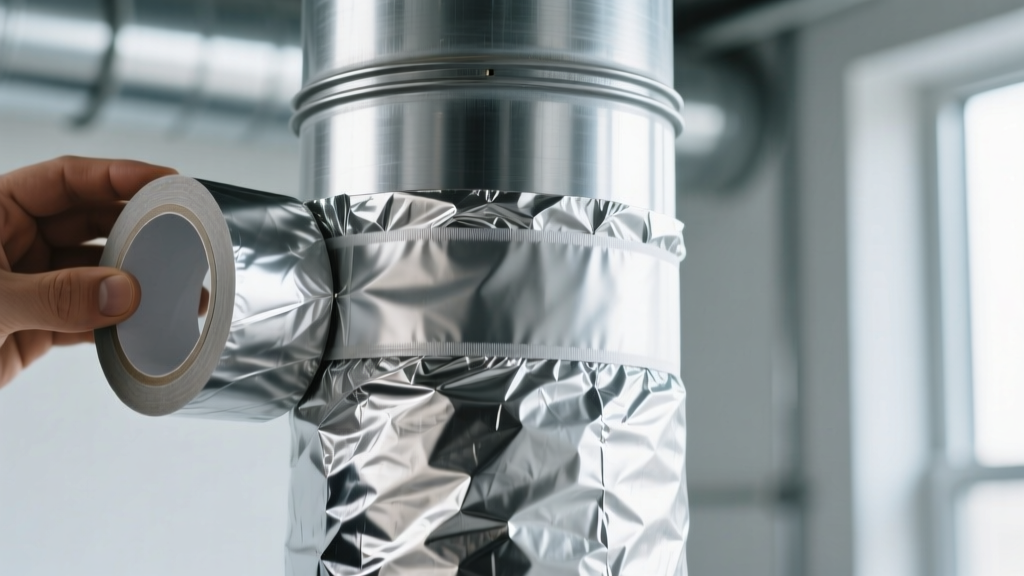
- Critical Detail: The FSK facing must be installed on the outside (the warm side) of the insulation to act as a Class I vapor retarder, preventing moisture from migrating inward and condensing on the cold duct metal.
2. Unconditioned Crawlspaces (Cool/Damp Climates)
Crawlspaces present a unique vapor drive challenge. Ground moisture constantly evaporates into the crawlspace air.
- Material Choice: Closed-cell elastomeric foam (like ArmaFlex) or heavily sealed rigid phenolic board.
- Why: Fiberglass wrap is highly susceptible to moisture absorption. If the vapor barrier is punctured, the fiberglass acts like a sponge, losing up to 50% of its R-value and promoting mold growth. Elastomeric foam's closed-cell structure inherently resists water vapor transmission (permeance < 0.05 perms) without relying on a fragile outer facing.
3. Commercial Plenums and VAV Systems
For commercial builds where sound attenuation is just as critical as thermal resistance, NAIMA (North American Insulation Manufacturers Association) heavily recommends rigid fiberglass duct board.
- Material Choice: 1-inch to 2-inch high-density fiberglass duct board (e.g., Johns Manville Microlite or Knauf EcoBatt Duct Liner).
- Why: Unlike sheet metal wrapped in insulation, duct board features an absorptive interior surface. It achieves a Noise Reduction Coefficient (NRC) of up to 0.95, effectively dampening the low-frequency rumble of air handlers and the high-frequency hiss of VAV terminal boxes.
Acoustic Performance and ASTM Standards
When specifying air duct insulation material for multi-family residential or commercial projects, acoustic performance is heavily scrutinized. The interior lining of the duct dictates sound propagation.
'Sheet metal ducts lined with 1-inch fiberglass duct liner (1.5 lb/ft³ density) will attenuate sound by 15 to 25 decibels in the 1000 Hz to 4000 Hz range, effectively eliminating cross-talk between adjacent rooms.' — HVAC Acoustic Design Guidelines
Ensure that any interior-facing insulation material meets ASTM C1071 (Standard Specification for Fibrous Glass Thermal and Sound Absorption Insulation) and has been tested for erosion resistance per UL 181. High-velocity systems (exceeding 2,500 FPM) require insulation with a factory-applied erodible surface coating or a perforated metal inner liner to prevent fiberglass particulates from entering the airstream.
Real-World Installation Failure Modes
Even the most expensive air duct insulation material will fail if installed incorrectly. Inspectors and HVAC commissioning agents frequently flag the following field errors:
- The Compression Penalty: Fiberglass derives its R-value from trapped air pockets. Compressing a 2.5-inch R-8 duct wrap into a tight 1.5-inch joist bay does not yield R-8; it drops the thermal resistance to roughly R-4.5. Fix: Use rigid insulation spacers or furring strips to maintain the material's full loft.
- The 'Duct Tape' Myth: Standard cloth-backed duct tape dries out, loses adhesion, and fails ASTM E84 flame spread tests within 18 months. Fix: Use only UL 181B-M listed mastic sealant (e.g., Hardcast 32-000) applied with a brush or gloved hand at a wet film thickness of 1/16 inch, combined with fiberglass mesh tape over joints.
- Thermal Bridging at Hangers: Metal duct hangers that wrap entirely around the outside of the insulation compress the material and create a thermal bridge, leading to localized condensation. Fix: Use insulation-friendly hanger shields (saddle pads) that distribute the load without crushing the fiberglass.
Cost Breakdown and ROI Analysis
When budgeting for a 2026 construction or retrofit project, factor in both material and labor costs. While elastomeric and phenolic foams carry a higher upfront material cost, their installation speed and lack of required separate vapor retarders can offset labor expenses in commercial applications.
| Insulation System | Material Cost (per sq ft) | Labor / Accessories | Total Installed Cost | Expected Lifespan |
|---|---|---|---|---|
| R-8 Fiberglass Wrap + Mastic | $0.75 | $1.10 | $1.85 | 20-25 Years |
| R-8 Duct Board (Fabricated) | $2.10 | $1.50 | $3.60 | 30+ Years |
| 1-inch Elastomeric Foam | $2.60 | $0.90 | $3.50 | 25-30 Years |
Frequently Asked Questions
Can I use spray foam directly on HVAC ducts?
Closed-cell spray polyurethane foam (SPF) can be applied to the exterior of rigid metal ducts in unconditioned spaces, providing an excellent air and vapor seal with an R-value of roughly R-6.5 per inch. However, it must be applied by a certified professional to ensure uniform thickness. Never spray foam on flexible ducts or duct board, as the expansion pressure can crush the ductwork, and it voids most manufacturer warranties.
What is the maximum temperature rating for standard duct wrap?
Standard fiberglass duct wrap with FSK facing is rated for continuous exposure to temperatures up to 250°F (121°C). This is more than sufficient for standard residential and commercial forced-air systems, which typically operate with supply air temperatures between 105°F and 140°F. For high-heat applications like kitchen exhaust or boiler flues, mineral wool insulation with an aluminum jacket is required.
Written by
Marcus ChenMarcus Chen is a licensed structural engineer (PE) and building materials analyst with over 12 years of experience across residential, commercial, and industrial construction. He holds a Master of Science in Civil Engineering from UC Berkeley and spent six years at Thornton Tomasetti before transitioning to independent consulting and technical writing. Marcus specializes in material selection for seismic-prone regions, concrete reinforcement strategies, and lifecycle cost analysis. His work has been cited by the American Concrete Institute (ACI) and the Structural Engineers Association of California (SEAOC). When he is not on a job site or at his desk, you will find him hiking the Sierra Nevada or restoring a 1920s craftsman bungalow in Oakland, CA.
More from Marcus Chen
View all
Construction Cost
How Much Did the Eiffel Tower Cost to Build?
How much did the Eiffel Tower cost to build in 1889? We adjust for inflation and compare its budget to modern skyscraper construction.
Aug 4, 2026

Fire Resistance
What Is a Fire Resistant Material? Testing & Certification Guide
Discover what is a fire resistant material through ASTM and UL testing. Learn how fire ratings, certifications, and assemblies work in construction.
Aug 4, 2026

Construction Cost
How Much Did the Burj Khalifa Cost to Build?
How much did the Burj Khalifa cost to build? We break down the $1.5B project and extract 5 money-saving strategies for your next build.
Jul 30, 2026