Selecting Mass Loaded Vinyl Soundproofing: Types and STC Ratings
Compare mass loaded vinyl soundproofing types, STC ratings, and weights. Learn how to select the right MLV barrier for walls, floors, and HVAC.
The Core Taxonomy of Mass Loaded Vinyl Soundproofing
Mass loaded vinyl (MLV) operates on the fundamental acoustic principle of the mass law: doubling the mass of a partition increases its sound transmission loss by approximately 6 decibels. However, treating MLV as a single, uniform product is a critical procurement error. The material's effectiveness relies heavily on its specific formulation, backing, and limpness. To select the correct barrier, you must first understand the four primary taxonomic categories of MLV available in the modern building materials market.
1. Standard Unreinforced MLV
Composed of high-density polyvinyl chloride (PVC) loaded with inert minerals like barium sulfate or calcium carbonate, standard MLV is the baseline acoustic barrier. Its defining characteristic is 'limp mass'—it lacks structural rigidity, which prevents it from resonating and transmitting low-frequency vibrations. It is highly flexible but prone to tearing under its own weight if suspended vertically without adequate support.
2. Reinforced (Scrim-Backed) MLV
For applications requiring vertical suspension or mechanical fastening, reinforced MLV integrates a polyester scrim mesh into the center of the vinyl matrix. This internal webbing drastically increases the material's tensile strength, allowing it to be hung directly from ceiling joists or wall studs without tearing at the fastener points. This is the mandatory choice for standalone acoustic curtains or drop-ceiling plenums.
3. Foil-Faced MLV
By laminating a layer of aluminum foil to one side of the vinyl, manufacturers create a barrier that blocks sound while simultaneously acting as a vapor retarder and thermal reflector. Foil-faced MLV is specifically engineered for HVAC duct wrapping, plumbing pipe lagging, and exterior wall assemblies where moisture intrusion is a secondary concern alongside noise transmission.
4. Composite (Foam-Backed) MLV
This hybrid material bonds a layer of MLV to a closed-cell polyethylene or polyurethane foam backing. The foam provides a decoupling layer that absorbs impact vibrations, while the MLV blocks airborne noise. It is the premium selection for hardwood floor underlayments and automotive cabin sound deadening, where both impact (structure-borne) and airborne noise must be mitigated.
Weight vs. STC Ratings: The Selection Matrix
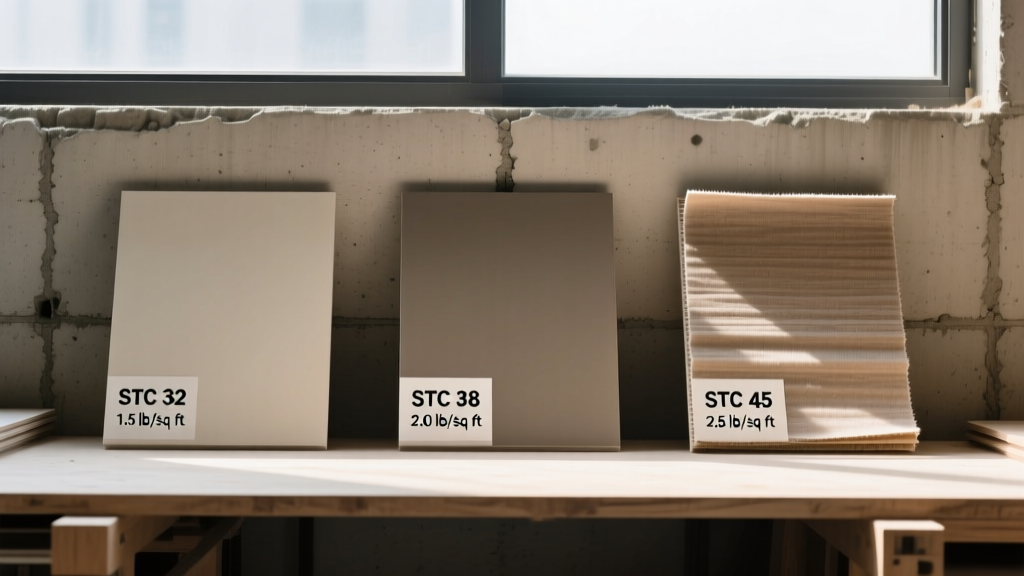
Sound Transmission Class (STC) is the standard metric for rating airborne sound insulation. When selecting mass loaded vinyl soundproofing, the material's weight per square foot is the primary driver of its STC rating. Below is the performance matrix for standard MLV configurations based on 2026 industry testing standards.
| Nominal Weight | Thickness | Standalone STC | Primary Application | Avg. Cost / Sq Ft (2026) |
|---|---|---|---|---|
| 1 lb / sq ft | 1/8 inch | STC 27 | Standard interior walls, light ceiling treatments | $1.20 - $1.60 |
| 2 lb / sq ft | 1/4 inch | STC 32 | Home theaters, shared party walls, generator enclosures | $2.00 - $2.80 |
| 3 lb / sq ft | 3/8 inch | STC 37 | Recording studios, industrial equipment wraps, heavy machinery | $3.50 - $4.50 |
Note: The 'Standalone STC' measures the material in isolation. When integrated into a complete wall assembly (e.g., drywall + resilient channel + MLV + drywall), the total assembly STC can reach 55 to 65, depending on decoupling techniques.
Application-Specific Selection Framework
Selecting the right weight and type of MLV requires mapping the material to the specific acoustic vector you are trying to block. According to acoustic engineering principles outlined by the Building Science Corporation, sound control requires addressing both airborne and structure-borne transmission paths simultaneously.
Walls and Ceilings (Airborne Noise)
For party walls separating living spaces or home theaters, 2 lb/sq ft standard or reinforced MLV is the optimal choice. The critical installation variable here is decoupling. MLV should never be sandwiched tightly between two rigid layers of drywall without a damping compound. The ideal assembly places the MLV over resilient channels, followed by a layer of Green Glue (or equivalent viscoelastic damping compound), and finally 5/8-inch Type X gypsum board. This creates a 'mass-spring-mass' system that drastically lowers the resonant frequency of the wall.
Floors (Impact and Airborne Noise)
Floor assemblies suffer from footfall impact noise (IIC rating) as well as airborne noise from the room below (STC). Standard MLV is ineffective against impact noise because it lacks a compressive layer. For floors, you must select a composite foam-backed MLV (typically 1 lb/sq ft MLV bonded to 1/4-inch closed-cell foam). This must be floated over the subfloor, with all perimeter edges sealed, before installing the final floor covering.
HVAC Ducts and Plumbing (Structure-Borne Vibration)
Ductwork and PVC drain pipes act as acoustic superhighways, carrying mechanical noise and water rush sounds through multiple floors. For these applications, select a 1 lb/sq ft foil-faced or reinforced MLV. Cut the material into strips and wrap it tightly around the pipe or duct. Secure it using nylon zip-ties or specialized acoustic velcro straps. Never use metal wire or rigid screws to secure MLV to pipes, as the metal will create a rigid mechanical bridge that transmits vibration directly into the framing.
A 1/8-inch gap in your MLV installation will degrade the acoustic performance of the entire assembly by up to 50%. Sound behaves like pressurized water; it will aggressively exploit the path of least resistance. When installing MLV on walls or ceilings, you must overlap all seams by a minimum of 2 inches. Seal these overlaps, as well as the perimeter edges, with a high-grade, non-hardening acoustic sealant (such as OSI Pro-Series or Tremco Acoustic). Furthermore, ensure the MLV extends continuously from the top plate to the bottom plate; stopping it at the floor line creates a flanking path that renders the wall treatment useless.
Logistics, Freight, and Hidden Procurement Costs
When budgeting for mass loaded vinyl soundproofing, material cost per square foot is only half the equation. The defining physical characteristic of MLV is its extreme density, which severely impacts shipping logistics. A standard 100-square-foot roll of 2 lb/sq ft MLV weighs exactly 200 pounds. A 3 lb/sq ft roll of the same size weighs 300 pounds.
Because these rolls exceed standard parcel weight limits, they must be shipped via LTL (Less Than Truckload) freight. In 2026, LTL freight rates and residential liftgate delivery fees can add 25% to 40% to your total material cost. To optimize procurement:
- Consolidate Orders: Order all required rolls in a single shipment to amortize the base freight and liftgate fees across the entire project.
- Verify Receiving Capabilities: Ensure your job site has a forklift or a designated crew capable of unloading 200+ lb rolls from a semi-truck if a liftgate service is not purchased.
- Calculate Waste Accurately: MLV is difficult to cut and maneuver. Factor in a 10% to 15% waste allowance for complex cuts around electrical boxes, HVAC vents, and irregular framing.
Environmental and Safety Considerations
Historically, some low-grade imported MLV products utilized lead or toxic plasticizers to achieve high mass. Modern, code-compliant MLV manufactured for the North American and European markets is strictly RoHS (Restriction of Hazardous Substances) compliant and utilizes safe barium sulfate or calcium silicate fillers. When procuring material, always request the manufacturer's Safety Data Sheet (SDS) and verify that the product is certified low-VOC. This is especially critical for interior residential applications where off-gassing could compromise indoor air quality. The CDC NIOSH guidelines on noise control emphasize that engineering controls, including acoustic barriers, must not introduce secondary chemical hazards into the workspace or living environment.
'The success of any acoustic barrier relies not just on the mass of the material, but on the absolute continuity of the installation. A $4 per square foot MLV installed with gaps and rigid fasteners will perform worse than a $1.50 per square foot MLV installed with meticulous seam sealing and proper decoupling.'
By matching the specific taxonomy of MLV to your acoustic vector, respecting the weight-to-STC matrix, and executing a continuous, decoupled installation, you can achieve laboratory-grade sound isolation in standard wood or steel-framed construction.