R-Value Performance of Top Sustainable Insulation Materials Compared
Compare the real-world R-value and thermal performance of top sustainable insulation materials like cellulose, sheep's wool, and hempcrete.

The R-Value Illusion: Lab vs. Field Performance
When evaluating sustainable insulation materials, architects and builders often fixate on the center-of-cavity R-value printed on the product label. However, this metric, tested under strict laboratory conditions via ASTM C518, rarely reflects real-world thermal performance. In a 2026 high-performance building envelope, factors like thermal bridging, air infiltration, and moisture accumulation dictate the actual thermal resistance (whole-wall R-value) far more than the base material conductivity.
Unlike rigid petrochemical foams that rely on blowing agents which can degrade over time (thermal drift), natural and bio-based insulations often compensate for slightly lower center-of-cavity R-values with superior air-sealing characteristics, hygroscopic moisture management, and thermal mass. According to the U.S. Department of Energy, a wall assembly's effective R-value can drop by up to 30% due to framing thermal bridges and air leaks. Sustainable materials like dense-pack cellulose and wood fiber boards mitigate this by conforming tightly to irregular cavities, effectively eliminating the convective loops that plague poorly installed fiberglass batts.
Key Insight: A lab-tested R-19 fiberglass batt installed with a 5% gap at the edges performs closer to R-11 in the field. Dense-pack cellulose with a nominal R-3.8 per inch routinely outperforms it in whole-wall thermal resistance due to near-zero air permeability.
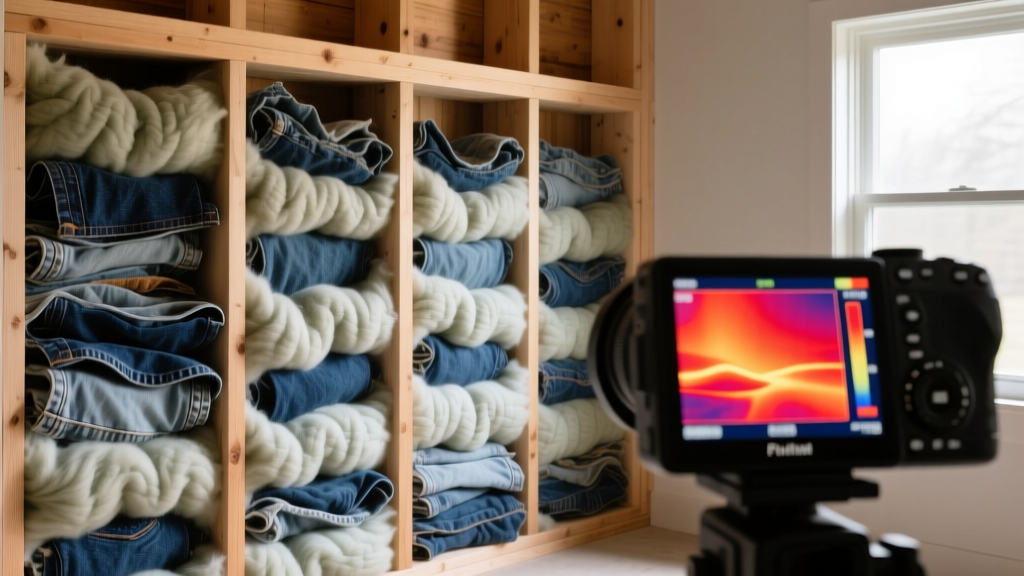
Sustainable Insulation Materials: Performance & Cost Matrix
The following matrix breaks down the 2026 market data for the most viable bio-based and recycled insulation systems, contrasting their nominal R-value with their functional field performance and installed costs.
| Material Type | Center-Cavity R-Value / Inch | Air Permeability | Moisture Buffering | 2026 Installed Cost (per sq ft) |
|---|---|---|---|---|
| Dense-Pack Cellulose | R-3.6 to R-3.8 | Very Low (when >3.0 lbs/ft³) | Moderate (hygroscopic) | $1.40 - $1.90 |
| Sheep's Wool Batts | R-3.5 to R-3.7 | Low | Exceptional (up to 33% weight) | $3.80 - $5.20 |
| Recycled Denim (Cotton) | R-3.5 to R-3.7 | Moderate | High | $2.10 - $2.80 |
| Wood Fiber Boards | R-3.6 to R-3.8 | Low (acts as WRB) | High (vapor open) | $2.90 - $4.10 |
| Hempcrete (Cast-in-place) | R-1.5 to R-2.5 | N/A (Monolithic) | Exceptional (high thermal mass) | $3.50 - $5.50 |
Moisture Management and Thermal Drift
Water is a highly efficient thermal conductor. When traditional insulation gets wet, its R-value plummets. The Cellulose Insulation Manufacturers Association (CIMA) notes that bio-based materials handle moisture fundamentally differently than synthetic alternatives, which directly impacts their long-term R-value retention.
Hygroscopic Buffers and Latent Heat
Sheep's wool and hemp fibers are hygroscopic—they absorb and desorb water vapor from the surrounding air into the cellular structure of the fiber itself, rather than trapping liquid water in the air pockets between fibers. This means the insulation maintains its trapped air (and thus its R-value) even in high-humidity environments. Furthermore, the phase change of moisture absorbing into wool releases trace amounts of latent heat, providing a microscopic but measurable thermal buffer during cold snaps.
The Air-Sealing Multiplier
Convective heat loss (air movement through the wall assembly) can strip away the effectiveness of high-R-value materials. Wood fiber boards, often used as continuous exterior insulation in 2026's high-performance Passive House builds, provide an R-3.7 per inch while simultaneously acting as a vapor-permeable air and water-resistive barrier. This dual functionality eliminates the need for synthetic house wraps, reducing thermal bridging at the sheathing layer.
Climate-Specific Decision Framework
Selecting the right sustainable insulation material requires aligning the material's hygrothermal properties with your specific IECC climate zone.
- Zones 1-3 (Hot/Humid & Hot/Dry): Prioritize vapor-permeable materials like hempcrete or exterior wood fiber boards. These allow incidental moisture from interior air conditioning condensation to dry rapidly to the exterior. Avoid high-density interior vapor barriers.
- Zones 4-5 (Mixed Climates): Dense-pack cellulose is the optimal choice here. Its high density restricts air movement (preventing interior humid air from reaching the cold sheathing in winter), while its hygroscopic nature allows the wall to dry safely in either direction during seasonal transitions.
- Zones 6-8 (Cold & Very Cold): Combine a high-R-value cavity fill (dense-pack cellulose or recycled denim) with a thick layer of continuous exterior wood fiber board. The exterior board keeps the structural sheathing above the dew point, eliminating condensation risks while maximizing the overall assembly R-value.
Critical Installation Failure Modes
The performance of sustainable insulation materials is highly dependent on installation precision. A failure to adhere to manufacturer specifications will degrade the R-value and risk structural rot.
If dense-pack cellulose is not installed at a minimum density of 3.0 to 3.5 lbs per cubic foot, it will settle over time, leaving uninsulated gaps at the top of the wall cavity. This drops the effective wall R-value by up to 20%. Always require your contractor to use a calibrated density gauge and mesh netting to verify compression during installation.
Recycled denim batts are highly compressible. If a builder attempts to stuff an R-19 (6.25-inch) denim batt into a 5.5-inch 2x6 cavity, the compression increases the material's thermal conductivity, effectively reducing its R-value to roughly R-16. Always match the batt thickness exactly to the cavity depth.
Hempcrete Curing and Moisture Trapping
While hempcrete offers excellent thermal mass and moisture buffering, its R-value is relatively low (R-1.5 to R-2.5 per inch). Furthermore, cast-in-place hempcrete contains massive amounts of water during installation. If encapsulated too quickly behind impermeable interior finishes like vinyl wallpaper or closed-cell spray foam, the trapped moisture will take years to dry, leading to mold and wood rot. Always pair hempcrete with vapor-open lime plasters or clay finishes to ensure the assembly can breathe and achieve its designed thermal performance.
Ultimately, the true R-value of sustainable insulation materials is not found on a datasheet, but in the precision of the assembly design. By leveraging the hygroscopic and air-sealing properties of bio-based materials, builders can achieve superior, durable thermal performance that outlasts traditional synthetic alternatives.
Written by
James ThorntonJames Thornton is a construction industry veteran with 25 years of hands-on experience in wood framing, lumber grading, and residential building codes. He started as a framing carpenter in rural Oregon, earned his ICC Residential Building Inspector certification, and eventually became a senior plan reviewer for the City of Portland Bureau of Development Services. James holds a B.S. in Wood Science & Technology from Oregon State University and is a certified lumber grader through the West Coast Lumber Inspection Bureau (WCLIB). He has inspected over 3,000 residential construction sites and authored the city's internal guide on advanced framing techniques (2x6 at 24" O.C.). James lives in Bend, OR, where he builds custom timber-frame cabins and competes in lumberjack sports.
More from James Thornton
View all
Insulation
Best Home Insulation Materials: Complete 2026 Guide
Compare top home insulation materials for 2026. Find R-values, installed costs per square foot, and best uses for fiberglass, spray foam, and mineral wool.
Aug 4, 2026

Sustainable Building
Certify Your Green Building Material for LEED and WELL
Step-by-step guide to certifying a green building material for LEED v5 and WELL v2. Master EPDs, HPDs, and VOC limits for 2026 project specifications.
Aug 4, 2026

Stone & Masonry
Veneer Stacked Stone Panels: Interior Design & Style Showcase
Discover how veneer stacked stone panels transform interiors. Explore modern design profiles, material pairings, and technical installation specs.
Aug 4, 2026