Soundproof Curtains: Material Taxonomy and Acoustic Selection Guide
Explore the material taxonomy of soundproof curtains. Compare MLV, fiberglass, and multi-layer fabrics to select the right acoustic treatment.
The Physics of Acoustic Curtains: STC vs. NRC
The term soundproof curtains is an industry misnomer. No flexible textile can achieve true soundproofing (STC 50+). Instead, acoustic window treatments operate on two distinct physical principles: sound transmission loss and sound absorption. Understanding the difference between Sound Transmission Class (STC) and Noise Reduction Coefficient (NRC) is the critical first step in material selection.
STC measures a material's ability to block airborne sound from passing through it, tested under strict laboratory conditions per ASTM E90 standards. NRC measures how much sound energy a material absorbs to prevent reverberation within a room. According to the Institute of Noise Control Engineering, blocking noise requires mass and decoupling, while absorbing noise requires porous, fibrous materials. Most commercial acoustic curtains excel at one, but rarely both, unless they utilize a complex multi-layer taxonomy.
Material Taxonomy: Core Layers and Face Fabrics
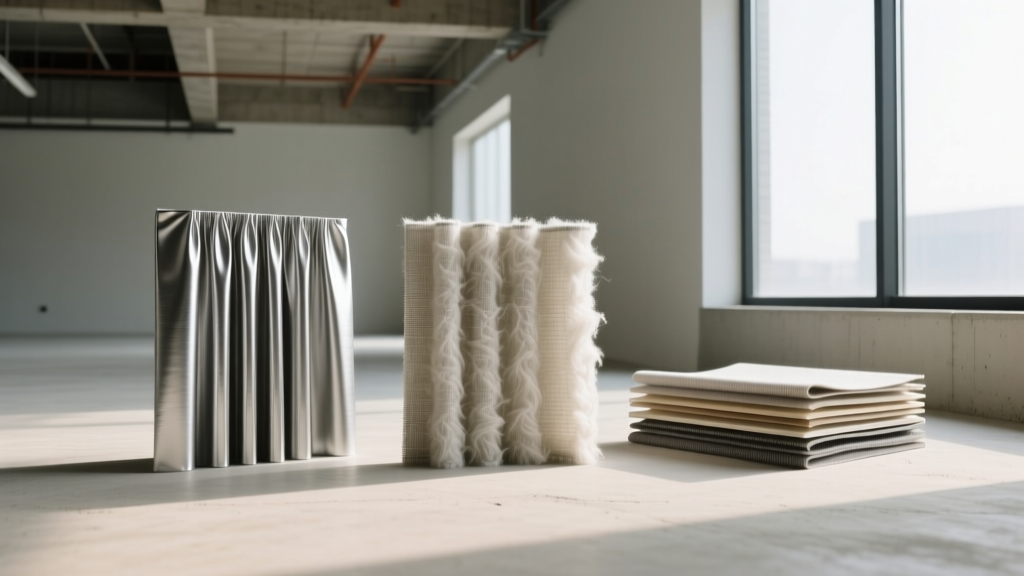
High-performance acoustic curtains are not single pieces of fabric. They are composite systems consisting of a face fabric, an acoustic core, and a backing liner. Selecting the right combination depends entirely on the frequency of the noise you are targeting.
Mass Loaded Vinyl (MLV) Cores
For blocking airborne noise (traffic, sirens, loud neighbors), mass is mandatory. MLV is a high-density, flexible polymer loaded with barium sulfate or calcium silicate. It operates on the 'limp mass' principle, meaning it resists sound wave vibration without transferring kinetic energy to the surrounding structure. A 1 lb/sq ft MLV layer adds roughly 27 STC points to a wall assembly, while a 2 lb/sq ft layer adds up to 33 STC points. MLV cores are heavy, rigid, and require heavy-duty architectural tracks for support.
Fiberglass and Mineral Wool Batts
If the goal is to eliminate room echo and high-frequency reverberation (home theaters, recording studios), fibrous cores are superior. Acoustic curtains utilizing 1-inch to 2-inch compressed fiberglass or mineral wool batts achieve NRC ratings of 0.85 to 1.05. However, because they lack limp mass, they offer virtually zero sound transmission blocking (STC gain of 2 to 5). They are excellent for interior acoustic conditioning but useless for blocking exterior street noise.
Multi-Layer Woven Polyester and Velvet
The face fabric dictates the aesthetic and provides the first line of high-frequency absorption. For genuine acoustic performance, avoid standard cotton or lightweight poly-blends. Specify 100% polyester velvet, suede, or heavy twill with a minimum weight of 16 oz to 32 oz per linear yard. The dense pile of velvet traps high-frequency sound waves, while multiple woven layers create microscopic air gaps that dissipate acoustic energy as heat.
An acoustic curtain rated at STC 30 in a laboratory will perform at STC 12 in your home if installed improperly. Sound behaves like water; it will exploit the path of least resistance. A mere 1/2-inch gap at the bottom hem or sides allows up to 50% of the acoustic energy to bypass the curtain entirely. Perimeter sealing is not optional.
Material Comparison Matrix
| Core Material | Primary Function | Typical STC Gain | NRC Rating | Avg Cost (per sq ft) | Best Application |
|---|---|---|---|---|---|
| 1 lb/sq ft MLV | Sound Blocking | +25 to +27 | 0.10 - 0.20 | $2.50 - $3.50 | Moderate traffic, loud voices |
| 2 lb/sq ft MLV | Heavy Sound Blocking | +30 to +33 | 0.05 - 0.15 | $4.00 - $5.50 | Highways, trains, industrial |
| 1-inch Fiberglass | Sound Absorption | +2 to +4 | 0.85 - 0.95 | $6.00 - $8.00 | Home theaters, echo reduction |
| Multi-Layer Velvet (No Core) | High-Freq Absorption | +5 to +8 | 0.60 - 0.75 | $8.00 - $12.00 | Bedrooms, light noise dampening |
Selection Framework: Matching Material to Noise Type
Do not purchase acoustic curtains based solely on marketing claims. Diagnose your specific noise profile using this decision framework:
- Low-Frequency Airborne Noise (HVAC rumble, diesel trucks, bass): Low frequencies require immense mass to stop. You must select curtains with a minimum 2 lb/sq ft MLV core. Fiberglass and velvet alone will be completely transparent to these wavelengths.
- Mid-to-High Frequency Airborne Noise (Conversation, dogs barking, birds): A combination of 1 lb/sq ft MLV and a heavy 24 oz velvet face fabric will provide sufficient mass to block transmission while the velvet absorbs the higher harmonics.
- Interior Reverberation (Echo, slap-back in large rooms): Skip the MLV entirely. It adds unnecessary weight and cost. Specify curtains with a 1-inch or 2-inch fiberglass core and a porous, textured face fabric to maximize NRC.
Installation Hardware: The Weak Link in Acoustic Sealing
The material taxonomy is only half the battle; the suspension system dictates real-world performance. Standard decorative curtain rods guarantee acoustic failure because they leave a 2-inch to 4-inch gap between the fabric and the wall, creating a massive flanking path.
For true acoustic isolation, specify architectural track systems (such as those manufactured by Kirsch or Rollease). These tracks utilize L-brackets to mount flush against the ceiling or wall, eliminating the top gap. To seal the sides and bottom, integrate hook-and-loop (Velcro) tape or magnetic strip seals along the curtain perimeter. The curtain must overlap the window frame by a minimum of 3 inches on all sides, and the bottom hem must rest firmly against the floor or a custom sill seal.
2026 Cost Breakdown and ROI
Pricing for acoustic window treatments has stabilized following supply chain adjustments, but heavy MLV-integrated systems remain a premium investment. Expect the following material and hardware costs for a standard 4x5 foot window:
- Basic NRC Velvet Curtains: $150 - $250 per window (Absorption only).
- MLV-Backed Acoustic Curtains: $400 - $700 per window (Transmission blocking).
- Architectural Track & Seal Hardware: $120 - $250 per window.
- Professional Installation: $150 - $300 per window (Highly recommended due to the extreme weight of MLV curtains, which can exceed 60 lbs per panel).
While the upfront cost of an MLV-based soundproof curtain system is high, it remains 60% to 80% cheaper than replacing existing windows with laminated acoustic glass or constructing an interior decoupled stud wall, making it the highest-ROI acoustic intervention for existing residential structures.