What Is Insulator Material? Types, R-Values & Uses
Learn what is insulator material, how R-values dictate performance, and compare fiberglass, spray foam, and mineral wool for optimal building efficiency.

Defining the Core: What Is Insulator Material in Construction?
To understand what is insulator material in the context of building science, we must look at thermodynamics. An insulator is a substance engineered to impede the transfer of heat, sound, or electricity. In building envelopes, thermal insulators function primarily by trapping pockets of gas—usually air, argon, or specialized blowing agents—within a solid or semi-solid matrix. Because gases are poor conductors of heat compared to solids, this trapped-gas structure drastically slows down conductive and convective heat flow.
Heat moves through building assemblies via three mechanisms: conduction (direct contact), convection (fluid/air movement), and radiation (electromagnetic waves). Modern insulator materials are designed to disrupt all three. For example, reflective foil facings on polyisocyanurate boards block radiant heat, while the dense cellular structure of closed-cell spray foam halts convective air leakage and conductive heat transfer simultaneously.
The R-Value Metric and Thermal Dynamics
The efficacy of any insulator material is quantified by its R-value, which measures thermal resistance. The higher the R-value, the greater the insulating power. According to the U.S. Department of Energy, R-value is determined by the material's thickness, density, and the specific type of gas trapped within its cellular structure.
Critical Distinction: Material R-Value vs. Assembly R-Value
A common mistake in construction is assuming the R-value of the cavity insulation equals the R-value of the entire wall. A wall framed with 2x6 wood studs (which have an R-value of roughly 1.0 per inch) and filled with R-21 fiberglass will perform at an effective R-value of only R-15 to R-17 due to thermal bridging through the highly conductive wood framing and fasteners.
Primary Insulator Materials: Performance & Cost Matrix
Selecting the right material requires balancing thermal resistance, moisture permeability, acoustic damping, and budget. Below is a 2026 market comparison of the most prevalent commercial and residential insulator materials.
| Material Type | Specific Product Example | R-Value / Inch | Est. Cost (2026) | Moisture Permeability |
|---|---|---|---|---|
| Fiberglass Batts | Owens Corning EcoTouch R-15 | 3.1 - 3.4 | $0.60 - $1.10 / sq ft | High (Vapor Open) |
| Mineral Wool | Rockwool Comfortbatt | 4.2 - 4.3 | $1.10 - $1.60 / sq ft | High (Vapor Open) |
| Open-Cell SPF | Demilec Sealection 500 | 3.6 - 3.9 | $0.44 - $0.65 / board ft | High (Vapor Open) |
| Closed-Cell SPF | Demilec Heatlok XT 2.0 | 6.0 - 7.0 | $1.50 - $2.50 / board ft | Low (Class II Retarder) |
| Polyiso Rigid Board | Hunter Panels Xci Foil | 6.0 - 6.5 | $0.70 - $1.20 / sq ft | Very Low (Vapor Closed) |
Fiberglass and Mineral Wool Batts
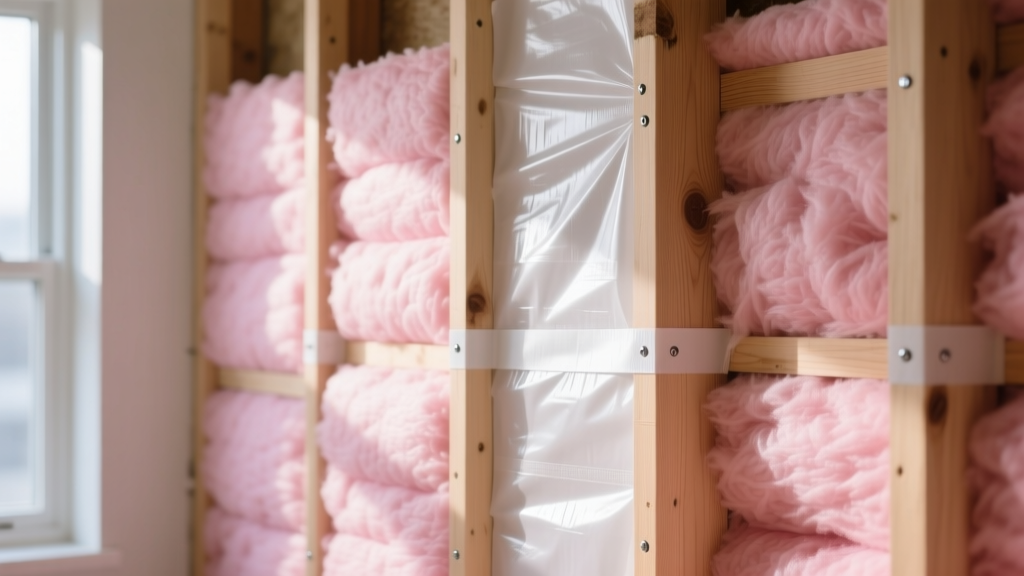
Fiberglass remains the most widely used insulator material in North America. As noted by the North American Insulation Manufacturers Association (NAIMA), modern fiberglass batts utilize bio-based binders that eliminate formaldehyde off-gassing. Mineral wool (slag or rock wool) offers a distinct advantage in fire resistance, withstanding temperatures up to 2,150°F without melting, making it the mandatory choice for fire-stopping and commercial shaft enclosures.
Spray Polyurethane Foam (SPF)
SPF is unique because it acts as both an insulator and an air barrier. Closed-cell SPF (ccSPF) utilizes Hydrofluoroolefin (HFO) blowing agents to comply with recent EPA AIM Act regulations, yielding an R-value of up to 7.0 per inch. Because ccSPF is rigid and vapor-impermeable at a thickness of 1.5 inches, it provides structural racking strength to shear walls and eliminates the need for a separate polyethylene vapor retarder in cold climates.
Acoustic Insulation: Decoupling and Damping
When addressing the question of what is insulator material for sound control, thermal metrics (R-value) become irrelevant. Acoustic insulation relies on mass, decoupling, and sound absorption to improve Sound Transmission Class (STC) ratings.
- Mineral Wool (e.g., Rockwool Safe'n'Sound): Its dense, non-directional fiber matrix absorbs mid-to-high frequency airborne noise. A standard interior partition with drywall on both sides has an STC of 33; adding Safe'n'Sound increases this to an STC of 45-50.
- Mass Loaded Vinyl (MLV): A high-density, limp-mass material (typically 1 lb to 2 lb per square foot) applied to studs or joists to block low-frequency impact noise and structural vibrations.
- Resilient Channels: While not an insulator material itself, this metal channel decouples the drywall from the framing, preventing structural sound transmission.
Critical Installation Failure Modes
Even the highest-performing insulator material will fail if installed incorrectly. Field audits consistently reveal three primary failure modes that destroy assembly R-values:
- Compression: Insulation relies on trapped air. Forcing a 6.25-inch R-19 fiberglass batt into a 5.5-inch 2x4 wall cavity compresses the glass fibers, increasing conductivity and dropping the effective R-value to roughly R-14. Always match the batt thickness to the cavity depth.
- Convective Looping: If a batt is cut too short or fails to touch the top and bottom plates, air circulates inside the wall cavity. This convective loop acts as a thermal siphon, bypassing the insulation entirely and causing localized condensation and mold growth.
- Thermal Bridging via Steel Studs: Steel is roughly 400 times more conductive than wood. Using standard cavity insulation in a commercial steel-stud wall results in up to a 50% loss of effective R-value. Continuous exterior rigid insulation (like Polyiso) is required to break the thermal bridge.
Expert Warning: Never place a vapor-impermeable material (like closed-cell foam or foil-faced polyiso) on the interior side of a wall assembly in a hot, humid climate. This traps outward-drying moisture inside the cavity, leading to rapid structural rot.
Frequently Asked Questions
Does doubling the thickness of the insulation double the R-value?
Yes, theoretically. Two layers of R-15 material will yield R-30, provided they are installed without compressing the bottom layer. However, in rigid board applications, thermal bridging through the fasteners used to secure the second layer can slightly reduce the effective assembly R-value.
Can I mix different insulator materials in one wall cavity?
You can, but you must calculate the dew point. A common 'flash and batt' method involves applying 1.5 inches of closed-cell spray foam against the exterior sheathing (to act as an air and vapor barrier) and filling the rest of the cavity with fiberglass. This prevents interior moisture from reaching the cold sheathing, mitigating condensation risks while keeping costs lower than a full closed-cell fill.
Written by
James ThorntonJames Thornton is a construction industry veteran with 25 years of hands-on experience in wood framing, lumber grading, and residential building codes. He started as a framing carpenter in rural Oregon, earned his ICC Residential Building Inspector certification, and eventually became a senior plan reviewer for the City of Portland Bureau of Development Services. James holds a B.S. in Wood Science & Technology from Oregon State University and is a certified lumber grader through the West Coast Lumber Inspection Bureau (WCLIB). He has inspected over 3,000 residential construction sites and authored the city's internal guide on advanced framing techniques (2x6 at 24" O.C.). James lives in Bend, OR, where he builds custom timber-frame cabins and competes in lumberjack sports.
More from James Thornton
View all
Insulation
Best Home Insulation Materials: Complete 2026 Guide
Compare top home insulation materials for 2026. Find R-values, installed costs per square foot, and best uses for fiberglass, spray foam, and mineral wool.
Aug 4, 2026

Sustainable Building
Certify Your Green Building Material for LEED and WELL
Step-by-step guide to certifying a green building material for LEED v5 and WELL v2. Master EPDs, HPDs, and VOC limits for 2026 project specifications.
Aug 4, 2026

Stone & Masonry
Veneer Stacked Stone Panels: Interior Design & Style Showcase
Discover how veneer stacked stone panels transform interiors. Explore modern design profiles, material pairings, and technical installation specs.
Aug 4, 2026