Soundproofing a Room: 2026 Cost Estimation & Material Guide
Calculate the exact cost of soundproofing a room in 2026. Get material quantities, pricing per square foot, and step-by-step estimation formulas.
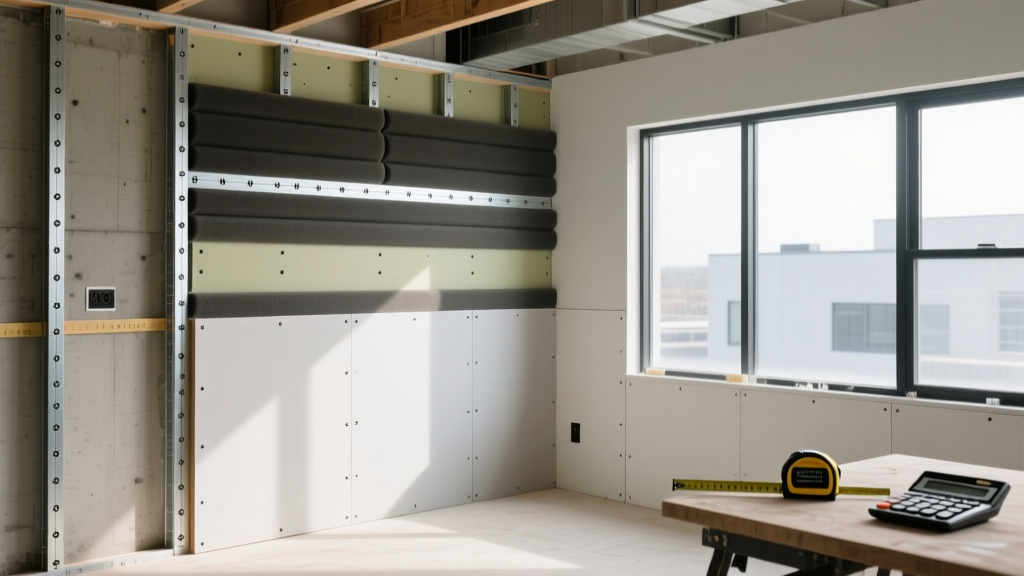
The True Cost of Soundproofing a Room in 2026
Soundproofing a room requires a strategic balance of mass, decoupling, and damping. Unlike standard thermal insulation, acoustic treatment demands specialized materials that carry distinct price points. In 2026, stabilized supply chains have brought the cost of mass loaded vinyl (MLV) and acoustic sealants down from their 2023 peaks, but high-density mineral wool and resilient channel systems remain premium investments. According to the Environmental Protection Agency (EPA), chronic noise exposure significantly impacts health, driving a 22% increase in residential acoustic retrofitting over the last three years. This guide provides a precise cost estimation framework and material quantity calculator to help you budget accurately for your project.
Material Quantity Calculator Framework
Before purchasing materials, you must calculate the exact surface area requiring treatment. Sound travels through all structural boundaries, meaning walls, ceilings, and sometimes floors must be addressed. Use the following formulas to determine your baseline square footage.
Core Measurement Formulas
- Wall Area: (Length + Width) × 2 × Ceiling Height
- Ceiling Area: Length × Width
- Floor Area: Length × Width (Only required if treating impact noise from above)
- Waste Factor: Multiply total area by 1.10 to account for 10% cutting waste and overlaps.
When calculating drywall and MLV, always round up to the nearest full 4x8 sheet (32 square feet). For acoustic sealant, standard application requires one tube per 100 linear feet of perimeter sealing.
Tiered Cost Breakdown by Soundproofing Method
The cost of soundproofing a room scales exponentially with the desired Sound Transmission Class (STC) rating. Below is a 2026 pricing matrix for three common retrofitting tiers. Pricing reflects material costs only; labor will add $2.50 to $5.00 per square foot depending on regional rates.
| Tier | Methodology & Key Materials | Est. STC Rating | Cost per Sq Ft (Wall) |
|---|---|---|---|
| Tier 1: Basic Damping | Existing drywall + Green Glue compound + 1/2" standard drywall overlay. | 45 - 50 | $1.80 - $2.20 |
| Tier 2: Mass & Decoupling | Demolition to studs, ROCKWOOL Safe'n'Sound batts, resilient channels (RC-1), 5/8" Type X drywall. | 55 - 60 | $3.50 - $4.50 |
| Tier 3: Studio-Grade | Tier 2 base + 1 lb/sq ft Mass Loaded Vinyl (MLV) + staggered stud framing + dual 5/8" drywall with Green Glue. | 65 - 70+ | $7.00 - $9.50 |
For comprehensive acoustic principles and STC testing methodologies, refer to the USG Sound Control guidelines, which detail how mass and decoupling interact to block airborne and impact noise.
Step-by-Step Estimation: Standard 12x12 Bedroom
To demonstrate the calculator in action, let us estimate the material costs for upgrading a standard 12x12 foot bedroom with an 8-foot ceiling using the Tier 2 (Mass & Decoupling) method. This is the most common approach for home offices and media rooms.
1. Calculate Surface Area
- Wall Area: (12 + 12) × 2 × 8 = 384 sq ft.
- Ceiling Area: 12 × 12 = 144 sq ft.
- Total Treatable Area: 528 sq ft. (We will exclude the floor for this airborne noise scenario).
- With 10% Waste: 528 × 1.10 = 580.8 sq ft.
2. Material Breakdown & Pricing
- Acoustic Mineral Wool: ROCKWOOL Safe'n'Sound (3.5-inch batts) covers 15.8 sq ft per bag. You need 37 bags. At $0.75 per sq ft, the cost is $435.60. Proper installation of high-density mineral wool is critical; see the ROCKWOOL home studio installation guide for specific friction-fit techniques.
- Resilient Channels (RC-1): Installed horizontally at 24 inches on center. Requires approx. 260 linear feet. At $0.45 per linear foot, the cost is $117.00.
- Drywall: 5/8" Type X (fire-rated, higher mass). Requires 19 sheets (4x8). At $22.00 per sheet, the cost is $418.00.
- Acoustic Sealant: Required for all perimeters and penetrations. Approx. 6 tubes at $9.50 each = $57.00.
- Fasteners & Isolation Clips: Neoprene isolators for channels and specialized drywall screws. Estimated flat rate of $120.00.
Total Material Cost Estimate
$1,147.60 (Approx. $2.17 per square foot for materials only)
Hidden Costs and Structural Bypasses
The most frequent point of failure in DIY soundproofing is ignoring flanking noise and structural bypasses. Sound behaves like water; it will find the path of least resistance. If you spend $1,500 on wall insulation but ignore the following elements, your STC rating will drop by 10 to 15 points.
Electrical Boxes and HVAC
Standard electrical outlets mounted back-to-back on a shared stud create a direct acoustic bridge. You must install acoustic putty pads (approx. $12.00 each) over every electrical box. For HVAC, if the room shares a return air vent with the rest of the house, you must install a duct silencer or acoustic maze ($150 - $300 per unit) to prevent airborne noise from traveling through the ductwork.
Door and Window Assemblies
A wall with an STC of 60 is useless if the interior door has an STC of 25. Upgrading to a solid-core MDF door ($250 - $400) and installing an automatic door bottom sweep ($85 - $150) is mandatory for high-performance rooms. Standard hollow-core doors must be replaced entirely, as surface-applied acoustic foam will not increase their mass sufficiently to block low-frequency noise.
Sourcing and ROI Considerations
When sourcing materials in 2026, avoid purchasing MLV from general consumer marketplaces where thickness and weight specifications are frequently misrepresented. A true 1 lb/sq ft MLV must weigh exactly 1 pound per square foot; lighter variants are often 0.5 lb/sq ft disguised by thicker, less dense PVC backing. Purchase MLV and Green Glue compounds from dedicated acoustic distributors or specialized building supply yards that provide manufacturer spec sheets.
From an ROI perspective, soundproofing a room rarely recoups 100% of its cost in direct home equity value. However, it drastically reduces time-on-market for homes located near high-decibel environments (airports, railways, dense urban centers). For home recording studios or dedicated home theaters, the investment is functional rather than purely financial, enabling the space to serve its intended purpose without acoustic bleed.
Estimator Summary Checklist
- Measure all treatable surfaces and apply the 1.10 waste multiplier.
- Select your STC target tier (Basic, Decoupled, or Studio-Grade).
- Calculate linear footage for resilient channels and perimeter sealant.
- Budget an additional 15% for hidden bypasses (putty pads, door sweeps, duct silencers).
- Factor in demolition and drywall finishing labor if hiring contractors.