Complete Guide to Selecting Insulator Materials for Thermal Efficiency
Compare top insulator materials including fiberglass, spray foam, and polyiso. Get 2026 pricing, R-values, and climate-specific installation frameworks.

The Physics of Thermal Resistance: R-Value vs. U-Factor
Before selecting insulator materials, you must understand the metrics governing thermal performance. The building industry relies on two primary measurements: R-value and U-factor. While R-value measures a material's resistance to conductive heat flow (higher is better), the U-factor measures the overall rate of heat transfer through an entire assembly, including framing and air films (lower is better). The mathematical relationship is inverse: U = 1 / R.
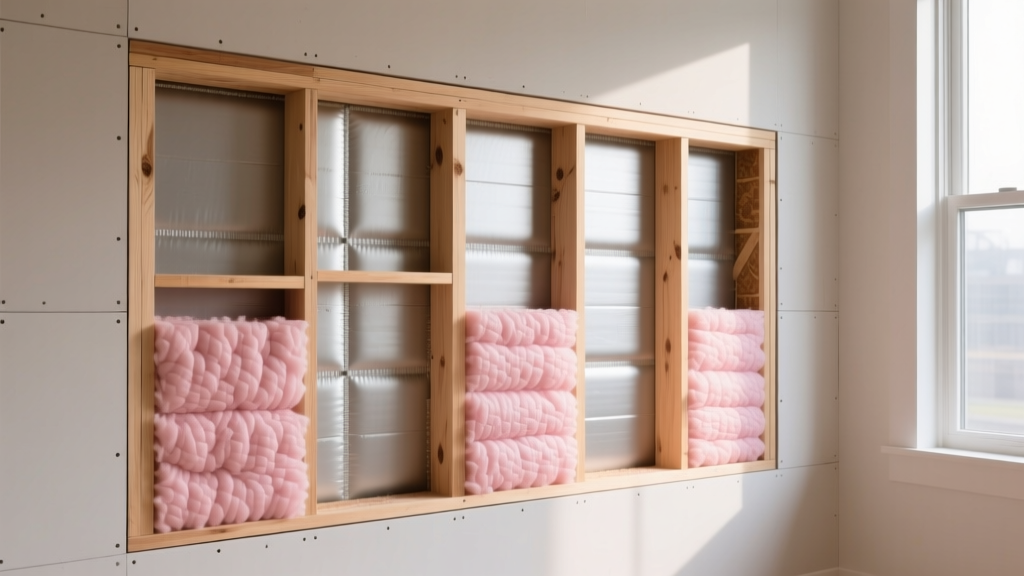
Comprehensive Matrix: Comparing Top Insulator Materials
The following matrix breaks down the most common insulator materials used in residential and light-commercial construction, reflecting current 2026 material costs and performance data.
| Material Type | R-Value per Inch | Cost (per sq. ft.) | Vapor Permeability | Best Application |
|---|---|---|---|---|
| Fiberglass Batts | 3.1 - 4.3 | $0.60 - $0.90 | High | Standard 2x4 / 2x6 wall cavities |
| Mineral Wool | 4.2 - 4.3 | $1.10 - $1.50 | High | Fire-rated assemblies, exterior continuous |
| Open-Cell SPF | 3.5 - 3.7 | $1.50 - $2.00 | High | Rooflines, soundproofing interior walls |
| Closed-Cell SPF | 6.0 - 6.5 | $2.50 - $3.50 | Vapor Barrier | Flood zones, rim joists, space-constrained cavities |
| Polyiso Rigid Board | 6.5 (drops in cold) | $1.20 - $1.80 | Foil-faced: Barrier | Continuous exterior insulation, commercial roofs |
| XPS Rigid Board | 5.0 | $1.00 - $1.40 | Semi-permeable | Below-grade foundations, under-slab |
Deep Dive: Fiberglass and Mineral Wool Batts
Fiberglass remains the baseline insulator material in North America due to its low cost and familiarity. Modern high-density fiberglass batts, such as Owens Corning EcoTouch R-21 for 2x6 walls, achieve R-4.2 per inch by packing more glass fibers into the same cavity space. However, fiberglass is highly susceptible to convective heat loss if air sealing is not meticulously executed prior to installation.
Mineral Wool: The Friction-Fit Advantage
Mineral wool (specifically stone wool) has gained massive market share due to its superior fire resistance and acoustic dampening. Products like Rockwool Comfortbatt offer distinct installation advantages over fiberglass:
- Dimensional Stability: Mineral wool is manufactured slightly wider than the stud cavity. It relies on a friction fit, eliminating the need for stapling and preventing the material from sagging or pulling away from the top plate over time.
- Moisture Resilience: While mineral wool is vapor-permeable, its stone fibers do not absorb water. If a wall assembly gets wet, the insulation retains its R-value and drains rapidly, unlike fiberglass which loses thermal resistance when saturated.
- Fire Rating: With a melting point exceeding 2,000°F (1,093°C), mineral wool acts as a passive fire block, often allowing builders to bypass additional fire-stopping materials in specific party-wall assemblies.
Spray Polyurethane Foam (SPF): The HFO Transition
Spray foam provides both insulation and an air barrier in a single application. The industry has recently undergone a massive shift in blowing agents. Historically, closed-cell SPF relied on HFC-245fa, which carried a high Global Warming Potential (GWP). Today, manufacturers have transitioned to Hydrofluoroolefin (HFO) blowing agents.
According to the Pacific Northwest National Laboratory, modern HFO closed-cell foams (like Icynene ProSeal Eco) boast a GWP of less than 5, compared to the previous 1,030, while maintaining an R-value of 6.5 per inch. Open-cell SPF (0.5 lb/ft3 density) remains an excellent choice for interior soundproofing and rooflines in mixed-humid climates where bidirectional drying is required, but it must be paired with a separate air barrier strategy.
Rigid Foam Boards and the Polyiso Thermal Drift Phenomenon
Rigid foam is essential for continuous exterior insulation to mitigate thermal bridging. However, specifying polyisocyanurate (polyiso) requires a deep understanding of its thermal limitations.
For below-grade applications, XPS (Extruded Polystyrene) has been the standard, but environmental regulations regarding HFC blowing agents are phasing it out in several regions. Builders are increasingly pivoting to high-compression EPS (Expanded Polystyrene) or specialized below-grade mineral wool boards like Rockwool Comfortboard 80 for sub-slab and foundation insulation.
Decision Framework: Matching Insulator Materials to Climate Zones
Selecting the right insulator materials depends heavily on your specific IECC Climate Zone. The Building Science Corporation emphasizes the "Perfect Wall" concept, which dictates that the control layers (water, air, vapor, thermal) must be located on the exterior of the structure.
Climate Zones 1-3 (Hot-Humid & Hot-Dry)
- Strategy: Maximize outward drying. Avoid interior vapor barriers.
- Recommended Materials: Open-cell spray foam in cavities, or unfaced fiberglass batts paired with a fluid-applied exterior air barrier. Use semi-permeable rigid foams (EPS or unfaced XPS) for exterior continuous insulation to allow the wall to dry to the exterior.
Climate Zones 4-5 (Mixed-Humid)
- Strategy: Balance bidirectional drying. Manage condensation on the interior side of the exterior sheathing.
- Recommended Materials: Mineral wool batts in the cavity. Apply a minimum of R-5 to R-7.5 continuous rigid insulation (Polyiso or Mineral Wool) to the exterior to keep the OSB sheathing above the dew point during winter months.
Climate Zones 6-8 (Cold & Very Cold)
- Strategy: Prevent interior moisture from reaching cold sheathing. High exterior R-value ratios are mandatory.
- Recommended Materials: Closed-cell spray foam (2 inches) against the interior sheathing to act as a Class II vapor retarder, filled out with mineral wool. Alternatively, use dense-pack cellulose in the cavity with a high ratio (40%+) of exterior continuous mineral wool or EPS.
Frequently Asked Questions
Can I mix different insulator materials in the same wall cavity?
Yes, this is known as a "flash-and-batt" assembly. A common high-performance method involves spraying 1.5 to 2 inches of closed-cell foam against the interior sheathing to seal air leaks and manage vapor, then filling the remainder of the cavity with inexpensive fiberglass or mineral wool batts to achieve the target R-value cost-effectively.
Does adding more insulation always yield proportional energy savings?
No. Thermal resistance follows the law of diminishing returns. Upgrading from R-10 to R-20 cuts heat loss by 50%. Upgrading from R-40 to R-50 only reduces heat loss by an additional 5%. According to the U.S. Department of Energy, once you reach the code-mandated R-values for your climate zone, investing in high-performance windows and advanced air-sealing typically yields a better return on investment than adding excessive insulation.
How do I prevent mold when using highly insulating materials?
Mold requires moisture, a food source, and optimal temperatures. Closed-cell spray foam and rigid XPS do not provide a food source for mold and block moisture ingress. However, if you use vapor-permeable materials like fiberglass or cellulose, you must ensure the wall assembly can dry to at least one side. Never trap a permeable insulation between two vapor-impermeable layers (e.g., interior polyethylene and exterior foil-faced polyiso), as any trapped construction moisture will lead to rapid rot and mold growth.
Written by
Elena RodriguezElena Rodriguez is a civil engineer and technical writer specializing in concrete technology, masonry systems, and ASTM/ACI compliance. She earned her B.S. in Civil Engineering from Texas A&M University and spent a decade at a materials testing laboratory, performing over 2,000 concrete compressive strength tests and masonry prism evaluations. Elena is an ACI-certified Field Testing Technician (Grade I) and a member of ASTM Committee C12 on Natural Building Stone. She currently consults on forensic engineering cases involving concrete failures and moisture intrusion. Based in San Antonio, TX, Elena is a proud member of the Society of Women Engineers (SWE) and coaches her daughter's FIRST Robotics team.
More from Elena Rodriguez
View all
Walls & Panels
Cost Analysis: Light Gauge Steel Framing Advantages and Disadvantages
Evaluate light gauge steel framing advantages and disadvantages through a strict cost analysis lens, comparing material, labor, and lifecycle expenses.
Aug 4, 2026

Walls & Panels
Gypsum Board Types: Exact Specifications, Thickness & Dimensions
Compare standard, Type X, and moisture-resistant gypsum board types. Get exact specifications, thicknesses, dimensions, and ASTM standards for your project.
Aug 4, 2026

Fire Resistance
Best Fire-Resistant Outdoor Decking Materials: 2026 Buyer Guide
Discover the best fire-resistant outdoor decking materials for 2026. Compare Class A PVC, aluminum, and hardwood options for WUI compliance and safety.
Aug 4, 2026