Soundproof Door Durability: Lifespan, Seal Degradation, and STC Loss
Analyze the true lifespan of a soundproof door. Learn how seal degradation, hinge sag, and core materials impact long-term STC ratings and acoustic performance.
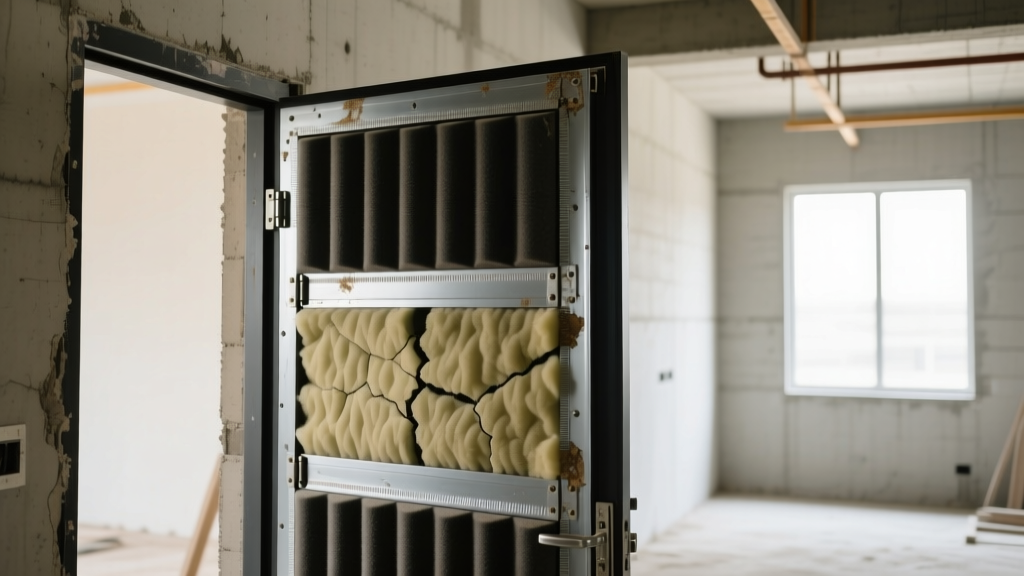
The True Lifespan of Acoustic Door Assemblies
When specifying a soundproof door for a recording studio, home theater, or mechanical room, architects and homeowners focus heavily on the initial Sound Transmission Class (STC) rating. However, an STC 50 rating is merely a snapshot in time measured under controlled laboratory conditions per ASTM E90 standards. In real-world applications, the acoustic lifespan of a door assembly is rarely dictated by the door slab itself. Instead, it is determined by the degradation of its sealing mechanisms, hardware deflection, and environmental wear.
A high-quality acoustic door assembly can last 30 to 50 years structurally, but its effective acoustic lifespan—the period during which it maintains its rated STC performance without intervention—is typically much shorter. Without proactive maintenance, a soundproof door can lose 10 to 15 STC points within the first decade due to microscopic gaps forming in the perimeter seals and automatic door bottoms. Understanding these degradation vectors is critical for facility managers and builders aiming to maintain long-term noise isolation.
Core Material Durability vs. Acoustic Degradation
The door slab serves as the primary mass barrier against airborne noise. While mass is the foundational requirement for sound blocking, the dimensional stability of the core material dictates how well the door maintains its fit within the acoustic frame over decades of use.
| Core Material | Expected Structural Lifespan | Acoustic Degradation Risks | Ideal Environment |
|---|---|---|---|
| 16-Gauge Steel | 40–50+ Years | Denting alters surface mass; internal honeycomb can rattle if adhesives fail. | Commercial, industrial, high-traffic corridors. |
| Solid Core Wood | 25–40 Years | Hygroscopic expansion/contraction warps edges, breaking the perimeter seal. | Climate-controlled studios, residential theaters. |
| Acoustic MDF | 15–20 Years | Sagging under its own weight; edge crumbling compromises hinge screw retention. | Low-traffic interior rooms, budget-conscious builds. |
| Composite/Lead-Lined | 30–45 Years | Delamination of the lead or mass-loaded vinyl (MLV) inner layer over time. | Medical imaging (X-ray), extreme industrial noise. |
According to the Whole Building Design Guide (WBDG), solid wood and steel remain the premier choices for long-term acoustic stability. MDF, while cost-effective and dense, is highly susceptible to moisture absorption, which causes the bottom rail to swell and drag, ultimately pulling the door out of acoustic alignment.
The Weakest Link: Perimeter Seals and Automatic Door Bottoms
If the door slab is the shield, the seals are the mortar. Sound behaves like water; it will exploit the path of least resistance. A gap as small as 1/16th of an inch around the perimeter of an STC 50 door can reduce its effective field performance to STC 30 or lower.
Seal Material Breakdown
- Neoprene Bulb Seals: The industry standard for mid-range acoustic doors. Neoprene suffers from "compression set"—a permanent deformation caused by the door remaining closed for extended periods. After 5 to 7 years, neoprene loses its rebound memory, leaving micro-gaps at the header and jambs.
- Silicone Seals: Highly resistant to compression set and temperature fluctuations. Silicone maintains its acoustic integrity for 15 to 20 years, making it the superior choice for long-term durability, despite a 30% higher upfront cost.
- Magnetic Perimeter Seals: Used in premium studio doors, these function like refrigerator gaskets. They offer the highest acoustic seal but require the door frame to remain perfectly plumb. If the frame racks even 2 millimeters, the magnetic bond breaks.
The ADB is a mechanical drop seal that engages when the door closes. The internal linkage and brass actuator button are subject to severe mechanical wear. In high-traffic environments, the internal spring mechanism can fatigue within 50,000 to 100,000 cycles (roughly 3 to 5 years). When the ADB fails to drop fully, a 3/8-inch gap is left at the floor, entirely negating the door's low-frequency blocking capabilities. Always specify ADBs with replaceable internal cartridges rather than sealed units.
Hinge Deflection and Frame Racking: The Silent STC Killers
A standard soundproof door is exceptionally heavy. An STC 50 solid wood door can weigh upwards of 200 pounds, while a composite acoustic door can exceed 300 pounds. Standard butt hinges are entirely inadequate for this mass over a multi-decade lifespan.
When butt hinges are used, the top hinge bears the brunt of the tensile load. Over time, the screws pull slightly from the jamb, causing the door to "sag" on the latch side. This sag compresses the weatherstripping at the top corner while pulling it away from the bottom hinge corner. To prevent this, acoustic doors must be hung on continuous (piano) hinges. Continuous hinges distribute the door's weight evenly across the entire height of the frame, virtually eliminating hinge-related sag and preserving the uniform compression of the perimeter seals for the life of the building. The Institute of Noise Control Engineering (INCE-USA) frequently cites improper hardware specification as a primary cause of field-tested acoustic failures.
Maintenance Matrix: Preserving STC Ratings Over Decades
To ensure a soundproof door achieves its maximum lifespan without acoustic degradation, facility managers must implement a strict maintenance protocol. The following matrix outlines the required interventions to preserve STC ratings.
- Quarterly: Inspect the ADB drop seal for uniform floor contact. Use a feeler gauge to ensure the gap between the seal and the floor does not exceed 1/32nd of an inch when engaged. Vacuum the ADB track to remove dust buildup that impedes the drop mechanism.
- Bi-Annually: Wipe down silicone or magnetic perimeter seals with a mild, non-petroleum-based cleaner. Petroleum products cause silicone to swell and magnetic strips to lose their polarity grip.
- Annually: Check the torque on all continuous hinge fasteners. The vibration from heavy door slams can loosen frame screws over time. Retorque to the manufacturer's specification (typically 25-30 in-lbs for #12 steel frame screws).
- Every 5-7 Years: Proactively replace neoprene bulb seals, regardless of visual condition. The internal cellular structure of neoprene degrades invisibly before external cracking appears.
Real-World Failure Modes and Troubleshooting
When an acoustic door fails to meet its rated STC in the field, the issue is rarely the door's core density. Troubleshooting must focus on the assembly's physical geometry.
Symptom: Low-Frequency Noise Bleed (HVAC Rumble, Bass)
Cause: Low-frequency sound waves require massive airtight seals to block. This symptom almost always indicates a failure at the automatic door bottom or the threshold. If the threshold is not sealed to the subfloor with acoustic caulk, sound will flank under the door assembly.
Fix: Remove the threshold, apply a 3/8-inch bead of acoustical sealant (such as Tremco Acoustical Sealant) to the subfloor, and reinstall.
Symptom: High-Frequency Noise Bleed (Voices, Hissing)
Cause: High frequencies are easily blocked by mass but will leak through microscopic pinholes. This indicates perimeter seal compression set or a warped door edge.
Fix: Perform the "dollar bill test." Close the door on a dollar bill at various points along the jamb. If you can pull the bill out without resistance, the seal has failed at that location. Replace the weatherstripping or adjust the continuous hinge to increase compression.
Ultimately, the durability of a soundproof door is an active process, not a passive guarantee. By selecting dimensionally stable core materials, specifying continuous hinges and silicone seals, and adhering to a rigorous maintenance matrix, building owners can ensure their acoustic investments perform at peak efficiency for decades.