Building Insulators Materials: 2026 Selection Guide
Master our 2026 selection framework for building insulators materials. Compare R-values, costs, and failure modes for spray foam, mineral wool, and more.
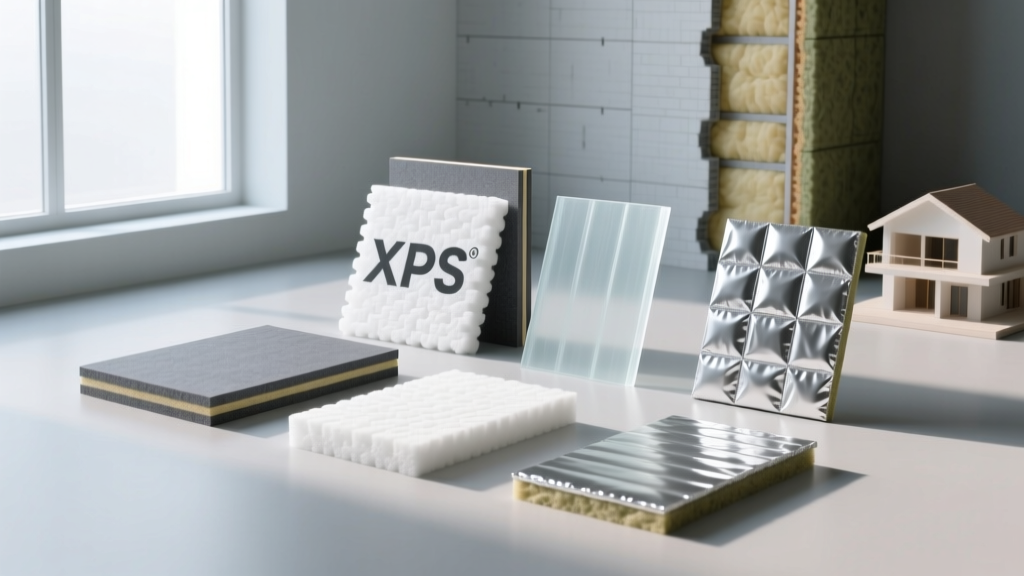
The 4-Step Insulators Materials Selection Matrix
Selecting the right insulators materials requires moving beyond basic R-value comparisons. In 2026, building envelopes must simultaneously manage thermal resistance, vapor drive, acoustic transmission, and fire propagation. A misstep in material selection leads to interstitial condensation, mold growth, or catastrophic energy loss. To navigate this, structural engineers and high-performance builders utilize a four-step selection matrix:
The Envelope Decision Framework
- Climate & Vapor Drive Analysis: Determine the dominant vapor drive direction (inward vs. outward) based on the IECC climate zone to select the correct vapor retarder class.
- Assembly Depth & Thermal Bridging: Calculate the effective R-value (not just the cavity R-value) accounting for framing factors and thermal bridging through studs.
- Acoustic STC/IIC Requirements: Identify if the assembly requires decoupling or high-mass materials to mitigate low-frequency mechanical or exterior noise.
- Fire & Code Compliance: Verify ASTM E84 flame spread indices and NFPA 285 assembly compliance for multi-story or commercial applications.
Climate Zone Mapping & R-Value Thresholds
The baseline for selecting insulators materials begins with the Department of Energy's climate zone mappings. The 2024 and 2026 IECC updates have significantly increased the minimum continuous insulation (ci) requirements for wood-framed and steel-framed assemblies to eliminate thermal bridging. According to the U.S. Department of Energy's insulation guidelines, cavity insulation alone is no longer sufficient in Zones 4 through 8.
| IECC Climate Zone | Dominant Climate Type | Min. Cavity R-Value (Wood Frame) | Min. Continuous Insulation (ci) | Recommended Primary Material |
|---|---|---|---|---|
| Zone 1-2 | Hot-Humid / Hot-Dry | R-13 | None required | Open-cell SPF or Fiberglass |
| Zone 3 | Warm-Humid | R-13 | R-3.8 to R-5 | Mineral Wool + EPS |
| Zone 4 | Mixed-Humid | R-20 or R-13+5ci | R-5 to R-7.5 | Closed-cell SPF or Polyiso |
| Zone 5-6 | Cold | R-20+5ci or R-13+10ci | R-7.5 to R-15 | ccSPF + Mineral Wool |
| Zone 7-8 | Very Cold / Subarctic | R-20+10ci or R-13+15ci | R-10 to R-20 | Thick Polyiso + ccSPF |
Material Deep-Dive: High-Performance Contenders
When specifying insulators materials for high-performance envelopes, three categories dominate the 2026 market due to their superior moisture management and thermal stability.
Closed-Cell Spray Polyurethane Foam (ccSPF)
Products like Icynene ProSeal LE or Demilec Heatlok XT deliver an R-value of 6.5 to 7.2 per inch. Beyond thermal resistance, ccSPF acts as a Class II vapor retarder at just 1.5 inches thick and provides structural racking strength to shear walls. It is the premier choice for unvented cathedral ceilings and rim joists where air sealing is critical. However, it carries a high global warming potential (GWP) unless formulated with next-generation HFO blowing agents, which are now standard in premium 2026 product lines.
High-Density Mineral Wool
Mineral wool batts (e.g., Rockwool Comfortbatt or Owens Corning Thermafiber UltraBatt) offer R-4.2 to R-4.3 per inch. While the R-value is lower than foam, mineral wool is vapor-permeable, allowing assemblies to dry to the exterior or interior. It is non-combustible (ASTM E136) and maintains its dimensional stability even when exposed to bulk water, making it the safest choice for below-grade exterior applications and rain-screen cavities.
Polyisocyanurate (Polyiso) Rigid Board
Polyiso offers the highest R-value per inch of any rigid board (R-6.0 to R-6.5). However, builders must account for thermal drift. Polyiso's R-value degrades in extremely cold temperatures (below 40°F) due to the condensation of blowing agents within the foam cells. In Zones 6 and above, polyiso should be paired with a layer of extruded polystyrene (XPS) or mineral wool to maintain thermal performance during deep freezes.
Acoustic vs. Thermal: Decoupling the Requirements
Expert Insight: Thermal insulation traps heat; acoustic insulation blocks sound waves. High R-value does not equal high STC (Sound Transmission Class). Treating them as interchangeable is a primary cause of multi-family construction defects.
For interior partitions where acoustic privacy is required (e.g., hotel rooms, multi-family dwellings, home theaters), the mass and density of the insulators materials dictate performance. Standard fiberglass batts (density ~0.5 lbs/ft³) achieve an STC of 39 in a standard 2x4 wood-stud wall. Upgrading to high-density mineral wool (density ~2.5 lbs/ft³) increases the STC to 45 without altering the framing. For low-frequency noise (HVAC rumble, traffic), mass is mandatory. Furthermore, acoustic performance relies heavily on decoupling—using resilient channels or staggered-stud framing—rather than simply stuffing the cavity with thicker insulation.
2026 Cost & ROI Breakdown
Material costs have stabilized following the supply chain disruptions of the early 2020s, but labor rates for specialized applications like spray foam continue to rise. Below is the 2026 national average pricing for residential and light-commercial applications.
| Material Type | Material Cost (per sq ft) | Installed Cost (per sq ft) | R-Value per Inch | Estimated Energy ROI Payback |
|---|---|---|---|---|
| Fiberglass Batt (Standard) | $0.45 - $0.65 | $1.20 - $1.80 | 3.1 - 3.4 | 4 - 6 Years |
| Mineral Wool Batt | $1.20 - $1.60 | $2.10 - $2.80 | 4.2 - 4.3 | 6 - 9 Years |
| Open-Cell SPF | $0.60 - $0.90 (bf) | $1.10 - $1.50 (bf) | 3.5 - 3.8 | 5 - 7 Years |
| Closed-Cell SPF | $1.30 - $1.80 (bf) | $2.20 - $3.10 (bf) | 6.5 - 7.2 | 7 - 11 Years |
| Polyiso Rigid Board (1.5') | $1.10 - $1.40 | $1.80 - $2.50 | 6.0 - 6.5 | 5 - 8 Years |
Note: (bf) denotes board foot (1 sq ft at 1 inch thickness).
Critical Failure Modes & Edge Cases
Even the highest-performing insulators materials will fail if the building physics are ignored. The Building Science Corporation's analysis on vapor control layers highlights several recurring failure modes in modern envelopes:
Failure Mode 1: The 'Flash and Batt' Dew Point Trap
In cold climates (Zones 5-7), builders often use a 'flash and batt' method: a thin layer of closed-cell foam against the sheathing, with fiberglass filling the rest of the cavity. If the foam layer does not provide a sufficient percentage of the total assembly R-value, the interior surface of the foam will drop below the dew point during winter. This causes interior moisture to condense directly on the back of the foam, rotting the sheathing. Rule of thumb: In Zone 5, the ccSPF must provide at least 20% of the total R-value; in Zone 6, it must provide 35%; in Zone 7, 50%.
Failure Mode 2: Interior Polyethylene in Mixed-Humid Climates
Installing a Class I vapor retarder (6-mil polyethylene sheeting) on the interior warm-in-winter side of the wall is standard in Zone 7. However, if this same detail is used in Zone 4 (Mixed-Humid), summer air conditioning cools the interior drywall. Exterior moisture drives inward, hits the polyethylene, and condenses inside the wall cavity. In Zones 3 and 4, always use a Class III vapor retarder (vapor-retarding primer or kraft-faced batts) to allow bidirectional drying.

Final Procurement Checklist for Contractors
Before finalizing your insulation schedule, verify the following specifications with your supplier and design team:
- ASTM E84 Compliance: Ensure all exposed foam plastics (like ccSPF in basements or attics) are coated with an approved 15-minute thermal/intumescent barrier (e.g., DC315) unless covered by drywall.
- Blowing Agent Verification: For spray foam and XPS, specify HFO (hydrofluoroolefin) blowing agents to meet 2026 environmental regulations and avoid high-GWP HFC penalties.
- Compression Ratings: If insulating under-slab, verify the compressive strength (psi) of the EPS/XPS. Standard EPS is 10-15 psi; structural slabs require 25-40 psi high-density XPS.
- Acoustic Decoupling: Confirm that acoustic insulation is paired with resilient channels or sound isolation clips; stuffing mineral wool into a rigidly coupled stud wall yields diminishing STC returns.
By treating insulators materials as an integrated system of thermal, moisture, and acoustic control layers rather than isolated products, builders can eliminate warranty callbacks and deliver genuinely high-performance building envelopes.
Written by
Elena RodriguezElena Rodriguez is a civil engineer and technical writer specializing in concrete technology, masonry systems, and ASTM/ACI compliance. She earned her B.S. in Civil Engineering from Texas A&M University and spent a decade at a materials testing laboratory, performing over 2,000 concrete compressive strength tests and masonry prism evaluations. Elena is an ACI-certified Field Testing Technician (Grade I) and a member of ASTM Committee C12 on Natural Building Stone. She currently consults on forensic engineering cases involving concrete failures and moisture intrusion. Based in San Antonio, TX, Elena is a proud member of the Society of Women Engineers (SWE) and coaches her daughter's FIRST Robotics team.
More from Elena Rodriguez
View all
Walls & Panels
Cost Analysis: Light Gauge Steel Framing Advantages and Disadvantages
Evaluate light gauge steel framing advantages and disadvantages through a strict cost analysis lens, comparing material, labor, and lifecycle expenses.
Aug 4, 2026

Walls & Panels
Gypsum Board Types: Exact Specifications, Thickness & Dimensions
Compare standard, Type X, and moisture-resistant gypsum board types. Get exact specifications, thicknesses, dimensions, and ASTM standards for your project.
Aug 4, 2026

Fire Resistance
Best Fire-Resistant Outdoor Decking Materials: 2026 Buyer Guide
Discover the best fire-resistant outdoor decking materials for 2026. Compare Class A PVC, aluminum, and hardwood options for WUI compliance and safety.
Aug 4, 2026