Cellulose Insulation Application Guide: Best Use Cases & Limits
Match cellulose insulation to your exact building scenario. Compare loose-fill, dense-pack, and damp-spray methods with costs and failure modes.
Material Baseline: R-Value, Borates, and Hygroscopicity
Cellulose insulation is fundamentally recycled paper (typically 80-85% post-consumer newsprint) milled into a fibrous matrix and treated with borate compounds (boric acid, sodium borate, or calcium borate). This treatment provides a Class A fire rating, deters pests, and resists mold. According to the U.S. Department of Energy, cellulose offers an R-value of R-3.2 to R-3.8 per inch, slightly outperforming standard fiberglass batts (R-2.9 to R-3.4). However, its defining physical characteristic is hygroscopicity: it absorbs, stores, and releases moisture. This moisture-buffering capacity is a massive advantage in certain wall assemblies but a critical liability in others. Success with this material relies entirely on matching the installation method—loose-fill, dense-pack, or damp-spray—to the specific building assembly.
Application-Fit Matrix: Where Cellulose Wins and Loses
Not all cavities are equal. Use this decision matrix to determine if cellulose is the optimal choice for your specific project scenario.
| Building Scenario | Recommended Form | Fit Rating | Primary Risk | Superior Alternative |
|---|---|---|---|---|
| Unfinished Attic Floor (Retrofit) | Loose-Fill (Dry) | Excellent | Settling over time; wind washing | None (Best in class for cost/R-value) |
| Existing Closed Walls (Retrofit) | Dense-Pack (Dry) | Very Good | Trapped moisture; drywall blowout | Injection foam (if budget allows) |
| New Construction Open Stud Bays | Damp-Spray (Wet) | Good | Incomplete drying before drywall | Mineral wool batts or closed-cell foam |
| Basement Walls / Crawlspaces | N/A | Poor | Capillary water absorption; mold | Extruded Polystyrene (XPS) or Mineral Wool |
| Unvented Cathedral Ceilings | N/A | Poor | Condensation trapping; roof rot | Closed-cell spray foam or rigid polyiso |
Scenario 1: Unfinished Attic Retrofits (Loose-Fill)
Blowing dry, loose-fill cellulose over an existing attic floor is the highest-ROI application for this material. It seamlessly conforms to irregular joist spacing, wires, and plumbing penetrations that would leave gaps with fiberglass batts.
Installation Specifics and Settling Mitigation
Historically, loose-fill cellulose suffered from 15-20% settling, leaving top plates exposed. Modern manufacturing (e.g., Greenfiber Sanctuary or Applegate) has reduced this to under 5%, provided the installer follows the manufacturer's coverage chart. Installers must calibrate the blower machine to achieve the specified weight per square foot. For example, achieving R-49 (approx. 15 inches settled) with Greenfiber Sanctuary requires applying roughly 1.45 lbs per square foot.
- Ventilation Baffles: You must install rigid foam or plastic baffles (like AccuVent) at the eaves to prevent the insulation from blocking soffit vents. Wind washing across the top of the cellulose will strip its R-value.
- Attic Hatch Dams: Build a wooden dam around the attic hatch and pull-down stairs to contain the material and allow for a deep fill without spilling into the living space.
- Cost Expectation: Professional installation typically ranges from $1.50 to $2.50 per square foot, translating to roughly $2,500 to $4,000 for a 1,500 sq. ft. attic to reach R-49.
Scenario 2: Existing Closed Walls (Dense-Pack)
When retrofitting walls without removing drywall, dense-pack cellulose is the premier choice. The material is blown into the wall cavity at high pressure, achieving a density of 3.0 to 3.5 lbs/ft³. At this density, the cellulose locks into place, eliminating settling and significantly improving the wall's Sound Transmission Class (STC) rating by dampening acoustic vibrations.
The Drilling and Patching Protocol
Installers drill 2.5-inch holes through the exterior siding or interior drywall. For a standard 2x4 wall (8-foot height), the DOE guidelines and industry best practices dictate a two-hole method: one hole at the top third of the stud bay and one at the bottom third. A specialized filling hose is inserted, and the cavity is packed from the bottom up. The dense-pack method restricts air movement so effectively that it acts as its own air barrier, often negating the need for an interior vapor retarder in mixed-humid climates (Climate Zones 4 and 5), provided the exterior assembly allows for outward drying.
Do not dense-pack cellulose into walls that have existing bulk water leaks or unmitigated interior vapor drives (e.g., a bathroom with no exhaust fan sharing a wall with a cold exterior). Because dense-pack limits air movement, trapped moisture cannot easily evaporate, leading to concealed stud rot.
Scenario 3: New Construction Open Stud Bays (Damp-Spray)
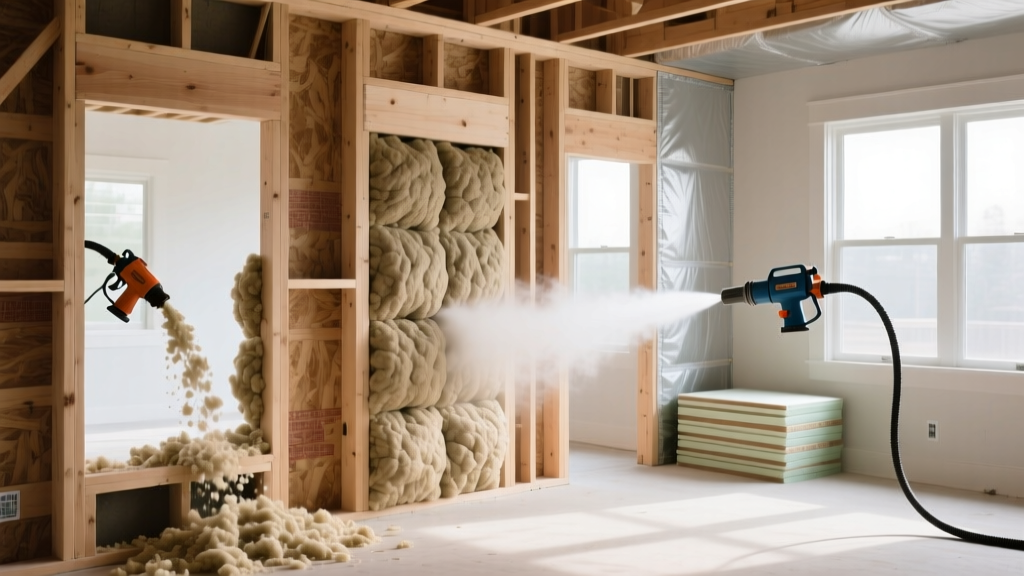
In new construction, damp-spray (or wet-spray) cellulose is applied directly into open stud bays before drywall. A fine mist of water is injected at the nozzle as the cellulose is blown. The water activates the natural lignins and added binders in the paper, causing the material to adhere to the studs and itself, creating a rigid, monolithic block that resists settling and air infiltration.
The Critical Drying Window
The fatal flaw of damp-spray occurs when drywall contractors are rushed. The insulation is typically sprayed with 1.5 to 2.0 gallons of water per 100 lbs of material. Before the cavity can be enclosed with drywall, the moisture content of the cellulose must drop below 25%. This requires 48 to 72 hours of active air circulation (using temporary construction fans and dehumidifiers). Enclosing the wall while the cellulose is above 25% moisture guarantees mold growth and structural degradation. If your project schedule cannot accommodate a mandatory 3-day drying pause, opt for mineral wool batts instead.
Where Cellulose Fails: The Anti-Scenarios
Because cellulose is essentially processed wood fiber, it behaves like wood when exposed to liquid water. It should never be used in the following scenarios:
- Below-Grade Foundation Walls: Concrete is porous and transfers ground moisture via capillary action. Cellulose placed against basement walls will wick this moisture, lose its R-value, and eventually compost.
- Unvented Roof Assemblies: In hot-humid climates, interior air conditioning causes condensation on the back of the roof sheathing. Cellulose will absorb this condensation, hiding the moisture until the roof deck rots. Unvented roofs require impermeable insulation like closed-cell spray foam or rigid polyiso.
- Direct Contact with Masonry: Always maintain a 1-inch air gap or use a rigid foam barrier between cellulose and any masonry or stone surface.
2026 Cost Breakdown by Application Method
Pricing fluctuates based on regional labor rates and material availability. The following table reflects national averages for professional installation in 2026.
| Method | Material Cost (per sq. ft.) | Installed Cost (per sq. ft.) | Target R-Value / Depth |
|---|---|---|---|
| Loose-Fill (Attic) | $0.60 - $0.90 | $1.50 - $2.50 | R-49 / ~15 inches |
| Dense-Pack (2x4 Walls) | $1.10 - $1.50 | $2.50 - $4.00 | R-13 to R-15 / 3.5 inches |
| Dense-Pack (2x6 Walls) | $1.60 - $2.10 | $3.50 - $5.50 | R-20 to R-22 / 5.5 inches |
| Damp-Spray (New Build) | $0.80 - $1.20 | $1.80 - $3.00 | R-13 to R-21 / Stud depth |
Quality Assurance: Verifying Installer Density
The Cellulose Insulation Manufacturers Association (CIMA) stresses that under-blown cellulose is the leading cause of thermal bypass and settling. As a homeowner or general contractor, you must verify the installation density.
For dense-pack applications, require your installer to perform a core sample test. They should extract a 1-cubic-foot sample of the packed cellulose using a specialized PVC tube and weigh it on a digital scale. If the sample weighs less than 3.0 lbs, the cavity is under-packed and will settle. Demand they re-pack the affected bays at their own expense before you release final payment.
Matching cellulose insulation to the correct building assembly leverages its high R-value, acoustic dampening, and eco-friendly profile while completely bypassing its moisture vulnerabilities. By enforcing strict density requirements and respecting its hygroscopic limits, you secure a high-performance thermal envelope that outlasts and outperforms cheaper alternatives.