Building Insulation R-Values: Material Taxonomy and Selection
Master building insulation R-values with our material taxonomy guide. Compare fiberglass, spray foam, and rigid boards for optimal thermal selection.
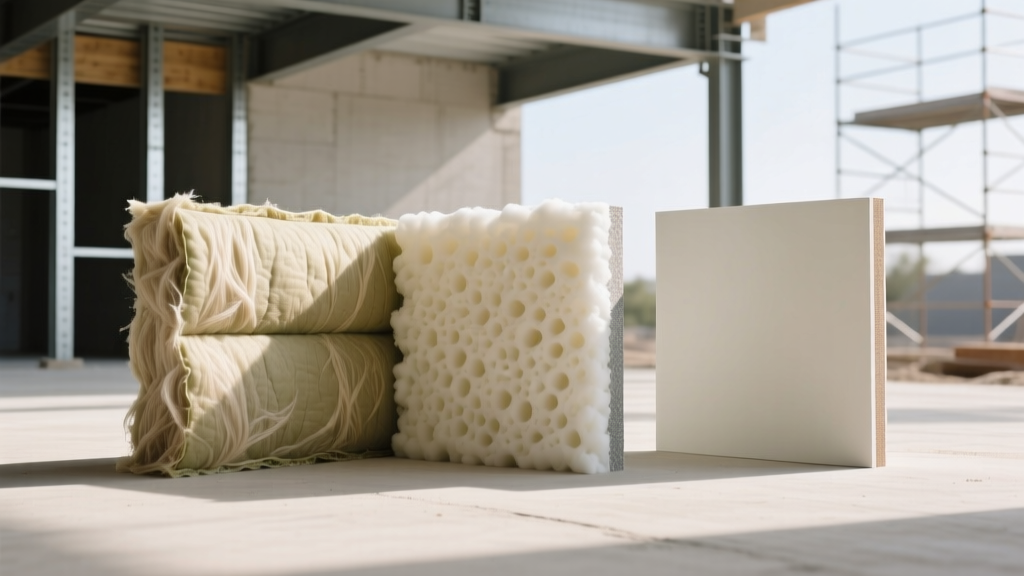
The R-Value Spectrum: Classifying Insulation Taxonomies
Selecting thermal protection for a building envelope requires moving beyond the simplistic notion that a higher number is universally better. Understanding building insulation R-values demands a material taxonomy approach—categorizing products by their chemical composition, physical structure, and hygrothermal behavior. R-value measures thermal resistance (the capacity of a material to resist heat flow), but it does not account for air leakage, vapor diffusion, or thermal bridging. According to the U.S. Department of Energy, while R-value is the baseline metric for code compliance, the effective performance of an assembly relies heavily on how the material class interacts with the surrounding structural elements.
Core Principle: The Law of Diminishing Returns
Doubling your insulation from R-10 to R-20 cuts heat loss by 50%. However, upgrading from R-40 to R-80 only reduces heat loss by an additional 2.5%. Material selection must balance the marginal cost of higher R-values against the physical constraints of the wall or roof cavity depth.
Low-to-Mid R-Value Materials (R-2.2 to R-4.3 per inch)
This taxonomy encompasses fibrous and cellular loose-fill materials. They are highly vapor-permeable, allowing walls to dry to the interior or exterior, which is critical for preventing moisture accumulation in wood-framed assemblies.
Fiberglass Batts and Blankets
Standard fiberglass batts offer an R-value of R-3.1 to R-3.4 per inch. High-density variants, such as Owens Corning EcoTouch R-15 (designed specifically for 3.5-inch 2x4 cavities), push this to R-4.3 per inch by packing more glass fibers into the same volume.
- Pros: Highly cost-effective ($0.40 - $0.70 per sq. ft.), non-combustible, easy to install in standard framing, highly vapor-permeable.
- Cons: Susceptible to convective heat loss if not perfectly air-sealed; loses thermal resistance if compressed or wetted.
Mineral Wool (Rock and Slag Wool)
Products like Rockwool Comfortbatt deliver R-4.2 per inch. Mineral wool is denser than fiberglass and offers superior acoustic dampening and fire resistance, maintaining its structural integrity at temperatures exceeding 1,800°F (ASTM E119 fire-rated assemblies).
- Pros: Rigid enough to friction-fit tightly into cavities (eliminating gaps), hydrophobic (repels water while remaining vapor-open), excellent soundproofing.
- Cons: Higher material cost ($0.90 - $1.30 per sq. ft.), generates irritating dust during cutting, requires specialized serrated knives.
Dense-Pack Cellulose
Blown-in cellulose (recycled paper treated with borate fire retardants) achieves R-3.5 to R-3.8 per inch when dense-packed at 3.5 lbs per cubic foot. It excels in retrofit scenarios where existing wall cavities cannot be opened.
High R-Value Rigid & Foamed Taxonomies (R-5.0 to R-7.0+ per inch)
When cavity depth is limited, or when continuous exterior insulation (ci) is required to break thermal bridges, closed-cell polymers and rigid foams dominate. The ENERGY STAR program heavily advocates for continuous rigid insulation to mitigate framing thermal bridges.
| Material Class | R-Value / Inch | Cost (per board ft) | Vapor Permeability | Critical Edge Case / Limitation |
|---|---|---|---|---|
| XPS (Extruded Polystyrene) | R-5.0 | $0.80 - $1.10 | Semi-Impermeable | LTTR (Long-Term Thermal Resistance) drops as HFC blowing agents off-gas over 15 years. |
| Polyiso (Polyisocyanurate) | R-6.0 - R-6.5 | $0.70 - $1.00 | Impermeable (Foil-faced) | <strong>Cold Weather Drop:</strong> R-value decreases in freezing temps as blowing gases condense in the cells. |
| ccSPF (Closed-Cell Spray Foam) | R-6.5 - R-7.0 | $2.50 - $3.50 | Impermeable (>1.5 inches) | High global warming potential (GWP) blowing agents; hides framing defects from visual inspection. |
The 'Effective R-Value' Trap: Thermal Bridging Realities
A common failure in building envelope design is relying solely on the center-of-cavity R-value. Wood framing acts as a thermal bridge. A standard wood stud has an R-value of roughly 1.25 per inch. Therefore, a 2x6 stud (which is actually 5.5 inches deep) has an R-value of only R-6.87.
Expert Insight: If you fill a 2x6 wall cavity with R-20 fiberglass batts, the wood studs (occupying roughly 20-25% of the wall area) drag the whole-wall 'effective R-value' down to approximately R-14 or R-15. To achieve a true R-20+ assembly in cold climates, building scientists at Building Science Corporation mandate the use of continuous exterior rigid insulation (ci) to completely sever the thermal bridge created by the framing.
Decision Framework: Selecting by Climate Zone and Assembly
Do not select materials based on R-value alone. Use this sequential framework to match the material taxonomy to your specific hygrothermal requirements:
- Identify the IECC Climate Zone: Determine the prescriptive code requirements. For example, IECC Climate Zone 5 typically requires wood-frame walls to meet R-20+5ci (R-20 cavity plus 1 inch of exterior foam) OR R-13+10ci.
- Calculate the Dew Point: If using exterior rigid foam, ensure the foam's R-value represents a high enough percentage of the total wall R-value to keep the interior sheathing above the dew point during winter. A general rule for Zone 5 is that exterior foam must be at least 20% of the total assembly R-value; for Zone 7, it must be at least 33%.
- Assess Vapor Retarder Needs: If you select closed-cell spray foam (ccSPF) for the cavity, it acts as a Class I vapor retarder at just 1.5 inches of thickness. You must never pair interior ccSPF with an exterior polyiso or XPS board, as this creates a 'double vapor barrier' that traps moisture inside the wall cavity, leading to catastrophic rot.
- Select the Material Class: Use vapor-open mineral wool or dense-pack cellulose for flash-and-batt assemblies where exterior drying is required. Use foil-faced polyiso for exterior continuous insulation where rain control and high R-value per inch are paramount.
Frequently Asked Questions
Does compressing a thick batt into a shallow cavity increase its total R-value?
No. If you take an R-19 batt (designed for a 6.25-inch 2x6 cavity) and compress it into a 3.5-inch 2x4 cavity, you increase its R-value per inch due to higher density, but the total R-value drops to approximately R-13. You also create immense pressure against the interior drywall, which can cause fasteners to pop. Always purchase batts sized specifically for the cavity depth.
Why does Polyisocyanurate (Polyiso) lose R-value in the cold?
Polyiso is manufactured using blowing agents that remain gaseous at room temperature, yielding a high R-6.5 per inch. However, when surface temperatures drop below freezing (typically around 25°F to 40°F depending on the specific manufacturer's blowing agent blend), these gases begin to condense into liquids inside the foam cells. This condensation reduces the insulating gas volume, dropping the effective R-value to R-5.0 or lower. In extremely cold climates, XPS or mineral wool may outperform Polyiso despite having a lower rated room-temperature R-value.
Is R-value the only metric that matters for energy efficiency?
No. Air leakage accounts for up to 40% of a building's heat loss. A wall with R-15 mineral wool that is meticulously air-sealed with fluid-applied membranes or aerobarriers will significantly outperform a wall with R-20 closed-cell foam that has gaps around electrical boxes, rim joists, and top plates. Always prioritize the continuity of the air control layer over marginal gains in raw R-value.