Soundproof Insulation Lifespan: Durability & Failure Analysis
Analyze the true lifespan of soundproof insulation. Explore durability, failure modes, and degradation for mineral wool, mass loaded vinyl, and acoustic foam.
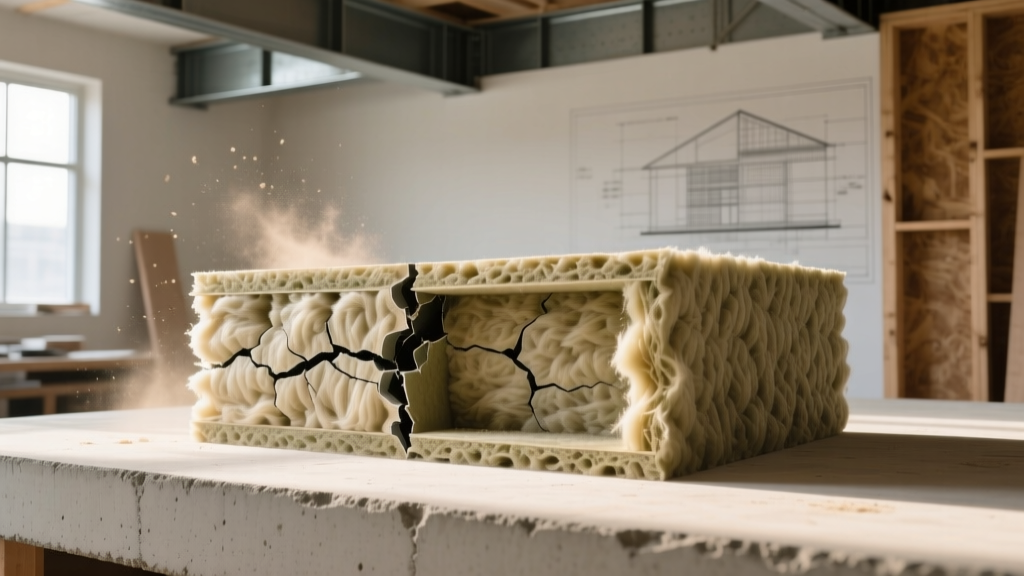
The Hidden Decay: Why Acoustic Performance Degrades Over Time
When builders and homeowners install acoustic treatments, the focus is almost entirely on initial Sound Transmission Class (STC) and Impact Insulation Class (IIC) ratings. However, soundproof insulation is not a static, permanent fixture. Unlike thermal insulation, which may slowly lose R-value over decades, acoustic insulation can suffer catastrophic performance drops from minor physical shifts. According to the Whole Building Design Guide, maintaining the integrity of the acoustic envelope is critical, as even microscopic breaches in a sound barrier can compromise the entire assembly.
The fundamental rule of acoustics is the '1% Rule': a gap comprising just 1% of a barrier's total surface area can reduce its sound transmission loss by up to 50%. Therefore, the durability of soundproof insulation is less about the material dissolving and more about its physical stability, resistance to gravity, and the longevity of the acoustic sealants binding the system together. In this analysis, we break down the expected lifespans, specific failure modes, and replacement triggers for the most common soundproofing materials used in modern construction.
Material-by-Material Lifespan and Failure Matrix
Not all soundproof insulation degrades at the same rate. The table below maps specific commercial and residential products to their expected functional lifespans and primary degradation vectors.
| Material Category | Specific Product Example | Expected Lifespan | Primary Failure Mode | Estimated Replacement Cost (per sq. ft.) |
|---|---|---|---|---|
| Mineral Wool Batts | Rockwool Safe'n'Sound | 30–50 Years | Gravity-induced sagging creating top-cavity air gaps | $2.50 – $4.00 (requires drywall demo) |
| Rigid Fiberglass | Owens Corning 705-FRK | 40+ Years | Foil facing delamination and edge compression | $4.50 – $6.50 |
| Mass Loaded Vinyl (MLV) | Acoustiblok (1 lb/sq ft) | 20–30 Years | Plasticizer migration causing brittleness and tearing | $3.00 – $5.00 |
| Viscoelastic Damping | Green Glue Compound | 20–40 Years | Polymer drying and loss of shear-damping properties | $1.50 – $2.50 (compound only) |
| Acoustic Sealants | OSI Acoustical Sound Sealant | 10–20 Years | Shrinkage, cracking, and loss of adhesion to substrates | $0.50 – $1.00 (material only) |
Mineral Wool and Fiberglass: The Gravity and Moisture Threat
Mineral wool is the gold standard for cavity soundproof insulation due to its high density and non-combustible nature. Products like Rockwool Safe'n'Sound boast a density of approximately 2.5 pounds per cubic foot (pcf), compared to standard thermal fiberglass batts which sit around 0.7 pcf. This high density is exactly what traps sound waves, converting acoustic energy into trace amounts of heat via friction.
The Sagging Phenomenon
Despite its density, mineral wool is subject to gravity. If the batts are not friction-fitted perfectly—or if the wall cavity exceeds the standard 16-inch on-center framing—the heavy material can slowly sag over a 15 to 20-year period. When a batt drops even half an inch, it exposes the top of the wall cavity. Because sound behaves like water, it will immediately find this unobstructed path, flanking the insulation and rendering the STC rating useless. To prevent this, professional acousticians recommend using mechanical wire supports or horizontal blocking in wall cavities taller than 10 feet.
Moisture and Acoustic Degradation
While mineral wool is hydrophobic and will not absorb water, the binder resins can degrade if subjected to chronic, high-humidity environments (such as interior walls adjacent to unventilated bathrooms). Once the resin breaks down, the batt loses its structural rigidity, accelerating the sagging process. Testing protocols outlined in ASTM E90 for airborne sound transmission loss assume a perfectly sealed, intact assembly; any physical degradation of the batt voids the laboratory-certified STC rating in real-world applications.
Mass Loaded Vinyl and Damping Compounds: Chemical Aging
Mass Loaded Vinyl (MLV) and viscoelastic damping compounds like Green Glue operate on entirely different acoustic principles than porous absorbers. MLV relies on sheer mass to block sound, while damping compounds convert sound vibrations into heat through shear friction between two layers of drywall.
MLV is manufactured using plasticizers to keep the vinyl flexible. Over 20 to 30 years, these plasticizers naturally migrate to the surface of the material (a process known as exudation). As the plasticizers leach out, the MLV becomes stiff and brittle. If the building experiences structural settling or thermal expansion, the brittle MLV can micro-crack, creating direct acoustic flanking paths that bypass the mass barrier entirely.
Viscoelastic compounds face a different aging challenge. Green Glue remains permanently viscoelastic, meaning it never fully 'cures' into a hard solid. However, if the drywall layers shift due to the building's natural settling over decades, the shear forces can exceed the compound's tensile strength, causing it to tear away from the gypsum board. When replacing damping compounds, contractors must completely scrape the old polymer residue before applying a new layer, adding significant labor costs to the replacement process.
The Weakest Link: Acoustic Sealants and Flanking Paths
If you ask an acoustic engineer what the most critical component of a soundproof assembly is, they will rarely say the insulation itself. The most common point of catastrophic failure is the acoustic sealant used at the perimeters, electrical outlets, and floor tracks.
Standard latex caulks dry hard and shrink over time. Acoustic sealants, like OSI Acoustical Sound Sealant or Tremco Acoustical Sealant, are formulated to remain permanently pliable. However, 'permanent' in the chemical industry typically means 15 to 20 years. After two decades of HVAC temperature cycling (expansion and contraction of the drywall), the sealant can lose its adhesion to the substrate. A 1/16th-inch crack along the bottom track of a wall will allow low-frequency bass and airborne speech to leak through effortlessly. During any renovation of a soundproofed space, cutting out and reapplying the perimeter acoustic caulk is the single most cost-effective way to restore the assembly's original STC rating.
Environmental Stressors That Accelerate Acoustic Failure
Key Degradation Accelerators
- Thermal Cycling: Buildings in climates with extreme seasonal temperature swings experience drywall expansion and contraction, putting immense shear stress on acoustic sealants and damping compounds.
- Structural Settling: New construction settles significantly in the first 5 years. This can compress ceiling acoustic hangers or shift wall studs, altering the tension on resilient channels and reducing their decoupling efficacy.
- UV Exposure: If acoustic foam or MLV is left exposed to sunlight (e.g., in a sunroom or near large windows), UV radiation will break down the cellular structure of foams and degrade MLV polymers within 3 to 5 years.
Proactive Maintenance and Replacement Triggers
Soundproof insulation does not require annual maintenance, but it does require strategic evaluation during building renovations. You should plan for a full tear-out and replacement of your soundproof insulation under the following conditions:
- Visible Drywall Bowing: If the drywall is bowing or pulling away from the studs, the heavy mineral wool or MLV behind it has likely shifted, compromising the acoustic decoupling.
- Electrical Upgrades: When electricians cut new holes for outlets or smart-home wiring, they often fail to reinstall acoustic putty pads or reseal the cavities. Any wall that has undergone electrical retrofitting should have its acoustic sealant and putty pads entirely replaced.
- Water Intrusion Events: While mineral wool survives water, the paper facing on drywall and the adhesive on rigid acoustic panels do not. Any moisture event requires the removal of the acoustic layers to prevent mold growth inside the sealed cavity.
By understanding the specific chemical and physical degradation vectors of soundproof insulation, builders and facility managers can design assemblies that not only achieve high STC ratings on day one, but maintain those acoustic barriers for the functional lifetime of the structure.