Insulation Materials Corporation R-Value & Performance Data
Analyze real-world R-value performance, thermal bridging, and installed vs. labeled data from top insulation materials corporation portfolios.

The Gap Between Labeled and Installed R-Value
When specifying products from a major insulation materials corporation, builders and architects frequently encounter a critical discrepancy: the laboratory-tested R-value printed on the packaging rarely matches the thermal resistance achieved in the field. This delta is not necessarily the result of deceptive manufacturing, but rather the physical realities of installation tolerances, thermal bridging, and convective looping. Understanding how flagship products perform outside the controlled environment of an ASTM C518 heat flow meter is essential for meeting 2026 energy codes and achieving net-zero building targets.
2026 Flagship Portfolio Matrix: Labeled vs. Real-World Performance
The following matrix evaluates the thermal performance of high-volume products supplied by leading industry manufacturers. Pricing reflects Q1 2026 national averages for residential and light-commercial applications.
| Product Line / Type | Labeled R-Value (per inch) | Effective R-Value (Installed) | 2026 Cost (per sq. ft.) |
|---|---|---|---|
| Owens Corning ProPink L77 (Blown-in Fiberglass) | R-3.70 | R-3.50 (attic), R-3.20 (wall) | $0.85 - $0.95 |
| Rockwool Comfortbatt (Mineral Wool) | R-4.22 | R-4.15 (friction fit minimizes gaps) | $1.45 - $1.60 |
| Johns Manville Spider Plus (Spray-in Fiberglass) | R-4.20 | R-3.90 (highly dependent on binder ratio) | $1.15 - $1.35 |
| Knauf EcoBatt Kraft (Fiberglass Batt) | R-3.14 | R-2.80 (susceptible to convective looping) | $0.65 - $0.75 |
Why Mineral Wool Outperforms in the Field
Evaluating an insulation materials corporation's technical data sheet reveals that mineral wool (stone wool) consistently maintains its labeled R-value post-installation. This is due to its high density (typically 6 to 8 lbs per cubic foot) and rigid dimensional stability. Unlike fiberglass, which relies on trapped air within a delicate glass matrix, mineral wool's dense fiber structure resists compression and completely fills irregular cavities, effectively neutralizing convective heat transfer that plagues lower-density batts.
The Mathematics of Compression and Convection Penalties
A common field error occurs when installers force a thicker batt into a shallower cavity. The assumption that R-value scales linearly with thickness is fundamentally incorrect. When fiberglass is compressed, the solid conduction through the glass fibers increases, degrading the overall thermal resistance.
- R-19 Batt (6.25" thick) in a 5.5" 2x6 cavity: The R-value does not drop to R-16.7. Due to increased solid conduction, the effective R-value degrades to approximately R-17.5.
- R-19 Batt (6.25" thick) in a 3.5" 2x4 cavity: Severe compression collapses the air pockets entirely. The effective R-value plummets to R-13 or lower, negating the premium paid for the higher-rated product.
- Convective Looping in Unfaced Batts: In exterior walls lacking an interior air barrier, temperature differentials create convective currents within the fiberglass matrix. Warm interior air rises against the cold sheathing, cools, and falls, creating a continuous loop that can reduce effective wall R-value by 15% to 25% during peak winter conditions.
Advanced Corporate Offerings: Aerogels and VIPs
For high-performance enclosures where cavity depth is restricted, top-tier manufacturers have integrated advanced materials into their distribution networks. Vacuum Insulation Panels (VIPs) and aerogel blankets represent the cutting edge of thermal resistance.
Products like Spaceloft aerogel blankets deliver an exceptional R-10 per inch. While the material cost is substantial (averaging $4.50 to $6.00 per square foot in 2026), it is the only viable solution for retrofitting historic masonry buildings or achieving Passive House standards in spaces where adding 6 inches of rigid foam is architecturally impossible.
Mitigating Thermal Bridging in Corporate-Specified Assemblies
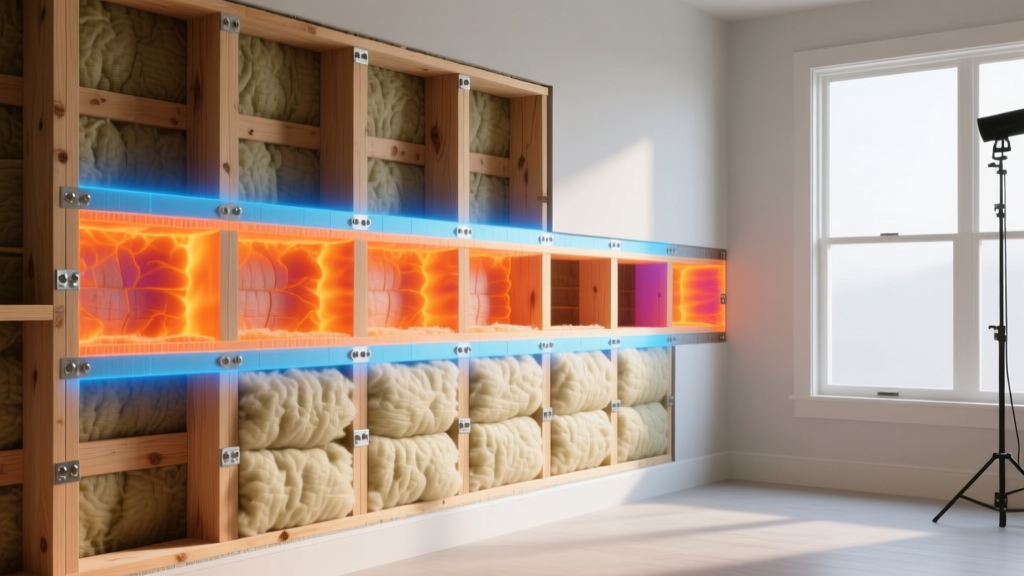
No matter how perfectly an insulation materials corporation manufactures its batts, the framing lumber creates a thermal bridge that bypasses the cavity insulation. Standard 2x6 wood framing at 16 inches on center reduces the whole-wall R-value by approximately 15% compared to the center-of-cavity R-value.
Actionable Installation Specifications
- Implement Continuous Insulation (ci): Always pair cavity batts with a minimum of R-5 continuous exterior rigid foam (polyiso or EPS) to break the thermal bridge of the wood studs.
- Seal the Top Plate: Use closed-cell spray foam or specialized fluid-applied membranes at the top plate-to-drywall intersection. This single detail stops the stack effect from pulling conditioned air through the insulation matrix.
- Density Verification for Blown-In: When using blown-in fiberglass, mandate that installers use a coverage chart and scale. For an attic application targeting R-49, the installed density must be exactly 1.5 to 1.8 lbs per cubic foot. Under-dense applications will settle over time, leaving the top of the wall cavity uninsulated.
FAQ: Corporate Warranties and R-Value Guarantees
Do manufacturer warranties cover installed R-value degradation?
No. Manufacturer warranties strictly cover the material's physical integrity and its R-value at the time of manufacture, provided it is installed exactly per their printed instructions. If a blower door test or infrared thermography reveals underperformance due to compression, gaps, or missing air barriers, the liability falls entirely on the installing contractor, not the corporation.
How does extreme cold affect fiberglass R-value?
Fiberglass insulation relies on trapped air to resist heat flow. In extreme cold (below 0°F), the temperature differential across the wall cavity increases, which can trigger internal convective looping if the batt is not faced or covered with an airtight membrane. In these conditions, the effective R-value of standard fiberglass can drop by up to 30%, whereas dense-pack cellulose and mineral wool remain largely unaffected due to their air-permeability resistance.
What is the best method to verify field R-value?
While you cannot measure R-value directly in the field without destructive testing, you can measure the result of the R-value. Utilizing a calibrated blower door test combined with quantitative infrared thermography allows energy raters to identify exact locations of missing insulation, compression, and thermal bridging, ensuring the assembly performs as designed by the EPA's Energy Star guidelines.
Written by
Marcus ChenMarcus Chen is a licensed structural engineer (PE) and building materials analyst with over 12 years of experience across residential, commercial, and industrial construction. He holds a Master of Science in Civil Engineering from UC Berkeley and spent six years at Thornton Tomasetti before transitioning to independent consulting and technical writing. Marcus specializes in material selection for seismic-prone regions, concrete reinforcement strategies, and lifecycle cost analysis. His work has been cited by the American Concrete Institute (ACI) and the Structural Engineers Association of California (SEAOC). When he is not on a job site or at his desk, you will find him hiking the Sierra Nevada or restoring a 1920s craftsman bungalow in Oakland, CA.
More from Marcus Chen
View all
Construction Cost
How Much Did the Eiffel Tower Cost to Build?
How much did the Eiffel Tower cost to build in 1889? We adjust for inflation and compare its budget to modern skyscraper construction.
Aug 4, 2026

Fire Resistance
What Is a Fire Resistant Material? Testing & Certification Guide
Discover what is a fire resistant material through ASTM and UL testing. Learn how fire ratings, certifications, and assemblies work in construction.
Aug 4, 2026

Construction Cost
How Much Did the Burj Khalifa Cost to Build?
How much did the Burj Khalifa cost to build? We break down the $1.5B project and extract 5 money-saving strategies for your next build.
Jul 30, 2026