Top Ceiling Sound Insulation Materials Compared (2026)
Compare the best ceiling sound insulation materials for 2026. Discover STC ratings, costs, and installation specs for mineral wool, fiberglass, and MLV.

The Physics of Ceiling Noise: Airborne vs. Impact
Selecting the correct ceiling sound insulation materials requires understanding the two distinct types of noise you are trying to block. Airborne noise (voices, television, music) travels through the air and vibrates the ceiling drywall. Impact noise (footsteps, dropped objects, dragging furniture) travels directly through the structural framing.
A common and costly mistake in residential and commercial construction is assuming that thermal insulation doubles as acoustic insulation. Standard low-density fiberglass batts do virtually nothing to stop sound. Effective acoustic control relies on four principles: Mass (heavy materials block sound), Damping (dissipating sound energy), Decoupling (breaking the mechanical path), and Absorption (reducing cavity resonance). The materials compared below address these specific physical requirements.
2026 Ceiling Sound Insulation Materials Comparison Matrix
The following matrix evaluates the primary cavity and surface materials used in modern ceiling assemblies. Sound Transmission Class (STC) measures airborne noise reduction, while Impact Insulation Class (IIC) measures impact noise reduction.
| Material | Primary Function | Avg. Cost (per sq ft) | Density / Weight | STC Boost (Cavity) |
|---|---|---|---|---|
| Mineral Wool Batts | Cavity Absorption | $1.15 - $1.45 | 2.5 lbs/ft³ | +3 to +5 STC |
| High-Density Fiberglass | Cavity Absorption | $0.75 - $0.95 | 1.5 - 2.0 lbs/ft³ | +2 to +4 STC |
| Mass Loaded Vinyl (MLV) | Surface Mass | $1.80 - $3.50 | 1.0 - 2.0 lbs/ft² | +5 to +8 STC |
| Viscoelastic Damping (Green Glue) | Layer Damping | $1.20 - $1.60 | N/A (Liquid/Paste) | +8 to +10 STC |
| Closed-Cell Spray Foam | Thermal/Air Seal | $1.50 - $2.20 | 2.0 lbs/ft³ (Rigid) | 0 to -1 STC |
Material Deep Dives: Performance, Pricing, and Application
Mineral Wool Batts (The Cavity Standard)
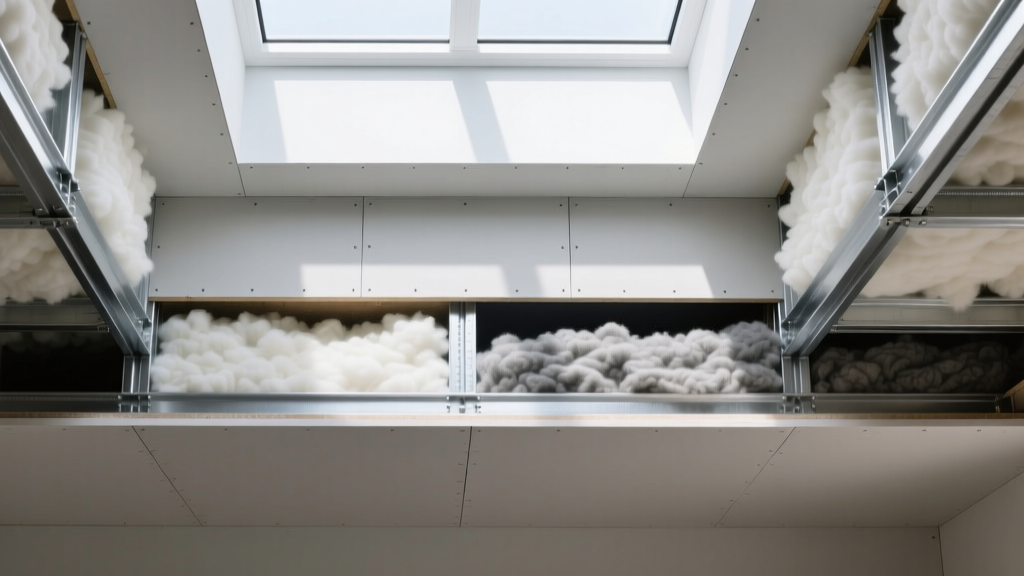
Mineral wool, specifically stone wool products like Rockwool Safe'n'Sound or Thermafiber SAFB, remains the gold standard for cavity absorption in ceiling joist bays. Unlike thermal batts, acoustic mineral wool is manufactured to a higher density (typically 2.5 lbs/ft³) and features a non-directional fiber matrix that traps and dissipates sound waves.
- Best Application: Unfinished ceiling joist bays before drywall installation.
- Installation Nuance: Mineral wool must be friction-fit. Do not compress it to fit into narrow bays; compressing the material increases its density but reduces its overall thickness, which degrades its low-frequency sound absorption capabilities.
- Bonus: It is inherently non-combustible, providing up to a 1-hour fire rating in tested assemblies, which is critical for multi-family residential codes.
High-Density Fiberglass (The Budget Alternative)
Standard pink fiberglass is acoustically transparent. To achieve meaningful sound absorption, you must use high-density acoustic fiberglass boards, such as Owens Corning 703 or 705. These rigid or semi-rigid boards offer excellent high-frequency absorption but lack the mass and low-frequency trapping capabilities of mineral wool.
- Best Application: Budget-constrained projects or commercial drop-ceilings where the material rests on a grid rather than being friction-fit into tight wood joists.
- Limitation: Fiberglass is highly irritating to the skin and respiratory tract during installation, requiring full PPE. It also sags over time if not properly supported in horizontal ceiling applications.
Mass Loaded Vinyl (MLV) & Damping Compounds
Cavity insulation alone cannot stop low-frequency impact noise. For this, you must add mass and damping to the ceiling surface. Mass Loaded Vinyl (1 lb/sq ft or 2 lb/sq ft) is a limp-mass material that reflects sound energy. However, in 2026, the industry has largely shifted toward viscoelastic damping compounds (like Green Glue) sandwiched between two layers of 5/8-inch Type X drywall.
Decision Framework: Choosing Your Assembly
- If blocking voices/TV (Airborne): Use Mineral Wool in the cavity + Double layer 5/8' drywall with Green Glue. (Target STC 55+).
- If blocking footsteps (Impact): Cavity insulation will fail you. You must decouple the ceiling using resilient channels or isolation clips (like Kinetics IsoMax) before hanging the drywall. Treat the floor above with acoustic underlayment if possible.
- If dealing with HVAC/Low-Frequency rumble: Increase the air gap. Drop the ceiling 2 inches below the joists using isolation hangers to create a dead air space that traps long sound waves.
The Decoupling Imperative: Why Insulation Alone Fails
The most frequent failure mode in DIY and contractor-grade soundproofing is treating insulation as a standalone solution. According to testing guidelines published by the Gypsum Association in their GA-600 Fire and Sound Design manual, an assembly's STC rating is heavily dependent on the mechanical separation of the drywall from the structural framing.
If you screw drywall directly into ceiling joists, the joists act as acoustic bridges, transmitting impact vibrations directly into the room below. Even if the joist cavities are packed with $3.00/sq ft mineral wool, the assembly will likely fail to achieve an STC above 40.
Critical Standard: Laboratory measurement of airborne sound transmission loss is governed by ASTM E90. Field tests (ASTM E336) almost always yield an apparent STC (ASTC) that is 3 to 5 points lower than lab results due to flanking paths. Always design your ceiling assembly to exceed your target STC by at least 5 points.
Sealing the Perimeter: The Flanking Noise Trap
Sound behaves like water; it will exploit the smallest structural gap. A ceiling assembly featuring premium mineral wool, resilient channels, and damped drywall will be completely compromised if the perimeter is not sealed.
You must apply acoustic sealant (a non-hardening, viscoelastic caulk) along the entire perimeter where the ceiling drywall meets the wall drywall. Furthermore, all electrical boxes for recessed lighting or ceiling fans must be wrapped in acoustic putty pads or enclosed in sealed backer boxes. Recessed LED lights without proper acoustic enclosures act as direct megaphones for airborne noise from the floor above. For comprehensive structural guidelines on preventing flanking noise in multi-family dwellings, refer to the HUD guidelines on Sound Transmission Control in Buildings.
Summary of 2026 Material Sourcing
When procuring ceiling sound insulation materials, avoid big-box store 'acoustic' foam panels—these are designed for interior room echo reduction (NRC), not sound isolation (STC). Source mineral wool from specialized lumber yards or commercial insulation distributors to ensure you are receiving the 2.5 lbs/ft³ acoustic density rather than standard thermal batts. Budget approximately $3.50 to $5.50 per square foot for a fully realized, decoupled, and damped ceiling assembly, including materials, fasteners, and acoustic sealants.
Written by
Priya KapoorPriya Kapoor is a real estate market analyst and construction economics researcher with expertise in housing affordability, development feasibility, and infrastructure investment. She holds a Master of Regional Planning from Cornell University and previously worked as a senior analyst at CBRE's Investment Properties group, where she modeled returns for $4B in mixed-use development pipelines. Priya now runs an independent research practice advising developers, municipalities, and REITs on construction cost forecasting and market timing. She publishes the quarterly "BuildMat Market Pulse" report tracking material price indices across 12 commodity categories. Based in Austin, TX, Priya serves on the board of Habitat for Humanity Austin and is a marathon runner.
More from Priya Kapoor
View all
Construction Cost
Cost to Build a 1600 Sq Ft Home in 2026: Full Breakdown
Accurate 2026 cost to build a 1600 sq ft home—material, labor, and regional pricing breakdowns included. Plan your budget with real-time estimates.
Aug 11, 2026

Wood & Lumber
Name the Types of Wood for Pressure Treatment and Preservation
Learn how to name the types of wood best suited for pressure treatment. Compare species treatability, chemical retention levels, and 2026 preservation costs.
Aug 4, 2026

Stone & Masonry
Stone Veneer Suppliers Lindenhurst: 2026 Cost Analysis
Analyze 2026 stone veneer costs in Lindenhurst, NY. Compare local supplier pricing, delivery fees, and Suffolk County installation labor rates.
Aug 4, 2026