Masonry Sand Cost Estimator & Quantity Calculator 2026
Calculate exact masonry sand quantities for brick projects and compare 2026 bulk vs. bagged costs. Includes ASTM C144 specs and mortar yield formulas.
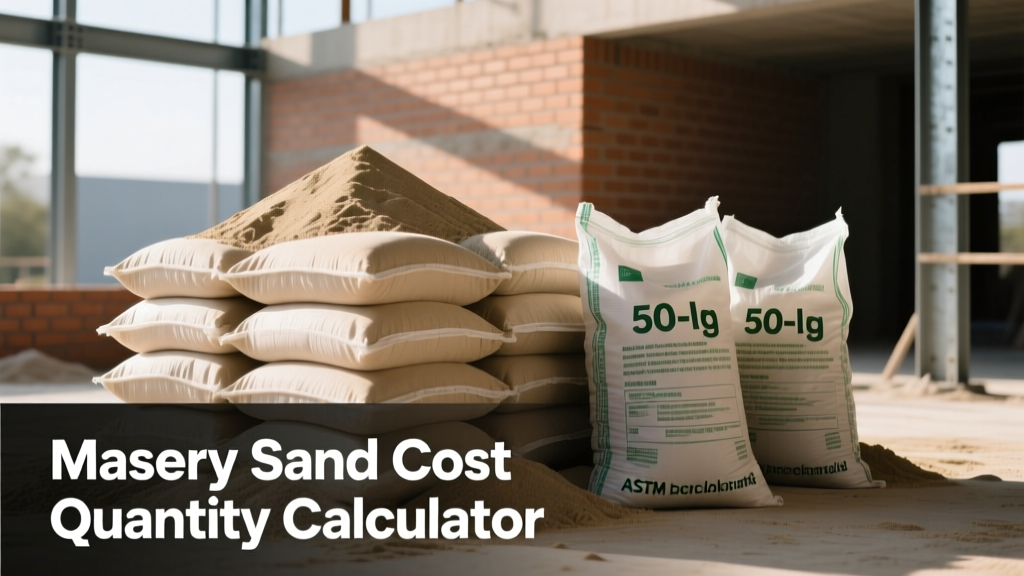
2026 Pricing Matrix: Bulk vs. Bagged Masonry Sand
Estimating masonry sand costs requires understanding the stark price divergence between bulk delivery and pre-packaged bags. In 2026, natural river-dredged sand continues to face environmental extraction limits, driving a 6-8% year-over-year price increase in metropolitan regions. Consequently, manufactured sand (M-sand) has captured significant market share, though it requires careful blending to maintain mortar workability.
| Purchasing Method | Average Unit Cost (2026) | Cost Per Cubic Yard (Equivalent) | Best Use Case |
|---|---|---|---|
| Bulk (Per Ton) | $32.00 - $48.00 | $45.00 - $68.00 | Projects requiring >2 cubic yards |
| Bulk (Per Cubic Yard) | $45.00 - $68.00 | $45.00 - $68.00 | Volume-based estimating (Recommended) |
| Bagged (50 lb / 0.48 cu ft) | $4.75 - $6.50 | $265.00 - $365.00 | Patchwork, small veneer repairs, remote sites |
The Masonry Sand Quantity Calculator
Calculating sand volume is not a simple 1:1 ratio with mortar yield. Mortar shrinks as the cement hydrates and fills the voids between sand particles. To calculate exact masonry sand requirements, you must account for the specific mortar type (N, S, or M) and the brick profile.
Step-by-Step Calculation for Standard Modular Brick
Standard modular brick (3 5/8" x 2 1/4" x 7 5/8") with a 3/8" mortar joint requires approximately 8.5 cubic feet of mortar per 1,000 bricks.
- Determine the Mix Ratio: Type N mortar (standard for above-grade veneer) uses a 1:2.5 ratio of Portland cement to masonry sand by volume.
- Calculate Sand Volume: Divide the sand ratio by the total parts (1 + 2.5 = 3.5). Multiply by the total mortar needed.
Formula: 8.5 cu ft × (2.5 / 3.5) = 6.07 cubic feet of sand. - Apply Waste Factor: Add 10% for drop waste, board waste, and joint tooling.
6.07 × 1.10 = 6.68 cubic feet of sand. - Convert to Weight (Tons): Dry, loose masonry sand weighs roughly 105 lbs per cubic foot.
6.68 cu ft × 105 lbs = 701 lbs (0.35 tons).
ASTM C144 Compliance: Avoiding the Concrete Sand Trap
A critical failure mode in brick masonry is the substitution of concrete sand for masonry sand. While both are aggregates, their gradation profiles dictate completely different structural behaviors in a mortar matrix.
According to the ASTM C144 Standard Specification for Aggregate for Masonry Mortar, masonry sand must meet strict fineness modulus requirements (between 1.3 and 3.0). This ensures a balanced distribution of fine and coarse particles, allowing the cement paste to coat each grain uniformly without excessive water demand.
| Property | Masonry Sand (ASTM C144) | Concrete Sand (ASTM C33) |
|---|---|---|
| Max Passing No. 4 Sieve | 100% | 95 - 100% |
| Max Passing No. 100 Sieve | 25% (Crucial for workability) | 5% (Too coarse for mortar) |
| Mortar Workability | High (Buttery, retains water) | Low (Harsh, segregates on trowel) |
| Shrinkage Risk | Low (Optimal void filling) | High (Requires excess water) |
Using ASTM C33 concrete sand in brick mortar results in a 'harsh' mix that lacks plasticity. Masons will instinctively add more water to achieve workability, which drastically increases the water-cement ratio, leading to severe drying shrinkage, efflorescence, and compromised bond strength. Always verify the batch plant ticket specifies ASTM C144 compliance.
The Moisture Trap: Why Weight-Based Purchasing Fails
When ordering bulk masonry sand by the ton, you are inherently vulnerable to moisture content discrepancies. Sand stored in open outdoor bays at the quarry absorbs significant rainfall.
"A 20-ton delivery of masonry sand with a 7% moisture content contains 1.4 tons (2,800 lbs) of pure water. You are paying aggregate freight rates for rainwater."
Furthermore, wet sand experiences 'bulking'—a phenomenon where surface tension from moisture pushes sand particles apart, increasing its volume by up to 25% while maintaining the same weight. If your masonry crew measures sand by the shovel or bucket (volume) rather than by weight, wet sand will yield significantly less actual aggregate per scoop than dry sand, throwing off your cement-to-sand ratio and weakening the mortar.
Procurement Best Practices
- Buy by the Cubic Yard: For large commercial projects, negotiate cubic yard pricing with the supplier. Volume is unaffected by the weight of absorbed water.
- Request Moisture Tickets: If you must buy by the ton, require the batch plant to run a moisture burn-off test and print the moisture percentage on the weighbridge ticket. Adjust your on-site volumetric batching accordingly.
- Cover On-Site Piles: Once delivered, cover bulk sand piles with heavy-duty 6-mil polyethylene tarps. Uncovered sand piles will fluctuate in moisture content daily, making consistent mortar batching impossible.
Manufactured Sand (M-Sand) vs. Natural Sand
With natural sand reserves depleting near major urban centers, crushed stone dust (M-Sand) is frequently supplied as masonry sand. While M-Sand can meet Brick Industry Association (BIA) guidelines if properly graded, its angular, crushed particles create higher inter-particle friction than naturally rounded river sand.
Actionable Adjustment: If your supplier provides M-Sand, you must increase the lime content in your mortar mix by 10-15% or introduce a liquid air-entraining plasticizer (meeting ASTM C260). This compensates for the lack of natural 'ball-bearing' roundness, restoring the workability and water retention required for proper brick adhesion and tooling.
Summary Checklist for Site Managers
- Verify batch tickets explicitly state ASTM C144 (not C33).
- Calculate requirements at 0.40 tons per 1,000 modular bricks.
- Avoid weight-based purchasing during wet spring months; order by the cubic yard.
- Test M-Sand for angularity and adjust lime/plasticizer ratios to prevent harsh mortar.
- Factor in $120-$250 delivery fees when comparing bulk vs. bagged break-even points.
For deeper technical guidance on mortar mix designs and aggregate interactions, consult the Portland Cement Association's Aggregates Guide and ensure all on-site batching aligns with current structural masonry codes.