How to Clean and Maintain Austin Stone Veneer Without Etching
Learn exact cleaning, sealing, and troubleshooting protocols for Austin stone veneer. Prevent etching, efflorescence, and water damage with expert steps.

The Chemistry of Austin Stone: Why Standard Masonry Care Fails
Austin stone is a regional limestone quarried from the Cretaceous-era Edwards Plateau in Texas, characterized by its warm cream, white, and pale gold hues. Unlike dense granites or siliceous sandstones, Austin stone is highly calcareous, meaning its primary mineral component is calcium carbonate. This geological reality dictates every maintenance decision you make.
Calcium carbonate is highly reactive to acidic compounds. Standard masonry cleaners, which often rely on hydrochloric or muriatic acid to strip mortar smears and heavy oxidation, will violently react with Austin stone. The acid dissolves the stone's surface matrix, leaving permanent pitting, dull etching, and a weakened exterior that accelerates spalling during freeze-thaw cycles. Furthermore, the calcium released by the acid reaction can combine with sulfates in the environment to form gypsum crusts that trap moisture against the veneer.
Routine Cleaning Protocols for Calcareous Veneer
Maintaining the aesthetic integrity of Austin stone veneer requires a low-impact, high-dwell-time approach. According to the National Park Service Preservation Brief on masonry cleaning, testing any chemical on an inconspicuous area and pre-wetting the substrate are non-negotiable steps for calcareous stone.
The 4-Step Alkaline Cleaning Method
- Pre-Wet the Substrate: Limestone is highly porous. If you apply cleaner to dry stone, the liquid is instantly drawn deep into the pores, carrying dissolved dirt and salts with it. Use a garden hose to thoroughly saturate the veneer from the bottom up until the stone stops absorbing water and surface runoff begins.
- Apply a pH-Neutral or Alkaline Cleaner: Use a specialized limestone cleaner, such as Prosoco Sure Klean Limestone & Masonry Cleaner (an alkaline-based formulation). Apply using a low-pressure pump sprayer, working from the bottom up to prevent streaking.
- Agitate with Natural Bristles: Allow the cleaner to dwell for 5 to 10 minutes (do not let it dry). Agitate stubborn areas using a natural Tampico fiber brush or a soft nylon brush. Never use wire brushes; they shed microscopic iron particles that embed in the limestone and oxidize into permanent rust spots.
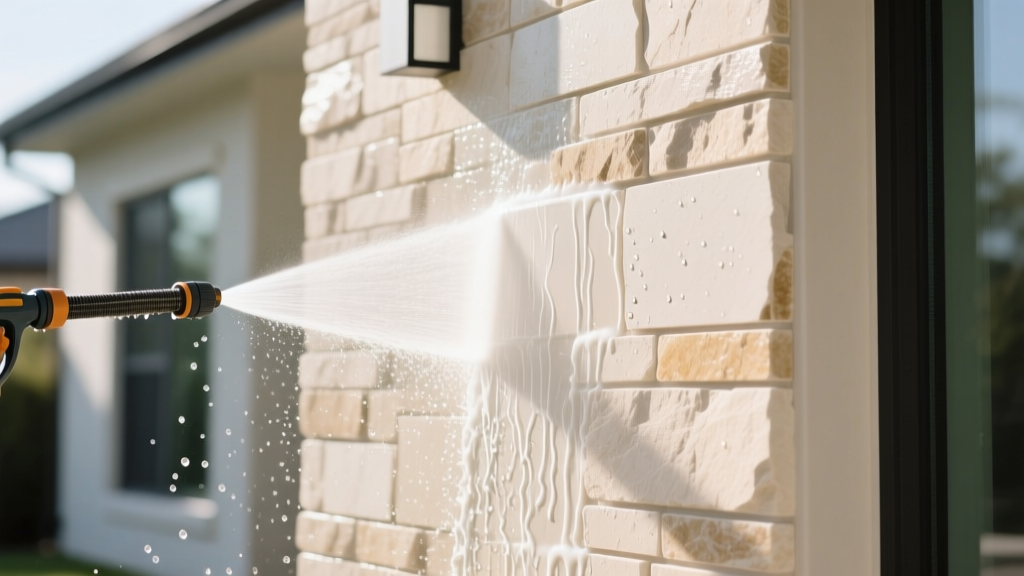
- Low-Pressure Rinse: Rinse thoroughly from the top down. If using a pressure washer, restrict the pressure to a maximum of 600 PSI with a 40-degree white fan tip, keeping the nozzle at least 12 inches from the stone surface. High pressure will blow out the mortar joints and erode the softer matrix of the limestone.
Troubleshooting Common Austin Stone Failures
When routine cleaning is insufficient, specific pathological issues require targeted interventions. The following matrix outlines the most common failure modes in Austin stone veneer systems and their precise remedies.
| Symptom | Root Cause | Corrective Action |
|---|---|---|
| Efflorescence (White, powdery crystalline deposits) | Soluble salts migrating through the veneer via uncontrolled moisture, often due to blocked weep holes or missing flashing. | Dry-brush deposits immediately. Do not use water, which re-dissolves salts. Clear weep holes and apply a siloxane water repellent. |
| Spalling (Flaking or peeling of the stone face) | Freeze-thaw cycles combined with trapped moisture, often exacerbated by a non-breathable film-forming sealer or overly hard mortar. | Remove affected stones. Strip acrylic sealers using a methylene chloride stripper. Repoint with Type O mortar. |
| Biological Growth (Green algae or black mildew) | Prolonged shade, poor air circulation, and high surface moisture retention in the limestone's natural pores. | Apply a quaternary ammonium biocide (not bleach, which leaves salt residue). Trim foliage to allow UV exposure and airflow. |
| Iron Staining (Orange/brown localized spots) | Natural pyrite inclusions in the limestone oxidizing, or residual iron from improper wire-brushing during installation. | Apply a custom diatomaceous earth and sodium citrate poultice to draw the iron oxide out of the pore structure. |
Deep Dive: Formulating an Iron Stain Poultice
Surface cleaners cannot remove iron staining because the oxidation occurs within the pore structure. You must use a poultice to draw the stain out via capillary action. Mix 1 part sodium citrate (a chelating agent) with 6 parts diatomaceous earth (the absorbent medium). Add distilled water slowly until the mixture reaches a thick peanut butter consistency. Apply a 1/4-inch layer over the stain, extending one inch past the margins. Cover with plastic wrap, tape the edges, and poke small holes in the plastic for slow evaporation. Leave for 48 to 72 hours. As the water evaporates, it pulls the dissolved iron into the poultice. Scrape off the dried powder with a wooden or plastic scraper.
Sealing Strategies: Breathability is the Only Metric
The most destructive maintenance error homeowners make with Austin stone veneer is applying a film-forming sealer, such as an acrylic or polyurethane coating. These products create a plastic-like barrier on the surface. While they initially make the stone look 'wet' and rich, they trap moisture vapor migrating from the interior wall assembly or the ground. When the sun heats the veneer, the trapped vapor expands, creating hydrostatic pressure behind the sealer film, which ultimately blows the face off the stone (spalling).
Industry Standard: The Natural Stone Institute explicitly advises against film-forming sealers for exterior calcareous stone. Only 100% breathable, penetrating sealers should be utilized.
The Solution: Silane/Siloxane Penetrating Sealers
Use a high-solids silane/siloxane penetrating sealer (such as Prosoco Siloxane PD or equivalent). These molecules are small enough to penetrate deep into the limestone's capillary network, where they chemically bond to the pore walls. They alter the surface tension of the pores, causing liquid water to bead and roll off, while remaining entirely open to water vapor transmission. Apply two coats using a low-pressure sprayer, applying the second coat 'wet-on-wet' (within 5 minutes of the first) to ensure deep penetration before the carrier solvent flashes off.
Mortar Joint and Weep Hole Maintenance
Austin stone veneer is a drainage system, not just a decorative facade. The Brick Industry Association's technical notes on masonry veneer emphasize that the longevity of any adhered or anchored veneer relies entirely on the drainage plane behind it.
Repointing with the Correct Mortar Hardness
When mortar joints degrade and require repointing, the new mortar must be softer and more permeable than the Austin stone itself. If the mortar is harder than the stone, thermal expansion and structural settling will force the stress into the limestone, causing the stone to crack rather than the mortar joint.
- Avoid Type S or Portland-heavy mixes: These are too rigid and impermeable for soft limestone.
- Use Type N Mortar: 1 part Portland cement, 1 part hydrated lime, and 6 parts sand. Suitable for most exterior veneer applications.
- Use Type O Mortar: 1 part Portland cement, 2 parts hydrated lime, and 9 parts sand. Ideal for highly porous, soft Austin stone in regions with minimal freeze-thaw cycles, as it offers maximum flexibility and vapor permeability.
Weep Hole Verification
Inspect the base of the veneer system annually. Weep holes (typically open head joints or manufactured plastic vents) must remain entirely clear of mortar droppings, landscaping mulch, and soil. If weep holes are blocked, hydrostatic pressure builds behind the veneer, forcing moisture through the stone face and guaranteeing efflorescence and eventual spalling. Use a specialized weep hole cleaning tool or a stiff piece of copper wire to gently clear obstructions without damaging the flashing behind the mortar.
Written by
James ThorntonJames Thornton is a construction industry veteran with 25 years of hands-on experience in wood framing, lumber grading, and residential building codes. He started as a framing carpenter in rural Oregon, earned his ICC Residential Building Inspector certification, and eventually became a senior plan reviewer for the City of Portland Bureau of Development Services. James holds a B.S. in Wood Science & Technology from Oregon State University and is a certified lumber grader through the West Coast Lumber Inspection Bureau (WCLIB). He has inspected over 3,000 residential construction sites and authored the city's internal guide on advanced framing techniques (2x6 at 24" O.C.). James lives in Bend, OR, where he builds custom timber-frame cabins and competes in lumberjack sports.
More from James Thornton
View all
Insulation
Best Home Insulation Materials: Complete 2026 Guide
Compare top home insulation materials for 2026. Find R-values, installed costs per square foot, and best uses for fiberglass, spray foam, and mineral wool.
Aug 4, 2026

Sustainable Building
Certify Your Green Building Material for LEED and WELL
Step-by-step guide to certifying a green building material for LEED v5 and WELL v2. Master EPDs, HPDs, and VOC limits for 2026 project specifications.
Aug 4, 2026

Stone & Masonry
Veneer Stacked Stone Panels: Interior Design & Style Showcase
Discover how veneer stacked stone panels transform interiors. Explore modern design profiles, material pairings, and technical installation specs.
Aug 4, 2026