Bamboo Builder Marble Run: Inspiring Kinetic Stone Art
Discover how the bamboo builder marble run inspires kinetic stone art. Explore material friction, natural marble selection, and architectural scaling.

The Physics of Play Meets Architectural Design
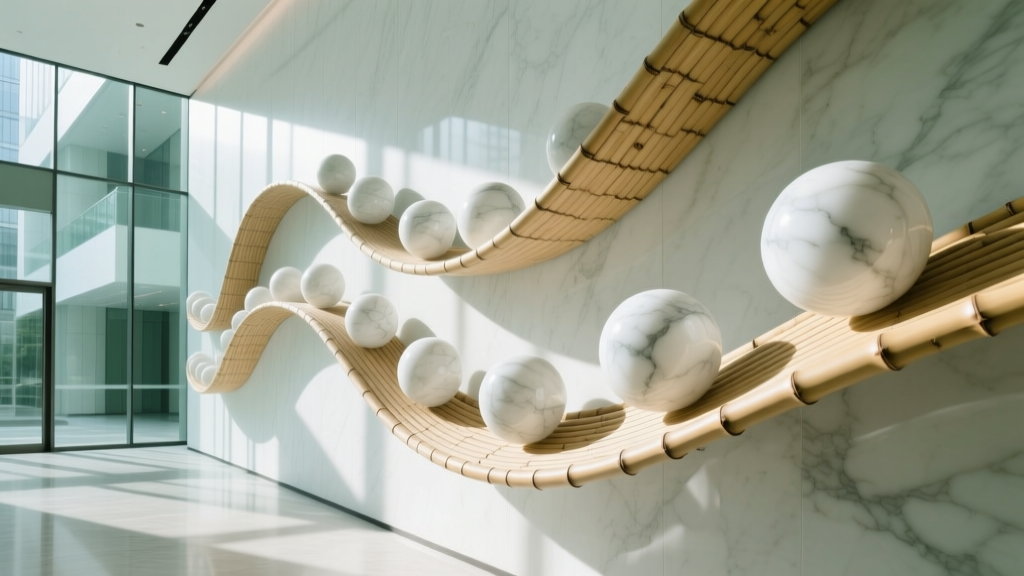
While the traditional bamboo builder marble run is widely recognized as an educational STEM toy designed to teach children about gravity and momentum, its underlying mechanical principles are increasingly inspiring high-end interior designers and landscape architects. By scaling up the concepts of gravity-fed tracks and rolling spheres, design professionals are creating bespoke kinetic stone art installations for corporate lobbies, luxury residences, and public spaces. Transitioning a desktop toy into a permanent architectural feature requires a rigorous understanding of material science, specifically the friction coefficients of natural stone and the structural limitations of bamboo substrates.
In architectural applications, a kinetic marble run is not merely a decorative element; it is a dynamic study in potential and kinetic energy. The mass of the rolling sphere dictates the momentum required to navigate loops, jumps, and gradual declines. According to the Natural Stone Institute, the density and mineral composition of natural stone vary wildly, meaning a sphere carved from limestone will behave entirely differently on a bamboo track than one carved from dense marble. Designing these installations requires precise calibration of track pitch—typically between 4 and 8 degrees—to maintain continuous motion without causing the stone to accelerate to destructive speeds.
Material Selection: Natural Stone Spheres vs. Glass
The most critical variable in a large-scale kinetic installation is the rolling sphere. While glass marbles are standard in commercial toys, architectural showcases demand the visual weight, acoustic resonance, and unique veining of natural stone. However, not all stone is suitable for continuous rolling friction.
Carrara and Calacatta Marble
Composed primarily of calcite, these Italian marbles offer a Mohs hardness of 3 to 4. They take an exceptional polish, which minimizes rolling friction. A 3-inch diameter Calacatta marble sphere weighs approximately 1.4 pounds, providing ample momentum to clear track gaps of up to 6 inches. However, calcite is brittle; repeated impacts against steel track stops will cause micro-chipping over time, requiring annual re-polishing.
Nero Marquina Marble
This deep black Spanish marble features striking white calcite veining. It is slightly denser than Carrara and offers superior acoustic properties, producing a deep, resonant 'thrum' rather than a high-pitched clack when rolling over bamboo joints. The darker color also hides micro-abrasions and track dust far better than white marbles, making it the preferred choice for low-maintenance commercial installations.
Soapstone and Limestone (Not Recommended)
Soapstone (talc-based, Mohs 1) is far too soft. The friction of the track will rapidly degrade the sphere, leaving a messy talc residue on the bamboo veneer. Similarly, sedimentary limestones are too porous and lack the structural integrity to survive the kinetic impacts of a multi-story drop.
Track Engineering: Solid Bamboo vs. Bamboo Veneer
The 'bamboo' in a standard bamboo builder marble run refers to solid, hollow culms sliced in half. While structurally sound for lightweight glass marbles, solid bamboo is entirely unsuited for architectural scaling. Solid bamboo is prone to longitudinal splitting, warping due to humidity fluctuations, and cannot be bent along its width without aggressive kerfing that compromises its structural integrity.
For permanent wall installations, architects utilize engineered bamboo veneer applied over a rigid substrate. The Food and Agriculture Organization (FAO) notes that bamboo's exceptional tensile strength is best harnessed when processed into laminates and veneers. Bamboo veneer, backed with a flexible fleece or paper substrate, can be steam-bent to radii as tight as 2 inches. This allows fabricators to create the sweeping, organic curves and helixes characteristic of high-end kinetic art while hiding a rigid steel or plywood armature underneath.
| Track Material | Bending Radius | Humidity Stability | Load Capacity (Stone) | Architectural Viability |
|---|---|---|---|---|
| Solid Bamboo Culm | N/A (Rigid) | Poor (Splits/Warps) | Low (< 1 lb) | Not Recommended |
| Bamboo Plywood (Solid) | 12+ inches | Good | High (50+ lbs) | Moderate (Heavy, hard to shape) |
| Fleece-Backed Bamboo Veneer | 2 inches (with heat) | Excellent (Substrate dependent) | Depends on Armature | Industry Standard |
Step-by-Step: Scaling the Run to a Wall Installation
Executing a 10-foot by 10-foot kinetic stone feature requires a departure from standard carpentry and a move toward precision metalworking and veneer application.
- Substrate and Armature Fabrication: The wall must be reinforced with 3/4-inch plywood blocking between steel studs. A welder fabricates a 1-inch square steel tube armature, bent to the exact pitch (usually 6 degrees) and banked curves calculated in CAD software. Steel is used because the repetitive kinetic vibration of heavy marble will eventually loosen standard wood screws.
- Track Trough Forming: The track is not a flat surface; it is a U-shaped trough. Fabricators use a CNC router to mill a U-channel into a high-density polyurethane foam core, which is then wrapped in the bamboo veneer using a vacuum press and epoxy resin. This creates a lightweight, perfectly smooth track that mimics the look of solid carved bamboo.
- Veneer Application and Seaming: The bamboo veneer is applied with the grain running longitudinally along the track to maximize tensile flexibility. Seams are mitered and filled with a tinted epoxy that matches the bamboo's natural caramel hue, ensuring the rolling marble does not catch on joints.
- Sphere Calibration and Dampening: Before final mounting, the 3-inch marble spheres are run through the track. Magnetic dampeners are installed at the base of the run to catch the heavy stone spheres, converting their kinetic energy into heat rather than allowing them to crash into a physical backstop, which would shatter the marble.
Maintenance and Wear Mitigation
Kinetic stone art is a living installation that requires specific maintenance protocols. The primary enemy of a bamboo and marble run is micro-dust. As the marble rolls, it sheds microscopic calcite particles. If left uncleaned, this dust acts as an abrasive lapping compound, slowly wearing grooves into the bamboo veneer and dulling the polish of the marble.
Facility managers should schedule a monthly track vacuuming using a soft-brush attachment. Every six months, the marble spheres should be removed and inspected for flat spots or chipping. The bamboo track itself should be lightly buffed and re-sealed with a hard-wax oil (such as Rubio Monocoat) annually to maintain a low-friction surface and protect against ambient humidity.
Cost Analysis for Bespoke Kinetic Installations
Scaling a bamboo builder marble run into a permanent architectural centerpiece is a significant investment. Below is a realistic cost breakdown for a bespoke 50-square-foot kinetic wall feature (10 ft high x 5 ft wide) in a commercial lobby, utilizing Nero Marquina marble and engineered bamboo veneer.
- Design and Engineering (CAD/CAM): $2,500 - $4,000 (Includes physics simulations and structural load calculations).
- Steel Armature Fabrication: $3,500 - $5,000 (Custom welding and precision bending).
- Track Substrate and Bamboo Veneer: $2,000 - $3,000 (CNC routed foam cores, vacuum-pressed veneer, and hard-wax finishing).
- Precision Lathed Marble Spheres: $1,200 - $2,000 (Set of 8 custom 3-inch Nero Marquina spheres, including spares).
- Installation and Calibration: $3,000 - $5,000 (On-site mounting, track alignment, and magnetic dampener tuning).
Total Estimated Project Cost: $12,200 to $19,000. While the initial outlay is substantial, the resulting installation provides a unique, mesmerizing focal point that bridges the gap between natural material science and kinetic art, offering an interactive experience that static stone veneers simply cannot achieve.
Written by
Priya KapoorPriya Kapoor is a real estate market analyst and construction economics researcher with expertise in housing affordability, development feasibility, and infrastructure investment. She holds a Master of Regional Planning from Cornell University and previously worked as a senior analyst at CBRE's Investment Properties group, where she modeled returns for $4B in mixed-use development pipelines. Priya now runs an independent research practice advising developers, municipalities, and REITs on construction cost forecasting and market timing. She publishes the quarterly "BuildMat Market Pulse" report tracking material price indices across 12 commodity categories. Based in Austin, TX, Priya serves on the board of Habitat for Humanity Austin and is a marathon runner.
More from Priya Kapoor
View all
Construction Cost
Cost to Build a 1600 Sq Ft Home in 2026: Full Breakdown
Accurate 2026 cost to build a 1600 sq ft home—material, labor, and regional pricing breakdowns included. Plan your budget with real-time estimates.
Aug 11, 2026

Wood & Lumber
Name the Types of Wood for Pressure Treatment and Preservation
Learn how to name the types of wood best suited for pressure treatment. Compare species treatability, chemical retention levels, and 2026 preservation costs.
Aug 4, 2026

Stone & Masonry
Stone Veneer Suppliers Lindenhurst: 2026 Cost Analysis
Analyze 2026 stone veneer costs in Lindenhurst, NY. Compare local supplier pricing, delivery fees, and Suffolk County installation labor rates.
Aug 4, 2026