Black Granite Countertops: Scenario Matching & Application Guide
Discover which black granite countertops suit your space. Compare finishes, edge cases, and costs to match Absolute Black, Black Pearl, and more to your project.
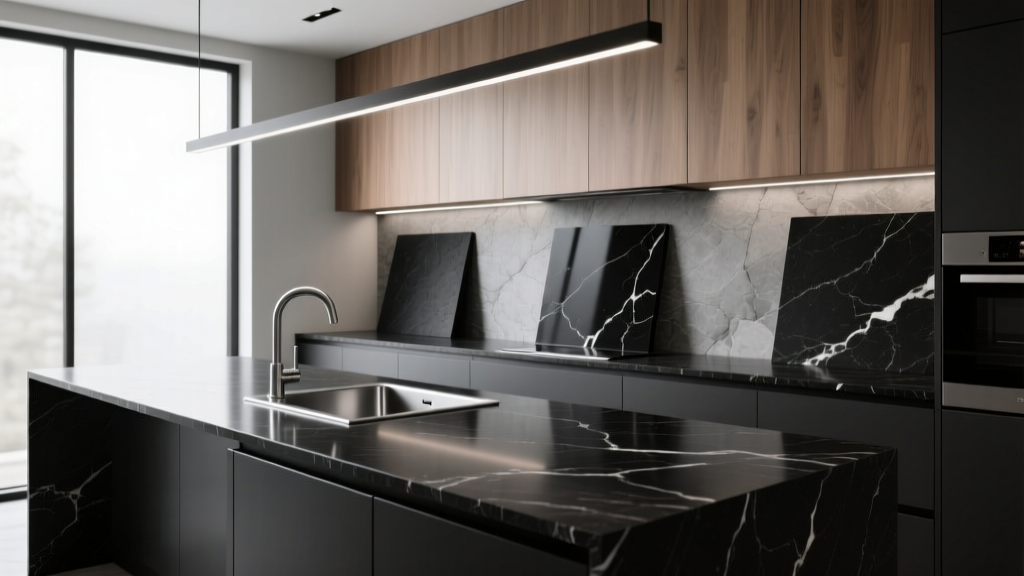
The Geological and Commercial Reality of Black Stone
Specifying black granite countertops requires navigating a geological and commercial minefield. What fabricators and slab yards label as "black granite" spans true granites, gabbros, basalts, and norites. This distinction is not merely academic; it dictates the stone's porosity, structural integrity during fabrication, and long-term maintenance profile. For instance, the highly sought-after Absolute Black is geologically a gabbro, meaning it lacks the quartz content of true granite, resulting in a denser, less porous surface that behaves entirely differently under diamond-blade cutting and daily chemical exposure.
Matching the right black stone to your specific application hinges on three variables: the geological composition, the surface finish, and the environmental lighting conditions. This guide provides a scenario-based framework to ensure your material selection aligns with your project's functional and aesthetic demands.
Finish Dictates Function: Polished vs. Honed vs. Leathered
The factory finish applied to black stone radically alters its application fit. A finish that works flawlessly in a low-traffic wet bar will become a maintenance nightmare in a high-use family kitchen.
| Finish Type | Surface Profile | Light Reflectance | Maintenance Reality | Ideal Scenario |
|---|---|---|---|---|
| Polished | Microscopically smooth, glass-like | High (Specular reflection) | Shows every water spot, fingerprint, and dust particle. Requires daily microfiber wiping. | Low-use powder rooms, formal dining buffet tops, vertical backsplashes. |
| Honed | Matte, smooth to the touch | Low (Diffuse reflection) | Hides dust and smudges well. Slightly more porous; requires a high-quality penetrating sealer. | Modern kitchens, high-traffic islands, bathroom vanities. |
| Leathered | Textured, undulating, soft sheen | Medium (Directional sheen) | Excellent at hiding debris and scratches. The textured surface can trap fine flour or powders. | Rustic or industrial kitchens, outdoor kitchens, wet bars. |
Scenario Matching: Where Specific Black Stones Excel
Scenario A: The Minimalist, Dark-on-Dark Kitchen
Recommended Material: Absolute Black (Nero Assoluto) in a Leathered Finish.
Why it Works: Absolute Black is uniformly dark with no veining or mottling. When leathered, it provides a rich, tactile surface that absorbs light softly, preventing the "black hole" effect that polished black can create in rooms with limited natural light. Because gabbro is incredibly dense (water absorption rate typically <0.1%), it rarely requires sealing, making it highly resilient against acidic spills like lemon juice or vinegar.
Scenario B: The High-Traffic Family Hub
Recommended Material: Black Pearl or Impala Black in a Honed Finish.
Why it Works: True granites like Black Pearl contain large mineral crystals (often quartz and feldspar) that create a mottled, speckled pattern. This natural visual noise is a functional asset: it camouflages crumbs, smudges, and minor scratches far better than solid black stone. Honing the surface eliminates the glare of overhead pendant lights while maintaining a smooth wiping surface.
Scenario C: Outdoor Kitchens and BBQ Islands
Recommended Material: Black Galaxy with a Flamed or Leathered Finish.
Why it Works: Black Galaxy is a norite characterized by striking bronzite (gold/copper) flecks. In direct sunlight, a polished finish will create blinding glare. A flamed or leathered finish diffuses the UV light while allowing the metallic flecks to shimmer subtly. Furthermore, the textured surface provides grip when wet, an essential safety feature for outdoor bar tops where condensation is common.
The Fabrication Edge Cases and Cost Matrix
Black stones present unique challenges during fabrication. The extreme density of materials like Absolute Black causes rapid wear on CNC router bits and diamond bridge saw blades, which fabricators factor into their pricing. Additionally, creating a mitered drop edge (to simulate a thicker slab) requires flawless 45-degree cuts; any chip or gap is glaringly obvious on solid black stone and requires meticulous color-matched epoxy work.
| Cost Component | Absolute Black (Gabbro) | Black Pearl (Granite) | Black Galaxy (Norite) |
|---|---|---|---|
| Material (Per Sq. Ft.) | $75 - $110 | $50 - $75 | $65 - $95 |
| Standard Fabrication | $60 - $90 / sq. ft. | $45 - $70 / sq. ft. | $55 - $85 / sq. ft. |
| Mitered Edge (Per Lin. Ft.) | $90 - $140 | $70 - $110 | $85 - $125 |
| Undermount Sink Cutout | $250 - $350 | $200 - $250 | $225 - $300 |
Note: Pricing reflects 2026 national averages for 3cm thickness. Premium edge profiles and complex radius cuts will increase fabrication costs by 20-40%.
Crucial Quality Control: The "Dyed Stone" Scam
A persistent issue in the imported stone market is the adulteration of lower-grade, grayish, or brownish slabs with black dyes and resins to mimic premium Absolute Black. Over time, UV exposure and acidic cleaners strip the dye, leaving the countertop with a faded, muddy appearance.
The Acetone Test: Before signing off on a slab at the yard, apply a small amount of pure acetone (nail polish remover) to a white cotton rag and rub an inconspicuous corner of the slab. If the rag turns black or gray, the stone has been artificially dyed. Walk away. True black gabbro will not transfer color.
Sealing, Safety, and Spatial Lighting Requirements
Not all black stones require sealing. As mentioned, Absolute Black is so dense that most impregnating sealers cannot penetrate the surface and will simply dry as a hazy, sticky film on top. Always consult the Natural Stone Institute's consumer care guidelines to verify the absorption rate of your specific slab batch. For more porous black granites like Impala Black, a solvent-based fluoropolymer sealer is required annually to prevent oil staining.
From a health and safety perspective, ensure your fabricator uses adhesives and sealants that comply with NSF/ANSI 51 certification for food-safe surfaces, particularly around undermount sink lip joints where food debris can accumulate.
Lighting Compensation Framework
Black countertops absorb between 80% and 95% of visible light. When transitioning from a light-colored surface (like white quartz or marble) to black granite, your kitchen's ambient and task lighting must be upgraded to compensate.
- Task Lighting: Increase under-cabinet LED output to a minimum of 500 lumens per linear foot (aim for 3000K-3500K color temperature to warm the dark stone).
- Pendant Spacing: Over a black island, reduce the spacing between pendant fixtures by 20% to eliminate dark shadows in the center workspace.
- Reflective Backsplashes: Pair black countertops with high-gloss or mirrored backsplashes (like stainless steel or glass tile) to bounce light back down onto the work surface.
Decision Flowchart: Finalizing Your Selection
Use this rapid diagnostic to confirm your material and finish choice:
- Is the space an outdoor kitchen or exposed to direct, harsh sunlight?
Yes: Choose Black Galaxy (Leathered/Flamed). Avoid polished surfaces to prevent UV glare and thermal shock micro-cracking.
No: Proceed to step 2. - Will the surface endure heavy daily meal prep, including flour dusting and acidic marinades?
Yes: Choose Absolute Black (Honed/Leathered) for its near-zero porosity, or Black Pearl (Honed) for its scratch-camouflaging pattern.
No: Proceed to step 3. - Is the primary goal a high-contrast, formal aesthetic with minimal physical use (e.g., a powder room vanity or bar top)?
Yes: Choose Absolute Black or Black Marquina (Polished) to maximize light reflection and visual depth.
By aligning the geological properties and surface finishes of black stone with the specific environmental and functional demands of your space, you eliminate the common pitfalls of dark countertops and ensure a durable, striking installation.