Stone Veneer Cost Per Sq Ft: 2026 Technical Specs & Pricing
Analyze the 2026 stone veneer cost per sq ft through technical specs. Compare ASTM grades, weight loads, substrate prep, and mortarless systems.

The Anatomy of Stone Veneer Pricing: Beyond Surface Area
Calculating the true stone veneer cost per sq ft requires looking past the showroom price tag and into the technical specifications that dictate material performance, structural requirements, and labor intensity. In 2026, the gap between budget-grade and architectural-grade veneer systems is defined by ASTM compliance, density metrics, and substrate engineering. A superficial material estimate often fails to account for the hidden structural and moisture-management costs inherent in adhered masonry systems.
Technical Specifications Driving Material Costs
The price variance between a $7 per sq ft manufactured stone and a $22 per sq ft premium natural thin veneer (NTV) is rooted in manufacturing tolerances and standardized testing. High-performance veneers must meet rigorous criteria to prevent spalling, efflorescence, and delamination in extreme climates.
ASTM Standards and Material Density
Manufactured stone masonry veneer (MSMV) is governed by ASTM C1670. This standard mandates a minimum compressive strength of 2,000 psi and a maximum water absorption rate of 28%. Premium architectural lines often exceed these baselines, utilizing high-density concrete mixes with integral iron-oxide pigments that push absorption rates below 15%. This lower porosity drastically reduces freeze-thaw vulnerability but increases the raw material cost by 20% to 30%.
Natural thin veneer, conversely, is evaluated under material-specific standards such as ASTM C616 (Sandstone) or ASTM C568 (Limestone). High-density limestone (Class III) commands a premium because its absorption rate is strictly limited to 3%, making it virtually impervious to moisture ingress without the need for surface sealers.
Profile Thickness and Weight Load Limits
Weight is a primary cost multiplier. The International Building Code (IBC Section 1404.10) generally limits adhered veneer to a maximum weight of 15 pounds per square foot (psf) without requiring supplemental mechanical anchoring.
- Standard Manufactured Veneer: Weighs 6 to 9 psf. Easily adheres to standard cementitious substrates without structural reinforcement.
- Natural Thin Veneer (NTV): Milled to 0.5-inch to 1.5-inch profiles to maintain a weight of 7 to 12 psf. The precision diamond-wire milling required to achieve these consistent thin profiles adds $3 to $6 per sq ft to the quarrying cost.
- Oversized/Full-Bed Profiles: Exceeding 15 psf triggers the need for mechanical ties, shelf angles, and reinforced masonry substrates, exponentially increasing the total project cost.
| Material Classification | ASTM Reference | Avg. Weight (psf) | 2026 Material Cost (per sq ft) |
|---|---|---|---|
| Standard Manufactured (CMU-based) | ASTM C1670 | 6.0 - 9.0 | $6.50 - $11.00 |
| Architectural Manufactured (High-Density) | ASTM C1670 (Exceeds) | 8.5 - 11.0 | $12.00 - $18.50 |
| Natural Thin Veneer (Limestone/Slate) | ASTM C568 / C625 | 7.0 - 13.0 | $15.00 - $28.00 |
| Mortarless Interlocking Polyurethane/CMU | Proprietary / ICC-ES | 2.0 - 5.0 | $19.00 - $32.00 |
Substrate Engineering & Installation Variables
The International Masonry Institute emphasizes that veneer failure is rarely a material defect; it is almost always a substrate or moisture-management failure. The technical specifications of your wall assembly directly dictate labor costs and material add-ons.
Traditional Scratch Coat vs. Direct-Apply Systems
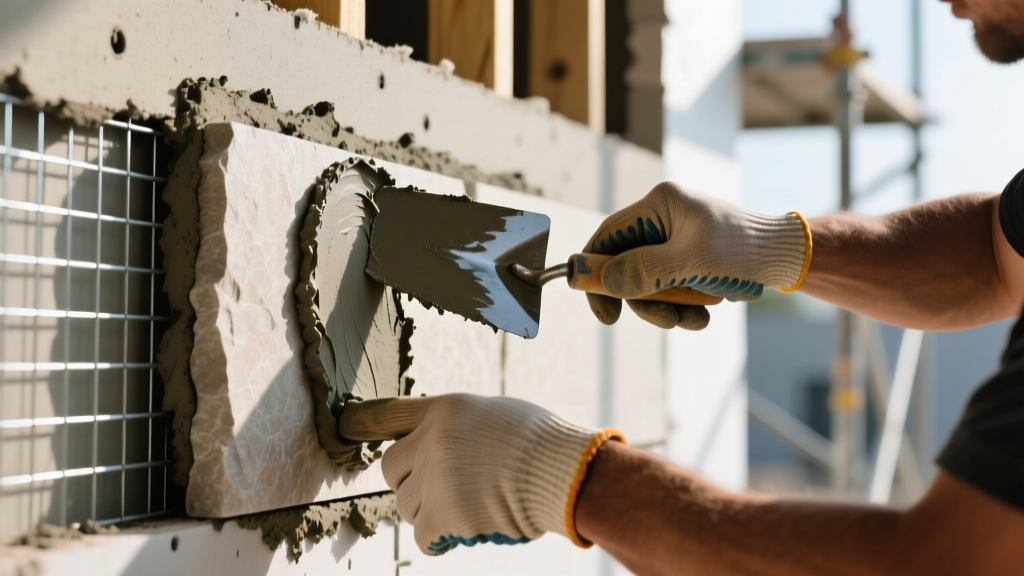
Traditional installation requires a weather-resistive barrier (WRB), self-furring metal lath (ASTM C847), and a 3/8-inch Portland cement scratch coat. This multi-day process adds $8 to $12 per sq ft in labor and materials. Direct-apply systems, which utilize specialized polymer-modified mortars applied directly over approved rigid foam insulation or specialized cement boards (ASTM C1325), can reduce substrate prep time by 40%, though the proprietary mortars cost 30% more per bag than standard Type S mix.
Mortarless Interlocking Systems: A Technical Alternative
For projects where structural weight limits are maxed out or skilled masonry labor is unavailable, mortarless interlocking systems (such as those evaluated under ICC-ES ESR reports) offer a distinct technical advantage. These panels utilize high-density polyurethane or lightweight CMU matrices that mechanically lock together and screw directly into the substrate.
While the upfront material cost is significantly higher ($19 to $32 per sq ft), the elimination of metal lath, scratch coats, and specialized masonry labor often results in a lower total installed cost for commercial retrofits or multi-story applications where scaffolding and wet-trade logistics are prohibitively expensive.
Hidden Technical Costs: Flashing, Weep Holes, and Sealers
When budgeting the stone veneer cost per sq ft, estimators frequently omit the critical moisture-management components required by modern building codes. Adhered veneer is a face-sealed system; it is not designed to manage bulk water intrusion internally.
Corrosion-Resistant Flashing
Code requires corrosion-resistant flashing at all penetrations, deck intersections, and above windows. Galvanized steel (ASTM A653 G90) is the minimum standard, but in coastal or high-salinity environments, PVC-coated galvanized steel or copper flashing is required. Upgrading from standard galvanized to copper flashing adds approximately $2.50 to $4.00 per linear foot to the project perimeter.
Vapor-Permeable Sealers
Applying a film-forming sealer (like acrylic or urethane) to stone veneer traps moisture inside the masonry, leading to catastrophic spalling during freeze-thaw cycles. If a sealer is specified for stain resistance, it must be a penetrating silane/siloxane water repellent that maintains a vapor transmission rate of >90%. Premium siloxane sealers cost $0.40 to $0.80 per sq ft and require reapplication every 7 to 10 years.
Expert Verdict: Optimizing Your Budget Without Compromising Specs
To optimize the stone veneer cost per sq ft without sacrificing structural integrity, focus your budget on the substrate and moisture management rather than simply upgrading the visual grade of the stone. A mid-tier manufactured stone (ASTM C1670 compliant, 8 psf) installed over a continuous drainage mat and a properly flashed cementitious substrate will outlast a premium natural limestone installed over a deficient scratch coat. Always verify the specific water absorption metrics and deflection limits of your wall assembly before finalizing material selections, and consult the latest manufacturer technical data sheets for approved mortar admixtures and substrate pairings.
Written by
Priya KapoorPriya Kapoor is a real estate market analyst and construction economics researcher with expertise in housing affordability, development feasibility, and infrastructure investment. She holds a Master of Regional Planning from Cornell University and previously worked as a senior analyst at CBRE's Investment Properties group, where she modeled returns for $4B in mixed-use development pipelines. Priya now runs an independent research practice advising developers, municipalities, and REITs on construction cost forecasting and market timing. She publishes the quarterly "BuildMat Market Pulse" report tracking material price indices across 12 commodity categories. Based in Austin, TX, Priya serves on the board of Habitat for Humanity Austin and is a marathon runner.
More from Priya Kapoor
View all
Construction Cost
Cost to Build a 1600 Sq Ft Home in 2026: Full Breakdown
Accurate 2026 cost to build a 1600 sq ft home—material, labor, and regional pricing breakdowns included. Plan your budget with real-time estimates.
Aug 11, 2026

Wood & Lumber
Name the Types of Wood for Pressure Treatment and Preservation
Learn how to name the types of wood best suited for pressure treatment. Compare species treatability, chemical retention levels, and 2026 preservation costs.
Aug 4, 2026

Stone & Masonry
Stone Veneer Suppliers Lindenhurst: 2026 Cost Analysis
Analyze 2026 stone veneer costs in Lindenhurst, NY. Compare local supplier pricing, delivery fees, and Suffolk County installation labor rates.
Aug 4, 2026