Calacatta Marble Taxonomy: How to Select Grades, Veining, and Slabs
Master Calacatta marble selection with our taxonomy guide. Compare Borghini, Gold, and Viola varieties, slab grades, thicknesses, and pricing.
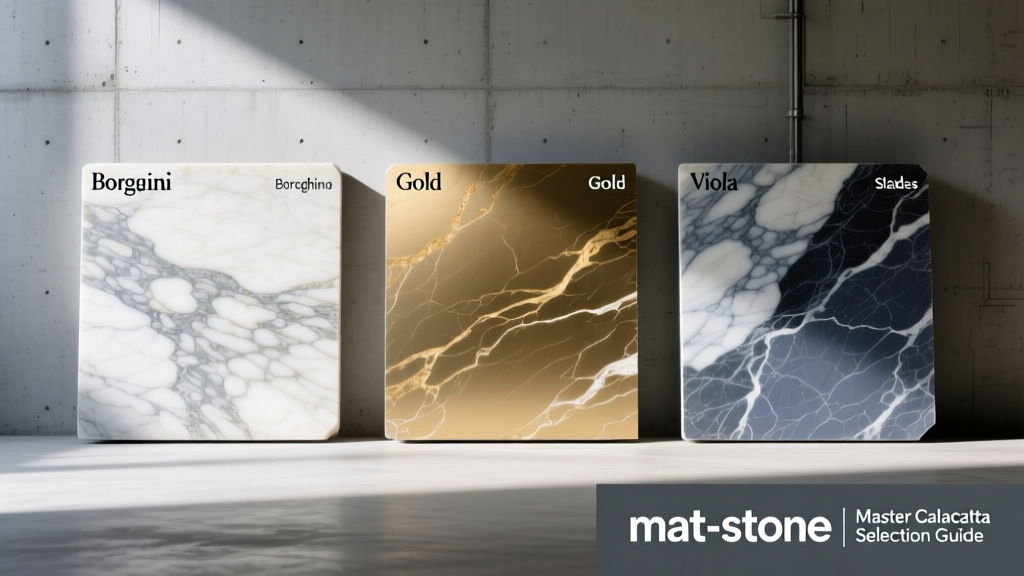
The Geological and Commercial Taxonomy of Calacatta
Calacatta marble is frequently misidentified by homeowners and junior designers as a single, uniform material. In reality, 'Calacatta' is a broad geological and commercial classification for high-end carbonate stone quarried primarily from the Apuan Alps in Tuscany, Italy. The price delta between a commercial-grade Calacatta slab and a premium, book-matched Calacatta Borghini selection can exceed $250 per square foot. Understanding the specific sub-varieties is the first critical step in material selection.
Calacatta Borghini
Widely considered the most prestigious and expensive variant, Borghini features a stark, brilliant white background intersected by thick, dramatic veins in gold, grey, and occasionally subtle burgundy. The veining is typically bold and unidirectional, making it the premier choice for book-matched feature walls and massive kitchen islands. Expect to pay between $180 and $350 per square foot for premium Grade A slabs.
Calacatta Gold
While Borghini has high-contrast grey and gold, Calacatta Gold leans heavily into warmer tones. The background is often a soft, creamy white rather than a stark optic white, and the veining is distinctly golden or honey-colored. It is less aggressive in its pattern than Borghini, offering a more subdued luxury. Pricing generally ranges from $120 to $200 per square foot.
Calacatta Viola
Viola (meaning 'purple' in Italian) is characterized by its unique burgundy, wine, and deep grey veining set against a white to light grey background. This variant has seen a massive resurgence in high-end contemporary design, particularly for powder room vanities and accent furniture. Because it is quarried in smaller, more fragmented blocks, large-format flawless slabs are rare, pushing prices to $140–$250 per square foot.
Calacatta Macchia Vecchia
Translating to 'old spot,' this variant is a brecciated marble. Instead of flowing, linear veins, it features a chaotic, fragmented pattern of grey, gold, and white clasts suspended in a calcite matrix. It is highly specialized and typically reserved for bespoke architectural features rather than standard countertop applications.
Calacatta vs. Carrara vs. Statuario: Selection Matrix
To specify the correct material, architects and fabricators must differentiate Calacatta from its more common Tuscan counterparts. The Natural Stone Institute notes that misidentification often leads to severe client dissatisfaction regarding veining expectations and budget overruns.
| Characteristic | Calacatta | Statuario | Carrara |
|---|---|---|---|
| Background Color | Stark, bright white to creamy | Bright white with slight grey clouds | Light grey to smoky grey |
| Vein Profile | Thick, bold, dramatic, high contrast | Sharp, linear, grey, feathery | Soft, subtle, feathery, low contrast |
| Block Size Availability | Medium to Large (often fragmented) | Large (excellent for book-matching) | Massive (highly abundant) |
| Average Cost (Material) | $120 – $350+ / sq. ft. | $90 – $200 / sq. ft. | $40 – $80 / sq. ft. |
| Best Application | Statement islands, feature walls | Large format flooring, full kitchens | Subway tile, secondary bathrooms |
Slab Grading and Structural Thickness Specifications
The quarry of origin is only half the selection equation; the factory grading and cut thickness dictate the stone's structural viability for specific architectural applications.
The Three-Tier Grading System
- Grade A (Premium / Extra): Pure white background, zero structural fissures, dramatic and continuous veining. Cut from the center of the highest-quality blocks. Required for seamless book-matching.
- Grade B (First Choice): Slight background warmth or minor grey clouding. May contain natural micro-fissures that have been professionally filled with clear or color-matched epoxy at the factory. Suitable for standard countertops.
- Grade C (Commercial): Noticeable grey background, heavy resin filling, inconsistent or muddy veining. Often used for pre-fabricated vanity tops or cut into smaller tiles where flaws can be discarded.
Thickness: 2cm vs. 3cm
Calacatta marble is typically cut into 2cm (approx. 3/4 inch) or 3cm (approx. 1 1/4 inch) slabs. The selection between the two is not merely aesthetic; it is a structural imperative.
- 2cm Slabs: Must be installed over a continuous plywood or particleboard substrate when used for horizontal countertops. They cannot support unsupported overhangs (such as a breakfast bar) without visible steel corbels or structural brackets. Ideal for vertical applications like shower walls and fireplace surrounds where weight is a concern.
- 3cm Slabs: Self-supporting and capable of spanning up to 12 inches of overhang without additional bracing. This is the mandatory specification for kitchen islands, peninsula seating, and heavy-use horizontal surfaces. The added thickness also allows fabricators to create more substantial, ornate edge profiles.
Fabrication, Edge Profiles, and Book-Matching
The raw cost of the slab is only the baseline. Fabrication of Calacatta marble requires specialized CNC machinery and highly skilled artisans to manage the stone's natural fissures and maximize the visual impact of the veining.
'When book-matching Calacatta Borghini, the fabricator must resin-fill the slab, polish it, and then cut it precisely down the center. The two halves are opened like a book to create a mirror image. This process destroys 3mm to 5mm of material in the saw blade kerf, meaning the vein will never match 100% perfectly at the seam. Clients must be educated on this inherent geometric reality.' — Senior Stone Fabricator
Edge Profile Cost Implications
Because Calacatta is a premium material, the edge profile must complement its luxury status. However, complex edges increase fabrication costs significantly due to the multi-step polishing required for the stone's high quartz and calcite variance.
- Eased / Pencil Edge: $15 – $25 per linear foot. Modern, minimalist, keeps the focus on the surface veining.
- Mitered Waterfall Edge: $65 – $120 per linear foot. Requires 45-degree precision cuts and specialized epoxy bonding to create the illusion of a solid, impossibly thick block of stone cascading to the floor.
- Full Bullnose / Ogee: $35 – $55 per linear foot. Traditional profiles that require extensive hand-polishing to ensure the rounded edges do not appear dull compared to the polished surface.
Sealing Protocols and Chemical Vulnerabilities
Calacatta marble is a calcareous stone, meaning it is primarily composed of calcium carbonate. This makes it inherently vulnerable to acidic etching, a chemical reaction that physically dulls the polished surface. According to USGS Dimension Stone Data, the porosity and absorption rates of dimension stones vary wildly, and Calacatta typically exhibits an absorption rate between 0.4% and 0.8% by weight.
The Etching vs. Staining Distinction
Design professionals must clearly communicate the difference between etching and staining to clients. Staining occurs when a pigmented liquid (like red wine or coffee) penetrates the pores of the stone. Etching occurs when an acid (lemon juice, tomato sauce, vinegar) touches the surface, chemically burning the calcium carbonate and leaving a dull, matte spot. No standard sealer can prevent etching; sealers only prevent staining.
Specifying the Correct Sealer
For Calacatta marble, avoid topical polyurethane or acrylic sealers. These sit on the surface, trap moisture beneath the stone, and can cause spalling or create a plastic-like, unnatural sheen that ruins the marble's optical depth.
Critical Sealer Specification
Specify a fluoropolymer-based impregnating sealer (such as Tenax Ager or Miracle Sealants 511 Impregnator). These sealers penetrate the microscopic pores and bond to the cell walls, creating a hydrophobic and oleophobic barrier without altering the natural light refraction of the polished surface. Application must occur in a climate-controlled environment (above 50°F / 10°C) and requires a 24-hour cure time before the stone is exposed to moisture.
Honing vs. Polishing: A Tactical Decision
While high-gloss polishing is the default for Calacatta, it exacerbates the visibility of etching. When light hits a polished surface, even a micro-etch from a drop of lemon juice will scatter light differently than the surrounding mirror finish, making the flaw highly visible.
For high-traffic kitchens or clients who refuse to use cutting boards and coasters religiously, specify a honed finish. Honing removes the reflective top layer, leaving a smooth, matte surface. While honed Calacatta is still susceptible to chemical etching, the matte texture camouflages the dull spots, making them virtually invisible to the naked eye. Furthermore, honing increases the stone's slip resistance, making it the superior technical choice for Calacatta bathroom flooring and shower pans.