Slate Tile Durability: Real Lifespan, Failure Modes, and ASTM Grades
Discover the true lifespan of slate tile. Analyze ASTM C629 grades, common failure modes like delamination, and expert specs to maximize durability.
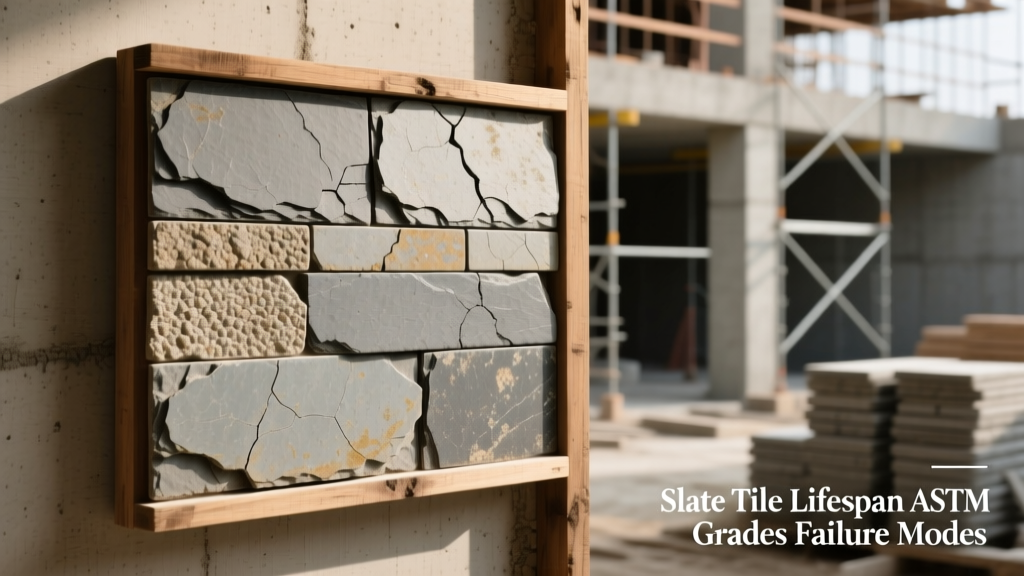
Slate is frequently marketed as an indestructible, lifetime flooring and cladding material. In reality, slate is a foliated metamorphic rock with distinct cleavage planes, meaning its structural integrity varies wildly depending on its geological origin and manufacturing grade. While a high-quality S1-grade slate tile can easily outlast the building it resides in (100+ years), low-grade slate installed in high-moisture environments can begin delaminating and spalling within 15 years.
Understanding the true durability of slate tile requires moving beyond marketing claims and examining the material through the lens of petrology, ASTM testing standards, and precise installation mechanics. This analysis breaks down the exact failure modes of slate and provides the actionable specifications required to ensure maximum lifespan.
The Geological Reality: Why Some Slate Tiles Fail Prematurely
True slate is formed from the low-grade regional metamorphism of shale or volcanic ash. The immense tectonic pressure creates a secondary alignment of microscopic clay minerals (chlorite and mica) known as foliation. This foliation allows the stone to be split into thin, flat sheets—a property called slaty cleavage. However, this same cleavage is the material's primary structural vulnerability.
Premature failure in slate tile almost always traces back to two geological factors:
- Phyllite Misclassification: Many tiles sold as 'slate' are actually phyllite or weakly metamorphosed shale. Phyllite has a higher clay content, making it highly susceptible to water absorption, freeze-thaw degradation, and surface flaking (spalling).
- Pyrite (Iron Sulfide) Inclusions: Slate often contains microscopic nodules of pyrite. When exposed to moisture and oxygen, pyrite oxidizes to form iron sulfate and sulfuric acid. This reaction causes the characteristic 'rust spots' on slate surfaces and, more critically, the expansion of the oxidation products forces the surrounding stone matrix apart, leading to localized pitting and spalling.
Decoding ASTM C629: The Lifespan Blueprint
To predict the lifespan of a slate tile, you must reference its classification under ASTM C629 (Standard Specification for Slate Dimension Stone). This standard categorizes slate into three distinct grades based on modulus of rupture (flexural strength) and water absorption rates. As of 2026, specifying the correct ASTM grade is the single most important purchasing decision for long-term durability.
| ASTM Grade | Modulus of Rupture | Max Water Absorption | Expected Lifespan | Approved Applications |
|---|---|---|---|---|
| S1 | > 9,000 psi | < 0.25% | 75 - 150+ Years | Exterior, Interior, Wet Areas, Freeze-Thaw Zones |
| S2 | 7,000 - 9,000 psi | 0.25% - 0.45% | 40 - 75 Years | Interior Only, Dry to Damp Areas |
| S3 | < 7,000 psi | > 0.45% | 15 - 40 Years | Interior, Low-Traffic, Non-Wet Wall Cladding |
Common Failure Modes in Slate Installations
Even S1-grade slate will fail if the installation mechanics ignore the stone's unique structural properties. According to forensic analysis of tile failures documented in the TCNA Handbook, the following are the primary failure modes specific to slate:
1. Cleavage Plane Delamination
Unlike homogenous porcelain, slate has horizontal planes of weakness. If a point load (such as a heavy appliance leg or high-heel impact) is applied to an area of the tile that lacks 100% mortar support beneath it, the shear stress will cause the slate to split horizontally along its natural cleavage plane. This results in a hollow-sounding tile that eventually cracks through the surface.
2. Alkali-Silica Reaction and Efflorescence
Slate contains varying amounts of reactive silica and clay minerals. Using an unmodified, high-alkali Portland cement mortar can trigger a slow chemical reaction that degrades the clay binders within the stone. This manifests as persistent white efflorescence that cannot be cleaned, followed by the softening and powdering of the slate's surface layer.
3. Thermal Shock in Radiant Heat Systems
Slate is an excellent thermal conductor, making it popular over radiant heating. However, rapid temperature fluctuations cause differential expansion between the mortar bed, the substrate, and the slate. Without a decoupling membrane, this thermal shear will tear the slate apart at its foliation seams.
Maximizing Longevity: Actionable Installation Specifications
To achieve the 100-year lifespan potential of S1 slate tile, the installation must be engineered to mitigate shear stress and moisture intrusion. Follow these exact specifications for all slate tile projects:
Substrate Preparation and Crack Isolation
Slate has virtually zero tensile flexibility. Any micro-cracking in a concrete slab will telegraph directly through the stone. You must install an ANSI A118.12 compliant crack isolation membrane over all concrete substrates. For wooden subfloors, the deflection rating must be L/720 (twice as stiff as the standard L/360 requirement for ceramic tile), achieved by adding a secondary layer of exterior-grade plywood or a structural mortar bed.
Mortar Selection and Coverage Mechanics
Never use standard unmodified thin-set for slate. You must specify an ANSI A118.15 (Improved Modified Dry-Set Mortar) for high-shear areas or an ANSI A118.4 modified mortar for standard applications. These polymers provide the necessary bond strength to counteract the dimensional instability of natural cleft slate.
The Sealing Myth: What Actually Protects Slate
A pervasive industry myth is that slate requires heavy, topical acrylic sealers to prevent staining. In reality, topical sealers trap moisture vapor within the stone's matrix. When this trapped moisture undergoes freeze-thaw cycles or thermal expansion, it causes sub-surface spalling—the exact failure mode the sealer was meant to prevent.
The Correct Protocol:
- Pre-Grout Release: Apply a water-based, non-film-forming penetrating sealer (siloxane or silane-based) before grouting. This prevents grout pigments from lodging in the stone's natural micro-fissures without altering the vapor transmission rate.
- Post-Installation Maintenance: For interior S1 slate, an impregnating fluoropolymer sealer applied every 3 to 5 years is sufficient to repel oil-based stains while allowing the stone to breathe.
- Exterior Cladding: High-grade exterior slate (S1) should ideally be left unsealed to allow natural weathering and unhindered vapor egress, provided the flashing and weep systems are correctly detailed.
By treating slate not as a monolithic slab, but as a layered geological composite, architects and installers can bypass the common pitfalls of delamination and oxidation. Specifying ASTM C629 S1 materials, enforcing L/720 subfloor rigidity, and utilizing ANSI A118.15 mortars transforms slate from a high-risk natural stone into a permanent, multi-generational building material.