Carrera Marble Grades & Product Lines: 2026 Buyer's Guide
Explore 2026 Carrera marble grades, brand product lines, and pricing. Learn the difference between C, CD, and D grades for your next stone installation.
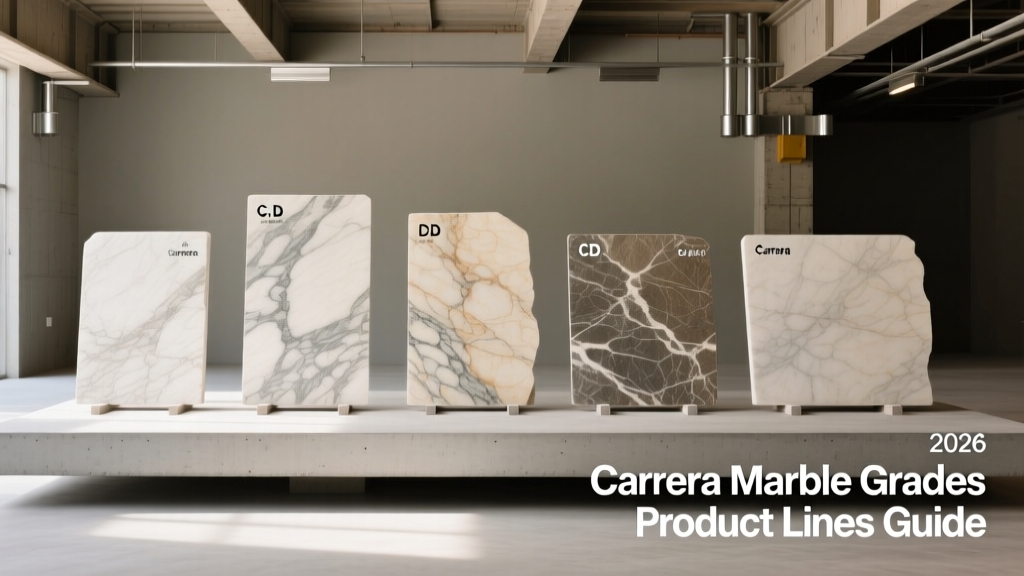
The "Carrera" vs. Carrara Distinction: A Geological & Market Reality
When architects, designers, and homeowners begin sourcing carrera marble for high-end residential or commercial projects, they immediately encounter a linguistic and geological fork in the road. While "Carrera" is one of the most frequently searched keywords in the natural stone industry, the authentic Italian stone is geologically and commercially classified as Carrara marble, named after the historic quarrying city in Tuscany, Italy. Some sintered stone and quartz manufacturers use "Carrera" as a proprietary product name to evoke the Italian aesthetic without the geological constraints, but in the natural stone market, you are buying Carrara.
Understanding this distinction is critical for 2026 procurement. If a supplier quotes you for "Carrera," they are either referencing a specific engineered product line or using the common phonetic misspelling for genuine Bianco Carrara. This deep-dive focuses strictly on the natural stone product lines, quarry grades, and fabrication realities of authentic Italian Carrara marble available in the current market.
Decoding Carrara Marble Grades: The 2026 Classification Matrix
Not all white marble from Tuscany is created equal. The Natural Stone Institute and Italian quarry consortiums classify Bianco Carrara into distinct grades based on background color purity, veining density, and structural integrity. The price variance between the highest and lowest grades can exceed 300%.
| Grade | Background & Veining Profile | Best Application | 2026 Avg. Price (3cm Slab) |
|---|---|---|---|
| Grade C (Extra / Bianco C) | Brilliant white background with minimal, sharp, light-grey feathered veining. | Luxury kitchen islands, bookmatched feature walls, high-end vanities. | $95 - $145 / sq. ft. |
| Grade CD (Commercial Standard) | Soft white to pale grey background with moderate, scattered grey veining. | Standard kitchen countertops, bathroom surrounds, flooring. | $55 - $80 / sq. ft. |
| Grade D (Standard / Utility) | Heavy grey or "stormy" background with dense, chaotic, dark grey veining. | Wainscoting, fireplace surrounds, low-traffic commercial cladding. | $35 - $50 / sq. ft. |
| Calacatta-Adjacent (Premium) | Often mislabeled as high-grade Carrara; features thick, dramatic gold/brown veining. | Statement pieces, luxury hospitality lobbies. | $160 - $250+ / sq. ft. |
Procurement Tip: When ordering Grade CD for a large kitchen, always request "dry-laid" digital photos of the specific slabs from your fabricator. Veining patterns can shift dramatically from one bundle to the next, even within the same grade classification.
Brand & Product Line Deep-Dive: Who Controls the Supply?
The journey from the Apuan Alps to your kitchen island is controlled by a few major global distributors and luxury brands. Understanding their specific product lines helps you specify exactly what you want, rather than relying on a fabricator's generic inventory.
Antolini: The Luxury Benchmark & Treated Stones
Antolini is arguably the most prestigious name in Italian marble distribution. Their standout product line for Carrara is the Azerocare collection. Natural Carrara marble is notoriously susceptible to etching from acidic substances (lemon juice, tomatoes, vinegar). Antolini's Azerocare technology is an advanced, factory-applied treatment that renders the marble highly resistant to both staining and etching without altering its natural touch or light refraction. If you are specifying Carrera marble for a high-use culinary kitchen and the client refuses to use quartz, Antolini's Azerocare Bianco Carrara is the only natural stone product line that bridges the gap between authentic geology and practical durability.
MSI Surfaces: The Commercial & Residential Workhorse
For volume builders, commercial contractors, and residential remodelers, Stone World industry reports consistently highlight MSI (M S International) as a dominant force in North American stone distribution. MSI's Carrara product lines are categorized by finish and thickness. Their Bianco Carrara line is available in 2cm and 3cm thicknesses, alongside specialized prefab vanity tops with integrated sinks. MSI excels in consistency; their "Carrara White" SKU is heavily vetted to ensure the background does not drift into the muddy grey tones common in lower-tier imports.
Levantina: The Spanish-Italian Hybrid
While headquartered in Spain, Levantina maintains deep quarrying ties in Tuscany. Their product line focuses heavily on large-format tiles and architectural cladding. If your project requires 12x24 or 24x24 Carrara marble tiles for a continuous floor-to-wall bathroom application, Levantina's "Blanco Carrara" tile line offers superior calibration (exact sizing) compared to standard field tiles, reducing lippage during installation.
Expert Warning: The Sealing vs. Etching Fallacy
A pervasive myth in the stone industry is that sealing Carrara marble protects it from etching. This is false. Carrara marble is primarily calcium carbonate (CaCO3). When it encounters an acid (pH below 7), a chemical reaction occurs that physically dissolves the surface, leaving a dull, whitish mark known as an etch.
- Impregnating Sealers (e.g., Tenax Ager, Miracle Sealants 511) penetrate the pores and prevent staining from oils and pigments. They do absolutely nothing to stop etching.
- Topical Coatings (polyurethanes or acrylics) can stop etching but alter the stone's appearance, creating a plastic-like sheen and requiring annual stripping and reapplication.
- The Solution: For kitchens, specify a honed finish rather than polished. Etches are virtually invisible on a honed (matte) surface because there is no mirror-like reflection to disrupt. Alternatively, specify a factory-treated line like Antolini Azerocare.
Fabrication Framework: Thickness, Edges, and Structural Limits
Specifying the right product line is only half the battle; fabrication dictates the final performance. In 2026, the standard for kitchen countertops remains 3cm (approx. 1 1/4 inches). However, 2cm material is frequently used for vertical applications, shower surrounds, and budget-conscious vanities.
The 2cm vs. 3cm Decision Tree
- Choose 3cm if: The application is a horizontal countertop with an overhang. A 3cm Carrara slab can support an unsupported overhang of up to 10 inches (ideal for standard bar seating). It also allows for robust edge profiles like the Ogee or Dupont.
- Choose 2cm if: You are cladding a vertical surface, building a shower bench, or fabricating a bathroom vanity top that will be fully supported by cabinetry. Note: 2cm kitchen countertops require a plywood substrate and a laminated edge to simulate thickness, which adds labor costs and can trap moisture if not sealed perfectly.
Edge Profile Vulnerabilities
Carrara marble is relatively soft (3 to 4 on the Mohs hardness scale). Sharp, 90-degree mitered edges (often called a "miter fold" or "waterfall edge") are highly susceptible to chipping from dropped pots or heavy glassware. Actionable Advice: Always specify a minimum 1/8-inch radius easing on all exposed edges. If a waterfall island is required, instruct your fabricator to use a high-strength, UV-stable epoxy (such as Tenax Knife Grade) for the seam, and ensure the substrate is perfectly leveled to prevent torsional stress on the miter joint.
Frequently Asked Questions (FAQ)
Does Carrera marble turn yellow over time?
Authentic Carrara marble does not naturally yellow. However, yellowing is a common failure mode caused by three specific factors: (1) The oxidation of naturally occurring iron minerals within the stone when exposed to prolonged moisture, (2) the breakdown of cheap, wax-based topical sealers, or (3) the use of alkaline cleaning agents that push embedded dirt into the stone's pores. To prevent this, use only pH-neutral cleaners specifically formulated for natural stone.
Can I use Carrara marble for an outdoor kitchen or patio?
It is highly discouraged. Carrara marble is porous and sensitive to freeze-thaw cycles. In climates where temperatures drop below freezing, water absorption can cause the stone to spall, crack, or delaminate. Furthermore, outdoor exposure to acid rain and environmental pollutants will rapidly degrade the polished surface. For exterior applications, specify a dense granite, quartzite, or porcelain sintered stone that mimics the Carrara aesthetic.
What is the difference between "Bianco Carrara" and "Statuario"?
While both are quarried in the same region of Tuscany, Statuario is a distinct, much rarer geological vein. Statuario features a blindingly white background with stark, high-contrast, deep grey or gold veining. Bianco Carrara (even Grade C) has a softer, warmer white background with lighter, more diffuse veining. Statuario typically commands prices 3 to 5 times higher than premium Bianco Carrara.